

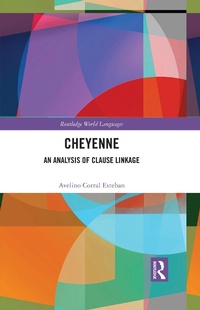
Cheyenne
An Analysis of Clause Linkage
1st Edition
Published on 31. July 2023
330 pages
978-1-000-90983-8 (ISBN)
Description

Cheyenne: An Analysis of Clause Linkage provides a detailed description of Cheyenne syntax, semantics, and pragmatics, notably on its nominal and verbal system and in both simple and complex sentences.
Based on fieldwork conducted on the Northern Cheyenne reservation, this book, which seeks to address descriptive and theoretical issues involving complex sentences, has three major aims: i) to present a morpho-syntactic, semantic, and discourse-pragmatic description of complex sentences in Cheyenne; ii) to investigate the relationship between the semantic and syntactic dimensions of complex sentences; and iii) to contribute to the research, preservation, and revitalization of this ancestral language spoken in the United States of America.
This book will be informative for scholars interested in language typology, comparative linguistics, theoretical linguistics, and language documentation, as well as those interested in Cheyenne learning and teaching.
Based on fieldwork conducted on the Northern Cheyenne reservation, this book, which seeks to address descriptive and theoretical issues involving complex sentences, has three major aims: i) to present a morpho-syntactic, semantic, and discourse-pragmatic description of complex sentences in Cheyenne; ii) to investigate the relationship between the semantic and syntactic dimensions of complex sentences; and iii) to contribute to the research, preservation, and revitalization of this ancestral language spoken in the United States of America.
This book will be informative for scholars interested in language typology, comparative linguistics, theoretical linguistics, and language documentation, as well as those interested in Cheyenne learning and teaching.
Reviews / Votes
"Dr. Avelino Corral Esteban has produced an impressive and insightful analysis of complex sentences in Cheyenne, a Native American language of the Algonquian family. It presents some unique challenges for any theoretical approach, and Dr. Corral Esteban employs a functional-typological theory, Role and Reference Grammar, which has a sophisticated theory of clause linkage. The result is a very revealing exploration of Cheyenne complex sentences. It is an important contribution to the study of Algonquian languages, on the one hand, and to functional linguistics and language typology, on the other."Prof (emeritus) Robert D. Van Valin, Jr., University at Buffalo, The State University of New York, Heinrich Heine University Duesseldorf
"This outstanding contribution of Prof. Avelino Corral to a better understanding of the grammar of Cheyenne, a critically endangered Algonquian language spoken in Montana and Oklahoma, is a unique and insightful exploration of the complex sentences of this Algonquian language according to the premises of Role and Reference Grammar. To this purpose he also provides an accurate and unmatched research on the iconic relationship between the syntactic and semantic dimensions of these sentences with the aim of improving the preservation and revitalization of this ancestral language."
Prof. Ricardo Mairal Uson, Universidad Nacional de Educacion a Distancia (UNED)
"Dr Avelino Corral Esteban's monograph is a timely and welcome investigation of Cheyenne, a severely endangered Plains Algonquian language spoken in Montana and Oklahoma (USA). Offering empirically rich and theoretically sophisticated analyses of predicate and clause linkage, and other aspects of the polysynthetic head-marking grammar of Cheyenne, the volume testifies to the critical importance of lesser studied languages for the advancement of knowledge in linguistic theory. It will be of interest to researchers in the discourse-semantics-syntax interface, field linguists, and the Tsehesenestsest?tse speakers themselves."
Professor Delia Bentley, The University of Manchester
"Offering an enlightening examination of the Cheyenne language, this book comes to satisfy the dire need for studies which describe seriously endangered languages. The volume provides an analysis of complex sentences in Cheyenne from the perspective of Role and Reference Grammar (RRG), one of the most fascinating grammatical theories which aims at explaining the structure of languages from a non-Anglocentric standpoint. By means of a wealth of data and analyses, ranging from morphology and syntax to semantics and pragmatics, Dr. Corral manages to cover the linguistic intricacies of these structures. This book is an indispensable reference for typological linguists and RRG practitioners."
Prof. Francisco Jose Cortes Rodriguez, Universidad de La Laguna
More details
Series
Edition
1. Auflage
Language
English
Place of publication
London
United Kingdom
Publishing group
Taylor & Francis Ltd
Target group
College/higher education
Professional and scholarly
Product notice
Reflowable
Illustrations
7 Tables, black and white; 33 Line drawings, black and white; 2 Halftones, black and white; 35 Illustrations, black and white
ISBN-13
978-1-000-90983-8 (9781000909838)
Copyright in bibliographic data and cover images is held by Nielsen Book Services Limited or by the publishers or by their respective licensors: all rights reserved.
Schweitzer Classification
Other editions
Person
Avelino Corral Esteban works as a Senior Lecturer in Linguistics at the Universidad Autonoma de Madrid, Spain, where he teaches courses on syntax, historical linguistics, and information structure. His main areas of research cover the interaction between syntax, semantics, and pragmatics across languages, with a focus on Native American, Romance, Germanic, and Celtic languages. He has collaborated in research projects funded by the Spanish Ministry of Science and Innovation, the Arts and Humanities Research Council in the UK, and the Advocates for Indigenous California Language Survival in the USA, and he co-leads the Honoxease Project, the aim of which is to foster the preservation and revitalization of the Cheyenne language. He also received the Phillips Fund grant for Native American Research and the Benjamin Franklin grant from the American Philosophical Society. He is the author of seven book chapters, published by Cambridge University Press, De Gruyter, John Benjamins, Peter Lang, and Routledge, and more than 20 research articles, which have appeared in major linguistics journals (Acta Linguistica Academica, Journal of Language Contact, Journal of Language and Intercultural Communication, RESLA, WORD, and Zeitschrift fuer Romanische Philologie).
Content
Cheyenne flag
Preface
List of tables
List of figures
List of abbreviations
1 Introduction
1.1 Background information
1.2 Overview of Cheyenne
1.2.1 Sociolinguistic information
1.2.2 Genealogical position
1.2.3 Basic points on the phonology of Cheyenne
1.2.4 Spelling system
1.3 Basic morphosyntactic properties of Cheyenne
1.3.1 Polsynthetic morphology
1.3.2 Morphosyntactic alignment
1.3.3 Information structure
1.3.4 The verbal complex
1.3.5 Grammatical categories
1.3.6 Lexical categories
1.3.7. Morphosyntactic coding of arguments
Notes
2 RRG and Cheyenne simple sentences
2.1 The syntactic representation of a sentence
2.2 The semantic representation of a sentence
2.3 Information structure
2.4 The linking algorithm
Notes
3 Clause linkage theory
3.1 Theoretical approaches to the study of complex sentences
3.2 The RRG approach to the study of the structure of complex sentences
Notes
4 Juncture-nexus combinations
4.1 Nuclear junctures
4.2 Core junctures
4.3 Clausal junctures
4.4 Sentential junctures
Notes
5 Semantic relations between units
5.1 Single actions
5.1.1 Causative [1]
5.1.2 Modifying sub-actions
5.1.3 Phase
5.2 Multiple actions
5.2.1 Simultaneous
5.2.2 Sequential
5.2.3 Causative [2]
5.3 Endeavour
5.3.1 Attempt
5.3.2 Success
5.3.3 Failure
5.4 Intentions
5.4.1 Refusal
5.4.2 Psych-action
5.4.3 Purposive
5.5 Bringing about
5.5.1 Causative [3]
5.5.2 Jussive
5.5.3 Permissive
5.5.4 Injunctive
5.6 Perception
5.6.1 Direct perception
5.6.2 Indirect perception
5.7 Intentionality
5.7.1 Propositional attitude
5.7.2 Cognition
5.7.3 Emotion
5.8 Speech
5.8.1 Indirect discourse
5.8.2 Direct discourse
5.9 Locational
5.9.1 Space
5.9.2 Time
5.10 Circumstances
5.10.1 Reason
5.10.2 Conditional
5.10.3 Concessive
5.11 Temporality
5.11.1 Temporal / Simultaneous actions
5.11.2 Temporal / Sequential actions
5.11.3 Situation-situation / temporally unordered SoAs
5.12 Complex RPs
Notes
6 Relationship between clause linkage types and semantic relations
6.1 Intereclausal relations hierarchy
6.2 Iconic correlation between syntactic and semantic representations
Notes
7 The role of discourse-pragmatics in complex sentences
7.1 Information structure in complex sentences
7.2 Obviation in Cheyenne narration
Notes
8 Concluding remarks
Glossary of RRG terms
References
Appendix
Index
Preface
List of tables
List of figures
List of abbreviations
1 Introduction
1.1 Background information
1.2 Overview of Cheyenne
1.2.1 Sociolinguistic information
1.2.2 Genealogical position
1.2.3 Basic points on the phonology of Cheyenne
1.2.4 Spelling system
1.3 Basic morphosyntactic properties of Cheyenne
1.3.1 Polsynthetic morphology
1.3.2 Morphosyntactic alignment
1.3.3 Information structure
1.3.4 The verbal complex
1.3.5 Grammatical categories
1.3.6 Lexical categories
1.3.7. Morphosyntactic coding of arguments
Notes
2 RRG and Cheyenne simple sentences
2.1 The syntactic representation of a sentence
2.2 The semantic representation of a sentence
2.3 Information structure
2.4 The linking algorithm
Notes
3 Clause linkage theory
3.1 Theoretical approaches to the study of complex sentences
3.2 The RRG approach to the study of the structure of complex sentences
Notes
4 Juncture-nexus combinations
4.1 Nuclear junctures
4.2 Core junctures
4.3 Clausal junctures
4.4 Sentential junctures
Notes
5 Semantic relations between units
5.1 Single actions
5.1.1 Causative [1]
5.1.2 Modifying sub-actions
5.1.3 Phase
5.2 Multiple actions
5.2.1 Simultaneous
5.2.2 Sequential
5.2.3 Causative [2]
5.3 Endeavour
5.3.1 Attempt
5.3.2 Success
5.3.3 Failure
5.4 Intentions
5.4.1 Refusal
5.4.2 Psych-action
5.4.3 Purposive
5.5 Bringing about
5.5.1 Causative [3]
5.5.2 Jussive
5.5.3 Permissive
5.5.4 Injunctive
5.6 Perception
5.6.1 Direct perception
5.6.2 Indirect perception
5.7 Intentionality
5.7.1 Propositional attitude
5.7.2 Cognition
5.7.3 Emotion
5.8 Speech
5.8.1 Indirect discourse
5.8.2 Direct discourse
5.9 Locational
5.9.1 Space
5.9.2 Time
5.10 Circumstances
5.10.1 Reason
5.10.2 Conditional
5.10.3 Concessive
5.11 Temporality
5.11.1 Temporal / Simultaneous actions
5.11.2 Temporal / Sequential actions
5.11.3 Situation-situation / temporally unordered SoAs
5.12 Complex RPs
Notes
6 Relationship between clause linkage types and semantic relations
6.1 Intereclausal relations hierarchy
6.2 Iconic correlation between syntactic and semantic representations
Notes
7 The role of discourse-pragmatics in complex sentences
7.1 Information structure in complex sentences
7.2 Obviation in Cheyenne narration
Notes
8 Concluding remarks
Glossary of RRG terms
References
Appendix
Index
