

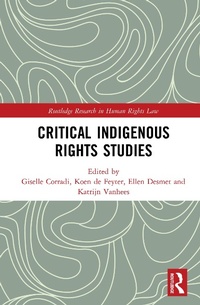
Critical Indigenous Rights Studies
1st Edition
Published on 3. September 2018
248 pages
978-1-351-74756-1 (ISBN)
Description

The field of 'critical indigenous rights studies' is a complex one that benefits from an interdisciplinary perspective and a realist (as opposed to an idealised) approach to indigenous peoples. This book draws on sociology of law, anthropology, political sciences and legal sciences in order to address emerging issues in the study of indigenous rights and identify directions for future research.
The first part of the volume investigates how changing identities and cultures impact rights protection, analysing how policies on development and land, and processes such as migration, interrelate with the mobilisation of identities and the realisation of rights. In the second part, new approaches related to indigenous peoples' rights are scrutinised as to their potential and relevance. They include addressing legal tensions from an indigenous peoples' rights perspective, creating space for counter-narratives on international law and designing new instruments.
Throughout the text, case studies with wide geographical scope are presented, ranging from Latin America (the book's focus) to Egypt, Rwanda and Scandinavia.
The first part of the volume investigates how changing identities and cultures impact rights protection, analysing how policies on development and land, and processes such as migration, interrelate with the mobilisation of identities and the realisation of rights. In the second part, new approaches related to indigenous peoples' rights are scrutinised as to their potential and relevance. They include addressing legal tensions from an indigenous peoples' rights perspective, creating space for counter-narratives on international law and designing new instruments.
Throughout the text, case studies with wide geographical scope are presented, ranging from Latin America (the book's focus) to Egypt, Rwanda and Scandinavia.
More details
Series
Edition
1. Auflage
Language
English
Place of publication
London
United Kingdom
Publishing group
Taylor & Francis Ltd
Target group
College/higher education
File size
5,66 MB
ISBN-13
978-1-351-74756-1 (9781351747561)
Copyright in bibliographic data and cover images is held by Nielsen Book Services Limited or by the publishers or by their respective licensors: all rights reserved.
Schweitzer Classification
Other editions
Additional editions
Giselle Corradi | Koen De Feyter | Ellen Desmet
Critical Indigenous Rights Studies
Book
01/2020
1st Edition
Routledge
€65.40
Shipment within 15-20 days
Giselle Corradi | Koen De Feyter | Ellen Desmet
Critical Indigenous Rights Studies
Book
08/2018
1st Edition
Routledge
€206.40
Shipment within 10-20 days
Persons
Giselle Corradi is senior researcher at the Human Rights Centre of Ghent University. She holds a PhD in Law (2012), a master's degree in Comparative Studies of Culture (2005) and a bachelor's degree in Law (2002). Her research focuses on the relationship between legal pluralism and human rights from a legal anthropological point of view. She has conducted and supervised qualitative studies of law and society in several countries and regions, including Mozambique, Bolivia, Sierra Leone, Greece and Belgium.
Koen De Feyter is professor of public international law at the University of Antwerp, where he founded the research group on law and development. He acted as one of the founding fathers of the Law and Development Research Network (LDRn). He publishes in the area of international sustainable development law and human rights. He has conducted socio-legal fieldwork in Asia and Africa and currently contributes to a long-term research project on indigenous rights in Bolivia.
Ellen Desmet is assistant professor of migration law at the Faculty of Law and Criminology of Ghent University, Belgium. She is a member of the Human Rights Centre and of the Centre for the Social Study of Migration and Refugees (CESSMIR). Her PhD research concerned indigenous peoples' rights in the context of nature conservation, with a case study on Peru (KU Leuven, 2010). Her current research focuses on asylum and migration law, with particular attention from human rights and legal anthropological perspectives.
Katrijn Vanhees is a PhD researcher (2014-2018) at the Human Rights Centre of Ghent University. She holds master's degrees in History and Law, both obtained at Ghent University. She is an affiliated researcher of the Centre for Gender Studies, University of Rwanda. Her PhD focuses on improving land rights for women in Rwanda. The research investigates the underlying causes of women's restricted access to land in Rwanda by studying the gender-based division of socio-economic power and resources in the household and the local community as a whole. In addition, it analyses how this gender-bargaining concept is articulated in judicial mediation cases at the Abunzi (local mediators) level.
Koen De Feyter is professor of public international law at the University of Antwerp, where he founded the research group on law and development. He acted as one of the founding fathers of the Law and Development Research Network (LDRn). He publishes in the area of international sustainable development law and human rights. He has conducted socio-legal fieldwork in Asia and Africa and currently contributes to a long-term research project on indigenous rights in Bolivia.
Ellen Desmet is assistant professor of migration law at the Faculty of Law and Criminology of Ghent University, Belgium. She is a member of the Human Rights Centre and of the Centre for the Social Study of Migration and Refugees (CESSMIR). Her PhD research concerned indigenous peoples' rights in the context of nature conservation, with a case study on Peru (KU Leuven, 2010). Her current research focuses on asylum and migration law, with particular attention from human rights and legal anthropological perspectives.
Katrijn Vanhees is a PhD researcher (2014-2018) at the Human Rights Centre of Ghent University. She holds master's degrees in History and Law, both obtained at Ghent University. She is an affiliated researcher of the Centre for Gender Studies, University of Rwanda. Her PhD focuses on improving land rights for women in Rwanda. The research investigates the underlying causes of women's restricted access to land in Rwanda by studying the gender-based division of socio-economic power and resources in the household and the local community as a whole. In addition, it analyses how this gender-bargaining concept is articulated in judicial mediation cases at the Abunzi (local mediators) level.
Content
1: The contours of a field of critical indigenous rights studies; PART I Changing identities and cultures; 2: Indigeneity vs Development: Nubian rights mobilisation in Egypt; 3: Politics of oneness and Twa's struggle for land: questioning identity discourses in Rwanda; 4: The impact of migration processes on indigenous peoples' rights: challenges for identity and culture; PART II Innovating the law; PART II.A Dealing with legal tensions in light of indigenous peoples' right; 5: A dual perspective on the right to enjoy the benefits of scientific progress; 6: Protecting traditional cultural expressions: copyright tensions and human rights opportunities?; PART II.B Creating space for counter-narratives within international law; 7: Indigenous people involvement in the REDD+ global debate: case study from the Amazon basin; 8: The rights of indigenous peoples in the jurisprudence of the Inter-American Court of Human Rights: a 'Third World Approaches to International Law' assessment to advance their protection in the Inter-American Human Rights System; PART II.C Designing new instruments; 9: The 2005 Draft Nordic Sami Convention and the implementation of the right of the Sami people to self-determination; 10: Legislation coordination and cooperation mechanisms between indigenous and ordinary jurisdictions: reflections on progress and setbacks in Ecuador; 11: Index
