

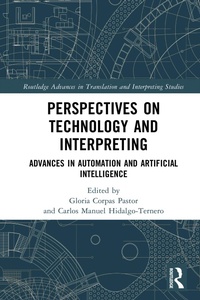
Perspectives on Technology and Interpreting
Advances in Automation and Artificial Intelligence
1st Edition
Will be published approx. on 2. July 2026
430 pages
978-1-040-68657-7 (ISBN)
Description

This volume provides a timely and authoritative account of how digital innovation, automation, and artificial intelligence are reshaping interpreting. Once considered a peripheral aid, technology now stands at the centre of professional practice, influencing how interpreters prepare, perform, and reflect on their work.
Organised into four thematic sections, the volume explores the integration of language technologies, AI-driven tools, and computer-assisted and remote interpreting systems. Leading international contributors examine how digital resources are transforming interpreter education, performance, and research while redefining professional identity and cognitive practice.
Combining theoretical insight with empirical evidence, the collection offers a concise road map to the profession's rapid technologisation. It is essential reading for researchers, educators, students, and professionals in translation and interpreting studies who wish to understand how human expertise and artificial intelligence interact in shaping the future of multilingual communication.
Organised into four thematic sections, the volume explores the integration of language technologies, AI-driven tools, and computer-assisted and remote interpreting systems. Leading international contributors examine how digital resources are transforming interpreter education, performance, and research while redefining professional identity and cognitive practice.
Combining theoretical insight with empirical evidence, the collection offers a concise road map to the profession's rapid technologisation. It is essential reading for researchers, educators, students, and professionals in translation and interpreting studies who wish to understand how human expertise and artificial intelligence interact in shaping the future of multilingual communication.
More details
Series
Edition
1. Auflage
Language
English
Place of publication
London
United Kingdom
Publishing group
Taylor & Francis Ltd
Target group
College/higher education
Product notice
Reflowable
Illustrations
43 Tables, black and white; 25 Line drawings, black and white; 52 Halftones, black and white; 77 Illustrations, black and white
File size
7,80 MB
ISBN-13
978-1-040-68657-7 (9781040686577)
Copyright in bibliographic data and cover images is held by Nielsen Book Services Limited or by the publishers or by their respective licensors: all rights reserved.
Schweitzer Classification
Other editions
Additional editions
Gloria Corpas Pastor | Carlos Manuel Hidalgo-Ternero
Perspectives on Technology and Interpreting
Advances in Automation and Artificial Intelligence
Book
approx. 07/2026
1st Edition
Routledge
€191.50
Not yet published
Persons
Gloria Corpas Pastor is a professor of translation and interpreting and the director of the Research Institute in Multilingual Language Technologies (IUITLM) at the University of Malaga, Spain. She also holds an honorary adjunct professorship at Xi'an Jiaotong-Liverpool University, China.
Carlos Manuel Hidalgo-Ternero is a lecturer in translation and interpreting at the University of Malaga and a researcher at IUITLM (Spain).
Carlos Manuel Hidalgo-Ternero is a lecturer in translation and interpreting at the University of Malaga and a researcher at IUITLM (Spain).
Content
Foreword (Maria Chiara Russo), Introduction (Gloria Corpas Pastor and Carlos Manuel Hidalgo-Ternero), PART I AI, LANGUAGE TECHNOLOGIES, AND INTERPRETING, Chapter 1 Artificial Intelligence and Multilingual Communication: The Generative AI Challenge (Enrique Alba), Chapter 2 Speech-to-Text Translation in the New Age of Interpreting Technologies: A Comparative Evaluation of the Interprefy AI Speech Translation System (Dora Murgu, Gloria Corpas Pastor and Francisco Javier Lima-Florido), Chapter 3 Exploration of Machine Interpretation and Multimodal Cognitive Computing (Xiaojun Zhang), Chapter 4 The Transition from Human to Automatic Live Captions and Its Impact on Quality Assessment (Pablo Romero-Fresco and Oscar Alonso-Amigo), Chapter 5 Speech-to-Text Interpreting: Intersection of Interpreting, Technology and Accessibility (Daniela Eichmeyer-Hell), PART II AI-DRIVEN TOOLS FOR INTERPRETER PREPARATION, Chapter 6 Artificial Intelligence and the Future of Language Interpreting: Big Data and Digital Solutions (Jun Pan), Chapter 7 AI-generated gamified activities with Ray: A technological tool for the interpreter preparation phase (Marta Alcaide-Martinez), Chapter 8 PracticeAI vs. ChatGPT: which tool can offer better speeches in Chinese for interpreting training? (Xiaoqing Zhou-Lian and Carlos Manuel Hidalgo-Ternero), Chapter 9 Exploring ChatGPT for the design of training materials in consecutive and bilateral interpreting: first attempts and results (Ingrid Caceres-Wuersig, Raquel Lazaro Gutierrez, and Dario Mantrana Gallego), PART III COMPUTER-ASSISTED INTERPRETING AND COGNITIVE DIMENSIONS, Chapter 10 Technology across Interpreting Phases: A Comparative Study among Professionals and Students (Laura Noriega-Santianez), Chapter 11 Computer-assisted interpreting tools and cognition: a sight translation study using eye-tracking technology (Jorge Lucas-Perez), Chapter 12 Interpreting technologies to improve stress management in the student learning process (Encarnacion Postigo Pinazo and Presentacion Aguilera Crespillo), Chapter 13 Term Extraction Methodology Based on Ad Hoc Parallel Corpora for Conference Interpreting Training in the English-Arabic Language Pair (Mahmoud Gaber), Chapter 14 The Technologisation of Interpreting: A User-Centred Road Map from Digitalisation to Human-AI Synergy (Gloria Corpas Pastor), PART IV REMOTE AND TECHNOLOGY-ENABLED INTERPRETING, Chapter 15 New RSI tools, new training implications: the case of a general-purpose videoconferencing platform applied to conference interpreter training (Michela Bertozzi and Francesco Cecchi), Chapter 16 Interpreting the Manner of Speech in Technology-Enabled Remote Court Hearings in Australia (Ran Yi, Ling Yan, and Jinhua Sun), Chapter 17 Lexical borrowing in refugee protection situations of social and remote interpreting: German, Spanish, Arabic and Russian combinations (Olga Koreneva Antonova and Hanan Saleh Hussein), Chapter 18 Remote Interpreting Systems, Machine Interpreting, and Multiword Units: A Melting Pot (Isabel Penuelas Gil and Maria Teresa Ortego Anton), Index
