

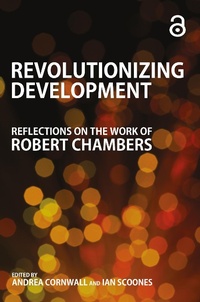
Revolutionizing Development
Reflections on the Work of Robert Chambers
1st Edition
Published on 28. March 2022
336 pages
978-1-000-60660-7 (ISBN)
Description

This book tells the story of development studies in practice over the last fifty years through the work of one remarkable individual, Robert Chambers. His work has taken him from being a colonial officer in Kenya through training and managing large rural development projects to a fundamental critique of top-down development and the championing of participatory approaches. The contributors eloquently demonstrate how he has been at the centre of major shifts in development thinking and practice over this period, popularising terms that are now at the centre of the development lexicon such as vulnerability, multi-dimensional poverty, sustainable livelihoods and 'farmer first'.
Robert Chambers played a major role in the massive growth in participatory approaches to development, and particularly the application of participatory methods in development research and appraisal. This has led to fundamental challenges to development practice, ranging from approaches to monitoring and evaluation to institutional learning and professional training. There is probably no-one who has had more influence on approaches to development in the past decades. Revolutionizing Development offers a unique overview of these contributions in thirty-two concise chapters from authors who have been intimately involved as collaborators, critics and colleagues of Robert Chambers.
Robert Chambers played a major role in the massive growth in participatory approaches to development, and particularly the application of participatory methods in development research and appraisal. This has led to fundamental challenges to development practice, ranging from approaches to monitoring and evaluation to institutional learning and professional training. There is probably no-one who has had more influence on approaches to development in the past decades. Revolutionizing Development offers a unique overview of these contributions in thirty-two concise chapters from authors who have been intimately involved as collaborators, critics and colleagues of Robert Chambers.
Reviews / Votes
'A powerful influence on development doing and thinking, Robert Chambers provokes us to focus on what doesn't fit our neat categories, reversing our normal assumptions. He has transformed attitudes and behaviours through impelling us to reflect on how we work and what we do. This wonderful collection of perspectives on Robert's life and work reminds us how much a single person can do by being confident, pragmatic and willing to take risks.'Dr Camilla Toulmin, Director, International Institute for Environment and Development, London
'Robert Chambers has been an ardent advocate of a livelihood approach to development, a testimony to his holistic vision of sustainable human security and happiness. This book captures the essence of his many original contributions during the last fifty years. Through the 'farmer first ' approach he has shown the pathway for linking ecology, economics, equity and employment in a mutually reinforcing manner leading to food for all and forever.'
Professor M S Swaminathan, Chairman, M S Swaminathan Research Foundation, Member of Indian Parliament (Rajya Sabha); and Chair, High Level Panel of Experts of the Committee on World Food Security of the UN Food and Agriculture Organisation
More details
Edition
1. Auflage
Language
English
Place of publication
London
United Kingdom
Publishing group
Taylor & Francis Ltd
Target group
College/higher education
File size
2,74 MB
ISBN-13
978-1-000-60660-7 (9781000606607)
Copyright in bibliographic data and cover images is held by Nielsen Book Services Limited or by the publishers or by their respective licensors: all rights reserved.
Schweitzer Classification
Other editions
Additional editions
Book
05/2011
1st Edition
Earthscan Ltd
€208.30
Shipment within 3-4 weeks
Book
04/2011
1st Edition
Earthscan Ltd
€79.60
Shipment within 3-4 weeks
Persons
Andrea Cornwall is Professor of Anthropology and Development in the School of Global Studies at the University of Sussex. She is director of the DFID-funded research programme consortium Pathways of Women's Empowerment, and works on the anthropology of democracy, gender and sexualities.
Ian Scoones is co-director of the ESRC STEPS Centre at the University of Sussex and joint convenor of the IDS-hosted Future Agricultures Consortium. He is an agricultural ecologist by original training whose interdisciplinary research links the natural and social sciences.
Ian Scoones is co-director of the ESRC STEPS Centre at the University of Sussex and joint convenor of the IDS-hosted Future Agricultures Consortium. He is an agricultural ecologist by original training whose interdisciplinary research links the natural and social sciences.
Content
Notes on Contributors. Acknowledgements. Acronyms. Robert Chambers. Putting the Last First: Reflections on the Work of Robert Chambers. Conceptualising Development. Challenging Development Priorities. Beginners in Africa: Managing Rural Development. The Path from Managerialism to Participation: The Kenyan Special Rural Development Programme. Foxes and Hedgehogs - and Lions: Whose Reality Prevails? Participation in International Aid. Power and Participation. Reframing Development. Rural Development, Poverty and Livelihoods - Exploring Sustainable Livelihoods. Putting the Vulnerable First. Seasonality: Uncovering the Obvious and Implementing the Complex. Refugee Studies. Farmer First: Reversals for Agricultural Research. Agricultural Development: Parsimonious Paradigms. In Search of a Water Revolution: Canal Irrigation Management. The Last Frontier: The Groundwater Revolution in South Asia. Trees as Assets: Legacies and Lessons. Finding a Sustainable Sanitation Solution: Scaling up Community-Led Total Sanitation. Technology and Markets. Methodological Innovations Village Studies. Whose Knowledge Counts? Tales of an Eclectic Participatory Pluralist. Learning to Unlearn: Creating a Virtuous Learning Cycle. The Use of Participatory Methods to Study Natural Resources. Participatory Numbers. Practising Development: New Professionalism. The Personal and the Political. International Poverty Professionals and Poverty. Changing Attitudes and Behaviour. Networking: Building a Global Movement for PRA and other Participatory Methods. Institutional Learning and Change. Participation, Learning and Accountability: The Role of the Activist Academic. Development Professionalism. Appreciation and Reflections. Appendix. List of Robert Chambers' Publications. References. Index
