

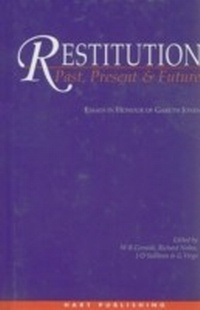
Restitution: Past, Present and Future
Essays in Honour of Gareth Jones
1st Edition
Published on 1. July 1998
368 pages
978-1-84731-335-5 (ISBN)
Description

The essays in this volume are dedicated to Gareth Jones, the retiring Downing Professor of English Law at the University of Cambridge. His contribution to legal scholarship has been immense, particularly in the fields of legal history, the law of trusts, charities law and, most famously, the law of restitution. The publication of the first edition of the Law of Restitution, which he co-authored with Lord Goff, stimulated a renaissance in the study of a subject which had previously lain dormant. The effect of its publication on English legal scholarship has been profound and enduring.
In these essays, written by a group of the world's leading restitution scholars, the opportunity is taken to conduct a fresh appraisal of the development of the subject - to look, in other words, at the past, present, and future of the law of restitution.
Contributors: John Baker, Peter Birks, Justice Finn, Roy Goode, Ewan McKendrick, Justice McLachlin, Sir Peter Millett, Lord Nicholls of Birkenhead, Richard Nolan, Janet O'Sullivan, Graham Virgo (as well as shorter contributions from invited commentators).
In these essays, written by a group of the world's leading restitution scholars, the opportunity is taken to conduct a fresh appraisal of the development of the subject - to look, in other words, at the past, present, and future of the law of restitution.
Contributors: John Baker, Peter Birks, Justice Finn, Roy Goode, Ewan McKendrick, Justice McLachlin, Sir Peter Millett, Lord Nicholls of Birkenhead, Richard Nolan, Janet O'Sullivan, Graham Virgo (as well as shorter contributions from invited commentators).
More details
Edition
1. Auflage
Language
English
Place of publication
London
United Kingdom
Publishing group
Bloomsbury Publishing PLC
Target group
Professional and scholarly
ISBN-13
978-1-84731-335-5 (9781847313355)
Copyright in bibliographic data and cover images is held by Nielsen Book Services Limited or by the publishers or by their respective licensors: all rights reserved.
Schweitzer Classification
Other editions
Additional editions
William Cornish | Richard C. Nolan | Janet O'Sullivan
Restitution: Past, Present and Future
Essays in Honour of Gareth Jones
Book
07/1998
Hart Publishing
€203.70
Shipment within 3-4 weeks
Persons
W.R.Cornish is Professor of English Law at the University of Cambridge and a Fellow of Magdalene College.
Richard Nolan is a Fellow of St John's College,Cambridge and a University Lecturer in Law.
Janet O'Sullivan is a University Lecturer in Law and a Fellow of Selwyn College Cambridge.
Graham Virgo is a Reader in Law at the University of Cambridge and a Fellow of Downing College, Cambridge.
Richard Nolan is a Fellow of St John's College,Cambridge and a University Lecturer in Law.
Janet O'Sullivan is a University Lecturer in Law and a Fellow of Selwyn College Cambridge.
Graham Virgo is a Reader in Law at the University of Cambridge and a Fellow of Downing College, Cambridge.
Content
- Intro
- Title Page
- Title verso
- Contents
- Preface
- Table of Cases
- 1. Misnomer
- Modern History
- Restitution and Unjust Enrichment
- A Greater Danger
- Consent
- Miscellaneous Other Events
- Two Legislative Puzzles
- Conclusion
- 2. Misnomer: A Response
- 3. The History of Quasi-Contract in English Law
- Fictions in Assumpsit
- Quantum Meruit
- Money Paid
- Goods Sold
- Money Had and Received
- The Absence of Theory
- 4. The Later History of Restitution
- Why fiction?
- Primitiveness
- English and American contributions
- 5. Proprietary Restitutionary Claims
- Introduction
- Legitimate and Illegitimate Foundations of a Proprietary Restitutionary Claim
- Failure of Consideration
- 6. Three Questions on Proprietary Claims
- 7. Conflicts of Interest, Unjust Enrichment, and Wrongdoing
- Introduction
- A. Some Conflicts Rules within the Law of Unjust Enrichment
- B. Some Conflicts Rules within the Law of Civil Wrongs
- C. Remuneration Taken by a Fiduciary from his Principal
- The Benefits of the Analysis Offered: Explaining the Cases
- Some Wider Consequences
- Conclusion
- 8. Conflicts of Interest, Unjust Enrichment and Wrongdoing: A Commentary
- 9. Restitution for Wrongs: The Basis of Liability
- The Parasitic Theory
- The Independent Claim Theory
- Immunity, Privilege and Other Bars to Recovery in Torts
- Conversion and the Appropriation of the Proceeds of Another's Property
- Appropriation of Another's Chose in Action
- What's in a Name
- Appropriation of a Commercial Opportunity or the Prospect of Receiving a Benefit from a Third Party
- Other Protected Interests - Potential for Development
- Restitutionary Wrongs
- Conclusion
- 10. Civil Disgorgement of Wrongdoers' Gains: The Temptation to Do Justice
- Introduction
- Context: Different Theories Concerning the Scope of Disgorgement (or "Restitution for Wrongs") in the Civil Law
- The English Law Commission's Recent Proposals for Expansion of the Civil Disgorgement Remedy
- Assessment
- Conclusion
- 11. Work Done in Anticipation of a Contract Which Does Not Materialise
- Does Classification Matter?
- The Possible Analyses
- Breach of Contract
- The Law of Restitution
- Other Grounds of Liability
- The Conduct of the Defendant
- Conclusion
- 12. Work Done in Anticipation of a Contract Which Does Not Materialise: A Response
- 13. Restitution and Constructive Trusts
- 14. Restitution and Constructive Trusts: A Commentary
- 15. Knowing Receipt: The Need for a New Landmark
- Recipient liability
- The Traditional Approach of Equity
- The Present State of the Law: Fault-Based Personal Liability
- Fault-Free Recipients
- Recipient Liability and the "Diplock" Principle
- Careless Recipients
- Dishonest Recipients: Dishonest Participation in Breach of Trust
- The Need for a New Landmark
- 16. Knowing Receipt: The Need for a New Landmark: Some Reflections
- 17. Equitable Doctrine and Discretion in Remedies
- The Trade Practices Act 1974 (Aust)
- The Revitalising of Modern Equity
- Conclusion
- 18. Restitution in Canada
- Introduction
- The Basic Rule
- Breach of Fiduciary Duty and Restitution
- Restitution and the Legislature
- Restitutionary Remedies
- Conclusion
- 19. Restitution in Canada: A Commentary
- 20. What is the Law of Restitution About?
- The Essence of the Law of Restitution
- The Principles Which Underlie the Award of Restitutionary Remedies
- Implications of Recognising that Three Principles Underlie the Award of Restitutionary Remedies
- Is the Law of Restitution Dead?
- 21. What is the Law of Restitution About: A Commentary
- 1. Pleadings
- 2. Defences
- 3. Conflicts
- Index
