

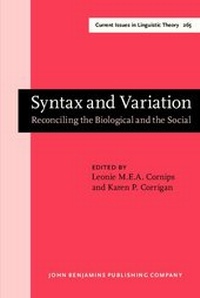
Syntax and Variation
Reconciling the Biological and the Social
1st Edition
Published on 22. June 2005
VI, 312 pages
978-90-272-9438-8 (ISBN)
Description

The papers in this collection share a common interest in the empirical, theoretical and meta-theoretical aspects of the 'internal-external' ('formal-functional') debate in linguistic theory. The primary aim of this volume is to initiate cooperation between internationally renowned generative and variationist linguists with a view to developing an innovative and more cohesive approach to syntactic variation. The present volume contains treatments incorporating the analysis of external factors into accounts focusing on the internal linguistic conditioning of syntactic variation and change cross-linguistically. As such, it offers novel approaches to three key areas of current linguistic debate, viz. (1) Methodological practices, (2) Theoretical applications and (3) Modularity. The volume is, therefore, an important achievement for the progress of linguistic theory more generally and it is an even more crucial milestone in the coming-of-age of 'Socio-Syntax' as a discipline in its own right.
More details
Other editions
Additional editions
Book
06/2005
John Benjamins Publishing Co
€127.20
Shipment within 10-15 days
Persons
Content
- SYNTAX AND VARIATION
- Editorial page
- Title page
- LCC data
- Table of contents
- 1. Toward an integrated approach to syntactic variation
- 1. Overview
- 1.1. Stimulus for the volume and its overarching aim
- 1.2. Wider context
- 1.3. The acquisition of local and supralocal varieties
- 2. Outline of contributions and their methodologies
- 3. Major themes addressed
- 3.1. An integrated theory of syntactic variation
- 3.2. External and internal constraints on syntactic variation
- 4. Conclusion
- Acknowledgements
- Notes
- References
- I. Aspects of modularity
- 2. A modular approach to sociolinguistic variation in syntax
- 1. Introduction
- 2. Models for syntactic variation
- 3. Modularity
- 4. The speech community
- 5. The syntactic variable: Gerunds
- 6. The distribution of the gerund and factors involved in the variation in use
- 7. Modular perspectives
- Notes
- References
- 3. Selective optionality in language development
- 1. Introduction
- 2. Adult bilingualism: Ultimate attainment and effects on the native language
- 2.1. End-state grammars
- 3. Revisiting previous studies of near-nativeness
- 3.1. Interface divergences
- 3.2. Interface convergences
- 4. Parallels between L2 acquisition and L1 attrition
- 5. A generalization on optionality in bilinguals
- 6. Interpreting optionality: Representational vs. processing accounts
- 7. Usage and exposure as critical variables
- 8. Conclusions
- Notes
- References
- 4. Syntactic variation and spoken language
- 1. Introduction
- 2. The generativist approach and spoken language
- 3. The variationist approach and spoken language
- 4. Prefabricated expressions
- 4.1. Prefabricated expressions in spoken language
- 4.2. Some prefabricated expressions in spoken English
- 5. Affective meanings in spoken language
- 6. Conclusion
- Notes
- Transcription conventions
- References
- II. Individual speaker variability and methodological innovation
- 5. Idiolectal variation and syntactic theory
- 1. Introduction
- 2. Methodology
- 2.1. Methodological practices adhered to in this study
- 3. Patterns of idiolectal variation in agreement structures
- 3.1. Agreement in sentences with expletive there
- 4. Implications for the nature of grammar
- Notes
- References
- 6. Focus raising
- 1. Introduction: Defining the problem
- 2. Varietas delectat? The problems, sources and types of variation
- 2.1. Delineating the problem
- 2.2. Sources and types of variation
- 3. An example: Detecting and analyzing microvariation in Hungarian focus-raising
- 3.1. The data: Empirical problems
- 3.2. An experimental solution
- 3.3. Towards a theoretical analysis
- 4. Discussion and conclusion
- Notes
- References
- Appendix: Instructions to the questionnaire
- The original Hungarian version:
- The English translation:
- III. Syntactic variability, social stratification and real/apparent time
- 7. Variation and the minimalist program
- 1. Introduction
- 2. The framework
- 3. Morphosyntactic variation in Buckie
- 3.1. Was/were alternation
- 3.2. Do absence in negative declaratives
- 3.3. Summary of findings
- 4. Linking syntax and variation
- 5. Analysis
- 5.1. Was/Were alternation
- 5.2. Variability in NP agreement
- 5.3. Do-absence
- 6. Conclusion
- Notes
- References
- 8. Principles and parameters in change
- 1. Introduction
- 1.1. Background
- 1.2. The use of corpora and statistics
- 2. Noun/pronoun splits
- 2.1. Pronouns vs. nouns
- 2.2. Case and person
- 3. Theoretical account
- 4. Principles and change: Pronouns as agreement markers
- 4.1. Shakespeare
- 4.2. BNC and HC
- 5. Parametric change is fast
- 6. Conclusion
- Notes
- References
- 9. Morphosyntactic variation and theory
- 1. Introduction
- 2. Morphosyntactic variation and change
- 3. Acadian French
- 4. Third person plural marking
- 5. Degree of retention of the conservative system
- 6. The case of subject relative clauses
- 7. More subject relatives: The case of il y en a.
- 8. A formal account of third person plural marking
- 9. Comparison with other varieties of French
- 10. Conclusion
- Notes
- References
- IV. Syntactic variability across georgraphical space
- 10. Word order variation in three-verb clusters and the division of labour between generative linguistics and sociolinguistics
- 1. Introduction
- 2. Word order variation in three-verb clusters
- 2.1. Empirical findings
- 2.2. Linguistic distribution
- 2.3. Geographic distribution
- 3. Some theoretical options
- 4. Analysis
- 5. Remaining questions about geographic and individual variation
- 6. Conclusion
- Notes
- References
- 11. The third dimension of person features
- 1. Introduction
- 2. The general perspective
- 2.1. Setting the problem: Se versus le
- 2.2. Further refining the problem: Vocalic clitics
- 2.3. Summary of extension patterns
- 3. Restrictions on extension
- 4. Person features in three-dimensional space
- 5. Further evidence for the feature composition
- 5.1. The peculiarity of fourth and fifth persons
- 5.2. Fourth person and impersonal: French on and Florentine si
- 6. On deriving extension patterns
- 7. Conclusion
- Notes
- References
- Appendix
- Map of Italian dialects
- Index
- The series CURRENT ISSUES IN LINGUISTIC THEORY
