

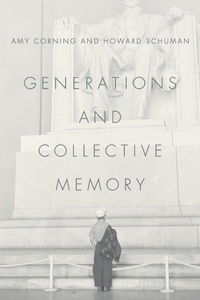
Generations and Collective Memory
1st Edition
Published on 22. December 2022
270 pages
978-0-226-28283-1 (ISBN)
Description

When discussing large social trends or experiences, we tend to group people into generations. But what does it mean to be part of a generation, and what gives that group meaning and coherence? It's collective memory, say Amy Corning and Howard Schuman, and in
Generations and Collective Memory, they draw on an impressive range of research to show how generations share memories of formative experiences, and how understanding the way those memories form and change can help us understand society and history.
Their key finding-built on historical research and interviews in the United States and seven other countries (including China, Japan, Germany, Lithuania, Russia, Israel, and Ukraine)-is that our most powerful generational memories are of shared experiences in adolescence and early adulthood, like the 1963 Kennedy assassination for those born in the 1950s or the fall of the Berlin Wall for young people in 1989. But there are exceptions to that rule, and they're significant: Corning and Schuman find that epochal events in a country, like revolutions, override the expected effects of age, affecting citizens of all ages with a similar power and lasting intensity.
The picture Corning and Schuman paint of collective memory and its formation is fascinating on its face, but it also offers intriguing new ways to think about the rise and fall of historical reputations and attitudes toward political issues.
Their key finding-built on historical research and interviews in the United States and seven other countries (including China, Japan, Germany, Lithuania, Russia, Israel, and Ukraine)-is that our most powerful generational memories are of shared experiences in adolescence and early adulthood, like the 1963 Kennedy assassination for those born in the 1950s or the fall of the Berlin Wall for young people in 1989. But there are exceptions to that rule, and they're significant: Corning and Schuman find that epochal events in a country, like revolutions, override the expected effects of age, affecting citizens of all ages with a similar power and lasting intensity.
The picture Corning and Schuman paint of collective memory and its formation is fascinating on its face, but it also offers intriguing new ways to think about the rise and fall of historical reputations and attitudes toward political issues.
More details
Other editions
Additional editions
Amy Corning | Howard Schuman
Generations and Collective Memory
Book
08/2015
University of Chicago Press
€99.04
Shipment within 10-20 days
Persons
Amy Corning is a research investigator at the Institute for Social Research at the University of Michigan. She resides in Virginia.
Howard Schuman is professor of sociology and research scientist emeritus at the University of Michigan. He is the author of many books, including, most recently,
Method and Meaning in Polls and Surveys. He lives in Maine.
Content
- Intro
- Contents
- Preface
- Authors' Note
- Acknowledgments
- Introduction: The Meanings of Collective
- Part One: Revising Collective Memories
- 1. Collective Memories and Counter-Memories of Christopher Columbus
- 2. Sally Hemings and Thomas Jefferson: Sex, Slavery, and Science
- 3. Abraham Lincoln: "Honest Abe" versus "the Great Emancipator"
- Part Two: The Critical Years and Other Sources of Collective Memory
- 4. The Critical Years Hypothesis: The Idea and the Evidence
- 5. Exploring Collective Memory in Eight Countries
- Part Three: Beyond Critical Years Effects
- 6. Does Emigration Affect Collective Memory?
- 7. Generational Experience of War and the Development of New Attitudes
- 8. Autobiographical Memory versus Collective Memory
- 9. Collective Knowledge: Findings and "Losings"
- 10. Commemoration Matters: The Past in the Present
- Closing Reflections
- Appendix A: Statistical Testing and Its Limitations
- Appendix B: Survey Response Rates
- Appendix C: Formal Tests of Critical Years Effects
- Appendix D: Robustness of Standard Events Question
- References
- Index
