

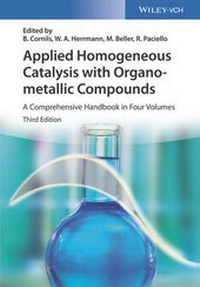
Applied Homogeneous Catalysis with Organometallic Compounds
Description

The internationally renowned editors and a plethora of international authors (including Nobel laureate R. Noyori) guarantee high quality content throughout the book.
A "must read" for everyone in academia and industry working in this field.
More details
Other editions
Additional editions
Persons
Wolfgang A. Herrmann is president of the Technical University of Munich and has received several awards for his work in organometallic chemistry, like the Otto-Bayer Medal, the DFG Leibniz Award, the ACS Award in Organometallic Chemistry, Max Planck Research Award, the GDCh Wilhelm Klemm Award and many more. He has authored a plethora of publications and is the editor of numerous bestselling books.
Matthias Beller is director of the Leibniz-Institute for Catalysis and Professor for Catalysis at the University of Rostock. He has received several awards such as the Otto-Roelen Medal, the DFG Leibniz Award, the first European Prize for Sustainable Chemistry, the Emil Fischer Medal and the Wöhler Prize of the German Chemical Society and the Gay-Lussac-Alexander-von-Humboldt Prize.
Rocco Paciello is a research manager at BASF SE in Ludwigshafen, Germany. After experience as a research chemist and assistant plant manager, he became responsible for the homogeneous catalysis group at BASF and has led it for the last fifteen years. The group is focused on finding new technical applications of transition metal catalyzed homogeneous catalysis, such as hydroformylations, carbonylations
and hydrogenations.
Content
APPLIED HOMOGENEOUS CATALYSIS
Hydroformylation
-General Aspects
-Conventional Processes
-Aqueous Phase Processes
Carbonylations
-Carbonylation: Introduction and General Aspects
-Carbonylation of Methanol and its Derivatives to Acetic Acid and Acetic Anhydride
-Alkyne-Carbonlylation
-Aryl-X and related Carbonylation
-Transition Metal-Catalyzed Oxidative Carbonlyation
-Alternating Copolymerization with Carbon Monoxide
Polymerization & Copolymerization
- General Aspects
-Metallocene-Catalyzed Polyolefins
-Post- and Non-metallocenes for Polymerizations
-Polymerization of 1,3-butadiene with organometallic complexes-based catalysts
-Polycarbonates
Oligomerization & Cyclooligomerization, Dimerisation
-Selective Production of 1-Hexene and 1-Octene
-Dimerization and selective oligomerization
-Telomerization of 1,3-butadiene
-Cyclotrimerization Reactions of Alkynes
Cross coupling reactions (Suzuki, Heck, Buchwald-Hartwig, Sonogashira)
-Coupling Reactions: Introduction and General Aspects
-Industrial applications of Palladium-Catalysed Coupling Reactions
-Ligand-Enabled Palladium-Catalyzed C-N and C-O Bond Formations from Aryl Halides, Tosylates and Mesylates
Oxidation
-General Aspects
-Aromatic Carboxylic Acids
-Oxidation of Olefins to Carbonyl-Compounds (Wacker-Process)
-Radical Chain Oxidations
-Manganese and iron bleaching catalysts
-Catalytic Decarbonylative and Decarboxylative Processes
-Oxidation of Phenol
Hydrosilylation and Related Reactions of Silicon Compounds
Hydrogenation
-Industrial Application of Asymmetric Hydrogenation
-Supercritical Fluids as Advanced Media for Reaction and Separation in Homogeneous Catalysis
-Hydrogenation of Esters
RECENT DEVELOPMENTS
New Trends in Organometallic Catalysts
-Iron Catalysis
-Copper-Catalyzed Arylation of Nucleophiles: History, Renaissance and Scalable Reactions
-Rare Earth Metal Catalysts
-Chiral Bronsted Acids/Chiral Frustated Lewis Pairs
New Ligands
-N-Heterocyclic Carbenes
-Phosphorus Ligands in Homogeneous Catalysis
-Host-Guest Relations and Selforganization in Homogeneous Catalysis
-Micellar Catalysis
-Switchable Catalysts
-Catalysis with Transition Metal Pincer Complexes
-Biocatalysis
Recent computational investigations into the Heck type reaction mechanisms
Chemical Reaction Engineering Aspects of Homogeneously Catalyzed Processes
Supported Liquid Phase Catalysis
Recent advances in Surface Organometallic Chemistry
High Throughput Screening of Homogeneous Catalysts: Selected Trends and Applications in Process Development
Homogeneous Photocatalysis with Organometallic Compounds
Electrochemical Water Oxidation and Reduction Catalyzed by Organometallic Compounds
Metal-Catalyzed Multicomponent Reactions
Carbonylation of nitroarenes and aromatic amines
Pauson-Khand Reaction
C-H Activation Coupling Reactions
Metathesis
Isomerization
Catalysis and Scope of the Hydroamination of Non-Activated CC Multiple Bonds
Catalytic Amide Bond Forming Methods
Synthesis of Heterocycles by Pd-catalyzed and Pd-catalysis Initiated Multi-Component Reactions
Metal-Catalyzed Baeyer-Villiger Oxidations
Dihydroxylations of Olefins and Related Reactions
Selective Alkane Oxidation
Catalytic Click Reactions
Sulfur in Catalysis
Oleochemistry
Carbon Dioxide
Electrochemical Water Oxidation and Reduction Catalyzed by Organometallic Compounds
Water Gas Shift Reactions
EPILOGUE
List of Contributors
Bruce A. Arndtsen
McGill University
Department of Chemistry
Sherbrooke St. W. 801
Montreal
QC H3A 0B4
Canada
Benjamin N. Atkinson
University of Bath
Department of Chemistry
Claverton Down
Bath BA2 7AY
UK
Manfred Baerns
Fritz-Haber Institut der MPG
Dept. Inorganic Chemistry
Faraday-Weg 4-6
14195 Berlin
Germany
Moritz C. Baier
Universität Konstanz
Fachbereich Chemie
Lehrstuhl für Chemische Materialwissenschaften
Universitätsstr. 10
78457 Konstanz
Germany
Katalin Barta
Rijksuniversiteit Groningen
Stratingh Institute for Chemistry
Nijenborgh 4
9747 AG Groningen
The Netherlands
Klaus Beckerle
RWTH Aachen University
Institute of Inorganic Chemistry
Landoltweg 1
52056 Aachen
Germany
Arno Behr
Technische Universität Dortmund
Fachbereich Bio- und Chemie Ing.
Emil-Figge-Str. 66
44227 Dortmund
Germany
Matthias Beller
Leibniz-Institut für Katalyse an der
Universität Rostock e.V. (LIKAT)
Albert-Einstein-Str. 29a
18059 Rostock
Germany
David E. Bergbreiter
Texas A&M University
Department of Chemistry
P.O. Box 30012
College Station
TX 77842-3012
USA
Hans Ulrich Blaser
Furglerstrasse 10
9000 St. Gallen
Switzerland
Armin Börner
Universität Rostock
Leibniz Institut für Katalyse e.V.
Albert Einstein Str. 29a
18059 Rostock
Germany
Uwe T. Bornscheuer
University of Greifswald
Institute of Biochemistry
Department of Biotechnology & Enzyme Catalysis
Felix-Hausdorff-Str. 4
17487 Greifswald
Germany
Alexandra Grosse Böwing
Bayer Antwerpen NV
Scheldelaan 600
2040 Antwerpen
Belgium
Fabrizio Cavani
Università di Bologna
Dipartimento di Chimica Industriale "Toso Montanari"
Viale Risorgimento 4
40136 Bologna
Italy
A. Rosie Chhatwal
University of Bath
Department of Chemistry
Claverton Down
Bath BA2 7AY
UK
Peter Claus
TU Darmstadt
Ernst-Berl Institut
Petersenstr.20
64287 Darmstadt
Germany
David J. Cole-Hamilton
University of Saint Andrews
School of Chemistry
Purdie Building
St Andrew's
Fife KY17 9ST
UK
Anna Company
Universitat de Girona
Departament de Química
Campus Montilivi
17071 Girona
Catalonia
Spain
Christophe Copéret
ETH Zürich
Department of Chemistry and Applied Biosciences
Vladimir Prelog Weg 1-5
8093 Zürich
Switzerland
Boy Cornils
Kirschgartenstr. 6
65719 Hofheim
Germany
Miquel Costas
Universitat de Girona
Departament de Química
Campus Montilivi
17071 Girona
Catalonia
Spain
Johannes W. de Boer
Catexel B.V.
BioPartner Center Leiden
Galileiweg 8
2333 BD Leiden
The Netherlands
Johannes G. de Vries
University of Groningen
Stratingh Institute for Chemistry
Nijenborgh 4
9747 AG Groningen
The Netherlands
and
Leibniz-Institut für Katalyse e.V.
Albert-Einstein-Str. 29a
18059 Rostock
Germany
Peter J. Deuss
Rijksuniversiteit Groningen
Stratingh Institute for Chemistry
Nijenborgh 4
9747 AG Groningen
The Netherlands
Eite Drent
University of Saint Andrews
School of Chemistry
Purdie Building
St Andrew's
Fife KY17 9ST
UK
Gwilherm Evano
Laboratoire de Chimie Organique (LCO)
Avenue F.D. Roosevelt
50 CP160/06
1050 Brussels
Belgium
Miguel A. Esteruelas
Universidad de Zaragoza - CSIC
Departamento de Química Inorgánica - ISQCH
Centro de Innovación en Química Avanzada (ORFEO-CINQA)
Plaza de San Francisco
s/n
50009 Zaragoza
Spain
Giancarlo Franciò
RWTH Aachen University
Institut für Technische und Makromolekulare Chemie
Worringerweg 2
52074 Aachen
Germany
Robert Franke
Evonik Industries AG
Paul-Baumann-Str. 1
45772 Marl
Germany
Lukas Gooßen
Ruhr-Universität Bochum
Lehrstuhl für Organische Chemie I
ZEMOS 2/27
Universitätsstraße 150 44801 Bochum
Germany
Karol Grela
Faculty of Chemistry
Biological and Chemical Research Centre
University of Warsaw
Pasteura 1, 02-093 Warsaw
Poland
Douglas B. Grotjahn
San Diego State University
Department of Chemistry and Biochemistry
5500 Campanile Drive
San Diego
CA 92182-1030
USA
Cai-Hong Guo
Shanxi Normal University
School of Chemistry and Materials Science
Linfen 041004
China
Ronald Hage
Catexel B.V.
BioPartner Center Leiden
Galileiweg 8
2333 BD Leiden
The Netherlands
Frédéric Hapiot
Université d'Artois
UMR CNRS 8181
Unité de Catalyse et de Chimie du Solide (UCCS)
62300 Lens
France
Marko Hapke
Leibniz-Institut für Katalyse e.V. an der Universität Rostock
Albert-Einstein-Str. 29a
18059 Rostock
Germany
Marcus Harrer
Philipps-Universität Marburg
Fachbereich Chemie
Hans-Meerwein-Straße
35043 Marburg
Germany
Marco Haumann
Friedrich-Alexander-Universität Erlangen-Nürnberg
Lehrstuhl für Chemische Reaktionstechnik
Egerlandstr. 3
91058 Erlangen
Germany
Florent Héroguel
ETH Zürich
Department of Chemistry and Applied Biosciences
Vladimir Prelog Weg 1-5
8093 Zürich
Switzerland
Wolfgang A. Herrmann
Technical University Munich
Department of Chemistry and Catalysis Research Center
Lichtenbergstr. 4
85748 Garching
Germany
Sandra Hinze
Leibniz-Institut für Katalyse e.V.
Albert-Einstein-Str. 29a
18059 Rostock
Germany
Norbert Hoffmann
CNRS
Université de Reims Champagne-Ardenne
Institut de Chimie Moléculaire de Reims (UMR 7312)
Equipe de Photochimie
UFR Sciences
B.P. 1039
51687 Reims
France
Shingo Ito
The University of Tokyo
Department of Chemistry and Biochemistry
7-3-1 Hongo
Bunkyo-ku
Tokyo 113-8656
Japan
Ralf Jackstell
Universität Rostock
Leibniz-Institut für Katalyse e.V.
Albert-Einstein-Str. 29a
18059 Rostock
Germany
Haijun Jiao
Leibniz-Institut für Katalyse e.V.
Universität Rostock
Albert-Einstein-Strasse 29a
18059 Rostock
Germany
Reinhard Jira
Kabastastrasse 9
81243 München
Germany
Kathrin Junge
Leibniz-Institut für Katalyse e.V. an der Universität Rostock
Albert-Einstein-Str. 29a
18059 Rostock
Germany
Philippe Kalck
Université de Toulouse UPS-INP-LCC
Laboratoire de Chimie de Coordination UPR CNRS 8241
composante ENSIACET
4 allée Emile Monso BP 44362
31030 Toulouse Cedex 4
France
Walter Kaminsky
University of Hamburg
Institute for Technical and Macromolecular Chemistry
Bundesstr. 45
20146 Hamburg
Germany
Mariusz Ke?dziorek
Faculty of Chemistry
Biological and Chemical Research Centre
University of Warsaw
Pasteura 1, 02-093 Warsaw
Poland
Rhett Kempe
University of Bayreuth
Inorganic Chemistry II
Universitätsstr. 30
95440 Bayreuth
Germany
Oxana A. Kholdeeva
Boreskov Institute of Catalysis, SB RAS
Pr. akademika Lavrentieva 5
630090 Novosibirsk
Russia
and
Novosibirsk State University
Pirogova str. 2
630090 Novosibirsk
Russia
Jürgen Klankermayer
RWTH Aachen University
Institut für Technische und Makromolekulare Chemie (ITMC)
Worringerweg 2
52074...
