

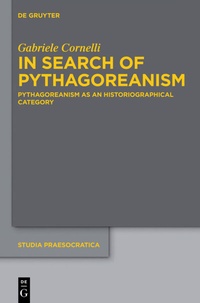
In Search of Pythagoreanism
Description

The history of Pythagoreanism is littered with different and incompatible interpretations, to the point that Kahn (1974) suggested that, instead of another thesis on Pythagoreanism, it would be preferable to assess traditions with the aim of producing a good historiographical presentation. This almost fourty-year-old observation by Kahn, directs the author of this book towards a fundamentally historiographical rather than philological brand of work, that is, one neither exclusively devoted to the exegesis of sources such as Philolaus, Archytas or even of one of the Hellenistic Lives nor even to the theoretical approach of one of the themes that received specific contributions from Pythagoreanism, such as mathematics, cosmology, politics or theories of the soul. Instead, this monograph sets out to reconstruct the way in which the tradition established Pythagoreanism's image, facing one of the central problems that characterizes Pythagoreanism more than other ancient philosophical movements: the drastically shifting terrain of the criticism of the sources. The goal of this historiographical approach is to embrace Pythagoreanism in its entirety, through - and not in spite of - its complex articulation across more than a millennium.
Reviews / Votes
"This brief but from now on fundamental book opens a new path for research in the search for Pythagoreanism."David Hernández in: BMCR 2014.10.22More details
Other editions
Additional editions
Complete work / Part of the work
Person
Content
2 - Acknowledgements [Seite 11]
3 - Note [Seite 12]
4 - Abbreviations [Seite 13]
5 - Introduction [Seite 15]
6 - 1 History of criticism: from Zeller to Kingsley [Seite 21]
6.1 - 1.1 Zeller: the skepticism of the beginnings [Seite 22]
6.2 - 1.2 Diels: a Zellerian collection [Seite 28]
6.3 - 1.3 Rohde: the reaction to skepticism [Seite 29]
6.4 - 1.4 Burnet: the double teaching of acousmatics and mathematicians [Seite 31]
6.5 - 1.5 Cornford and Guthrie: in search of unity between science and religion [Seite 33]
6.6 - 1.6 From Delatte to De Vogel: Pythagoreanism and politics [Seite 37]
6.7 - 1.7 Aristotle's unique testimony and the uncertain Academic tradition [Seite 47]
6.8 - 1.8 From Burkert to Kingsley: the third way and mysticism in the Pythagorean tradition [Seite 54]
6.9 - 1.9 Conclusion [Seite 63]
7 - 2 Pythagoreanism as a historiographical category [Seite 66]
7.1 - 2.1 Interpreting interpretations: diachronic and synchronic dimensions [Seite 66]
7.2 - 2.2 Pythagorean identity [Seite 69]
7.3 - 2.3 The Pythagorean koinonía [Seite 75]
7.4 - 2.4 Acousmatics and mathematicians [Seite 91]
7.5 - 2.5 Conclusion [Seite 97]
8 - 3 Immortality of the soul and metempsýchosis [Seite 100]
8.1 - 3.1 "Is it the soul?" (Xenophanes) [Seite 103]
8.2 - 3.2 "Wiser than all" (Heraclitus and Ion of Chios) [Seite 108]
8.3 - 3.3 "Ten or twenty human generations" (Empedocles) [Seite 111]
8.4 - 3.4 Plato and Orphism [Seite 114]
8.4.1 - 3.4.1 "Understanding the logos of their ministry" [Seite 115]
8.4.2 - 3.4.2 Hierarchy of incarnations [Seite 120]
8.4.3 - 3.4.3 Sôma-sêma [Seite 121]
8.4.4 - 3.4.4 Pythagorean mediation [Seite 130]
8.5 - 3.5 Herodotus, Isocrates and Egypt [Seite 135]
8.6 - 3.6 Legends on immortality [Seite 138]
8.7 - 3.7 A Pythagorean Democritus? [Seite 141]
8.8 - 3.8 Aristotle and the Pythagorean myths [Seite 143]
8.9 - 3.9 Conclusion [Seite 148]
9 - 4 Numbers [Seite 151]
9.1 - 4.1 All is number? [Seite 152]
9.1.1 - 4.1.1 Three versions of the Pythagorean doctrine of numbers [Seite 152]
9.1.2 - 4.1.2 Two solutions [Seite 161]
9.1.3 - 4.1.3 The Philolaic solution [Seite 164]
9.1.3.1 - 4.1.3.1 One book or three books? [Seite 165]
9.1.3.2 - 4.1.3.2 Authenticity of Philolaus' fragments [Seite 167]
9.1.3.3 - 4.1.3.3 The Doric pseudo-epigraphic tradition [Seite 169]
9.1.4 - 4.1.4 The Aristotelian exception (Met. A 6, 987b) [Seite 173]
9.1.5 - 4.1.5 The Platonic testimony (Phlb. 16c-23c) [Seite 181]
9.2 - 4.2 The fragments of Philolaus [Seite 186]
9.2.1 - 4.2.1 Unlimited/limiting [Seite 186]
9.2.2 - 4.2.2 The role of numbers in Philolaus [Seite 192]
9.3 - 4.3 Conclusion [Seite 198]
10 - Conclusion [Seite 203]
11 - Bibliography [Seite 211]
11.1 - Primary sources [Seite 211]
11.2 - Secondary sources [Seite 214]
12 - Index of Topics [Seite 228]
13 - Index of Passages [Seite 233]
14 - Index of Names [Seite 238]
