

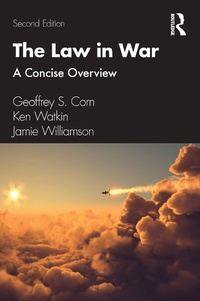
The Law in War
A Concise Overview
2nd Edition
Published on 29. March 2023
454 pages
978-1-000-85178-6 (ISBN)
Description

The Law in War offers an insightful roadmap to understanding a broad range of operational, humanitarian, and accountability issues that arise during armed conflict.
Each chapter provides a clear and comprehensive explanation of the impact that international law has on military operations. The second edition has been fully revised to reflect recent advances in international humanitarian law and expands the analysis to include as a brand-new chapter on international human rights law, which addresses issues such as the conduct of law enforcement during hostilities. The revusions are particularly focused on updates concerning the status of combatants and unprivileged belligerents, the protection of civilians, targeting, the treatment of POWs and detainees, weapons law, air and missile warfare, naval warfare and neutrality, command responsibility, and accountability. New material has also been added to address the increasing involvement of private security contractors in warfare.
The Law in War is an ideal text for students in a variety of domains, to include international humanitarian law, international human rights law, international relations, and military science. It is also a valuable resource for those involved in the planning, execution, and critique of military operations across the spectrum of conflict.
Each chapter provides a clear and comprehensive explanation of the impact that international law has on military operations. The second edition has been fully revised to reflect recent advances in international humanitarian law and expands the analysis to include as a brand-new chapter on international human rights law, which addresses issues such as the conduct of law enforcement during hostilities. The revusions are particularly focused on updates concerning the status of combatants and unprivileged belligerents, the protection of civilians, targeting, the treatment of POWs and detainees, weapons law, air and missile warfare, naval warfare and neutrality, command responsibility, and accountability. New material has also been added to address the increasing involvement of private security contractors in warfare.
The Law in War is an ideal text for students in a variety of domains, to include international humanitarian law, international human rights law, international relations, and military science. It is also a valuable resource for those involved in the planning, execution, and critique of military operations across the spectrum of conflict.
More details
Edition
2nd edition
Language
English
Place of publication
London
United Kingdom
Publishing group
Taylor & Francis Ltd
Target group
College/higher education
Product notice
Reflowable
Illustrations
2 Line drawings, black and white; 2 Illustrations, black and white
ISBN-13
978-1-000-85178-6 (9781000851786)
Copyright in bibliographic data and cover images is held by Nielsen Book Services Limited or by the publishers or by their respective licensors: all rights reserved.
Schweitzer Classification
Other editions
Additional editions
Book
03/2023
2nd Edition
Routledge
€67.20
Shipment within 15-20 days
Book
03/2023
2nd Edition
Routledge
€187.60
Shipment within 15-20 days
Persons
Geoffrey S. Corn is the George R. Killam, Jr. Chair of Criminal Law and Director of the Center for Military Law and Policy at Texas Tech University School of Law. He joined the Texas Tech faculty after a 17-year tenure as a Professor of Law at South Texas College of Law Houston. Prior to joining academia in 2005, Professor Corn served in the U.S. Army for 21 years as an officer, retiring in the rank of Lieutenant Colonel in 2004. His career culminated as the Special Assistant to the Judge Advocate General for Law of War Matters, the U.S. Army's senior expert advisor on all issues related to the laws of war. His career also included service as tactical intelligence officer in Panama; supervisory defense counsel for the Western United States; Chief of International Law for US Army Europe; Professor of International and National Security Law at the US Army Judge Advocate General's School; and Chief Prosecutor for the 101st Airborne Division. He has authored more than 60 scholarly articles and is co-author of The Law of Armed Conflict: An Operational Perspective; The Laws of War and the War on Terror; National Security Law and Policy: Principles and Policy; U.S. Military Operations: Law, Policy, and Practice; and National Security Law and the Constitution.
Ken Watkin served for 33 years in the Canadian Forces, including four years as the Judge Advocate General. In 2002 he was appointed to the Order of Military Merit, in 2006 a Queen's Counsel, and in 2010 he received the Canadian Bar Association President's Award. Ken was responsible for providing operational law advice regarding Canada's military operations post-9/11, and worked as government counsel for various inquiries arising from the 1994 Rwandan genocide. Since his retirement in 2010, he has served as a foreign observer to the Israeli Independent Commission investigating the 2010 Gaza blockade incident, and as the Charles H. Stockton Professor of International Law at the United States Naval War College (2011-12). Ken has also worked as a counterinsurgency/counterterrorism consultant for the United Nations and the Government of Canada. In addition to writing over 50 scholarly articles, commentaries and book reviews he is the author of Fighting at the Legal Boundaries: Controlling the Use of Force in Contemporary Conflict (Oxford University Press, 2016), which was awarded the 2017 Francis Lieber Prize by the American Society of International Law.
Jamie Williamson is the Executive Director of the International Code of Conduct for Private Security Service Providers Association. He previously worked with the International Committee of the Red Cross (ICRC) advising and training State and non-State weapons bearers, and led the ICRC's legal dialogue in numerous contexts globally, including the U.S., Canada and Southern and Eastern African. Jamie Williamson also served from 1996-2005 with the UN ad hoc international criminal tribunals in Tanzania and the Netherlands, and the Special Court for Sierra Leone. He is on the faculty of American University's Program of Advanced Studies of the Academy on Human Rights and Humanitarian Law.
Ken Watkin served for 33 years in the Canadian Forces, including four years as the Judge Advocate General. In 2002 he was appointed to the Order of Military Merit, in 2006 a Queen's Counsel, and in 2010 he received the Canadian Bar Association President's Award. Ken was responsible for providing operational law advice regarding Canada's military operations post-9/11, and worked as government counsel for various inquiries arising from the 1994 Rwandan genocide. Since his retirement in 2010, he has served as a foreign observer to the Israeli Independent Commission investigating the 2010 Gaza blockade incident, and as the Charles H. Stockton Professor of International Law at the United States Naval War College (2011-12). Ken has also worked as a counterinsurgency/counterterrorism consultant for the United Nations and the Government of Canada. In addition to writing over 50 scholarly articles, commentaries and book reviews he is the author of Fighting at the Legal Boundaries: Controlling the Use of Force in Contemporary Conflict (Oxford University Press, 2016), which was awarded the 2017 Francis Lieber Prize by the American Society of International Law.
Jamie Williamson is the Executive Director of the International Code of Conduct for Private Security Service Providers Association. He previously worked with the International Committee of the Red Cross (ICRC) advising and training State and non-State weapons bearers, and led the ICRC's legal dialogue in numerous contexts globally, including the U.S., Canada and Southern and Eastern African. Jamie Williamson also served from 1996-2005 with the UN ad hoc international criminal tribunals in Tanzania and the Netherlands, and the Special Court for Sierra Leone. He is on the faculty of American University's Program of Advanced Studies of the Academy on Human Rights and Humanitarian Law.
Content
1. International Humanitarian Law Application 2. Non-International Armed Conflicts 3. International Humanitarian Law and Human Rights Law: Their Interface and Overlap 4. Status of Individuals in Armed Conflict 5. Protecting Civilians, Wounded, and Sick 6. Prisoners of War and Other Detainees 7. Targeting 8. Weapons and Tactics 9. Naval Warfare and Neutrality 10. Air and Missile Warfare 11. Command Responsibility 12. International Justice and Compliance 13. War Crimes and Accountability
