

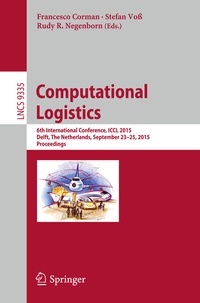
Computational Logistics
6th International Conference, ICCL 2015, Delft, The Netherlands, September 23-25, 2015, Proceedings
Published on 18. September 2015
XV, 752 pages
978-3-319-24264-4 (ISBN)
Description

This book constitutes the refereed proceedings of the 6th International Conference on Computational Logistics, ICCL 2015, held in Delft, The Netherlands, in September 2015.
The 50 papers presented in this volume were carefully reviewed and selected for inclusion in the book. They are organized in topical sections entitled: transport over ground, transport over water, international coordination within a system, external coordination among systems.
More details
Other editions
Additional editions

Francesco Corman | Stefan Voß | Rudy R. Negenborn
Computational Logistics
6th International Conference, ICCL 2015, Delft, The Netherlands, September 23-25, 2015, Proceedings
Book
09/2015
Springer
€53.49
Shipment within 10-15 days
Content
- Intro
- Preface
- Organization
- Contents
- Transport Over Ground
- Ant Metaheuristic with Adapted Personalities for the Vehicle Routing Problem
- 1 Introduction
- 2 Ant Algorithms
- 3 Presentation of the and Literature Review
- 4 New Algorithms for the VRP
- 4.1 GR: A Greedy Constructive Algorithm with Restarts
- 4.2 ANT: An Ant Algorithm with Two Phases
- 4.3 AL: ANT Enhanced with Local Search Techniques
- 4.4 ALM: AL Enhanced with a Central Memory
- 4.5 ALMP: ALM with Different Ant Personalities
- 5 Results
- 6 Conclusion
- References
- The Round-Trip Ridesharing Problem with Relay Stations
- 1 Introduction
- 2 Problem Description and Notation
- 2.1 Matching Constraints
- 2.2 Objective of Ridesharing System
- 3 Algorithmic Details
- 3.1 Adding Offer
- 3.2 Adding a Demand
- 3.3 Total Gain in Round-trip
- 3.4 Removing Offers
- 4 Experiments
- 5 Conclusion
- References
- A Hierarchical Model for the Cash Transfer System Design Problem
- 1 Introduction
- 2 The Model
- 2.1 Strategic Problem: An Uncapacitated Facility Location Problem (UFLP)
- 2.2 Tactical Problem: A Vehicle Routing Problem (VRP)
- 2.3 Operational Problem: A Cash Management Problem Under Uncertainty (CMPU)
- 2.4 Integrating Problem: The Vehicle Number Determination Problem (VNDP)
- 3 A Numerical Study
- 4 Concluding Remarks
- References
- A Decision Support Model for Routing and Scheduling a Fleet of Fuel Supply Vessels
- 1 Introduction
- 2 Problem Descrip ption
- 3 Mathematical Model
- 3.1 Modeling Approach
- 3.2 Notation
- 3.3 Model
- 4 Computational Study
- 4.1 Test Instances
- 4.2 Computational Experiments and Results
- 5 Concluding Remarks
- References
- An Approximate Dynamic Programming Approach to Urban Freight Distribution with Batch Arrivals
- 1 Introduction
- 2 Literature Review
- 3 Problem Formulation
- 4 Markov Model
- 5 Solution Approach
- 6 Numerical Experiments
- 7 Conclusions
- References
- Emission Vehicle Routing Problem with Split Delivery and a Heterogeneous Vehicle Fleet
- 1 Introduction
- 2 Ecological Approaches for Mixed Vehicle Routing
- 3 Calculation of Emissions
- 4 A Mathematical Model
- 5 Computational Study
- 5.1 Generation of Instances
- 5.2 Computational Results
- 6 Conclusion
- References
- A Combined Liquefied Natural Gas Routing and Deteriorating Inventory Management Problem
- 1 Introduction
- 2 Problem Description
- 3 Arc-Flow Model
- 3.1 Inventory Level at Vertices
- 3.2 Objective Function and Constraints
- 4 Path-Flow Model
- 4.1 Objective Function and Constraints
- 5 Computational Results
- 5.1 Example 1
- 5.2 Example 2
- 6 Conclusion
- References
- An Ant Colony-Based Matheuristic Approach for Solving a Class of Vehicle Routing Problems
- 1 Introduction
- 2 The Proposed Matheuristic
- 2.1 Description
- 2.2 Implementation to VRP Variants
- 3 Computational S Study
- 3.1 Benchmark Instances
- 3.2 Results
- 4 Conclusion and Future Research
- Appendix
- References
- Transport Over Water
- A Hybrid Reactive Tabu Search for Liner Shipping Fleet Repositioning
- 1 Introduction
- 2 Liner Shipping Fleet Repositioning
- 3 Literature Review
- 4 A Hybrid Reactive Tabu Search Approach
- 4.1 Graph Overview
- 4.2 Existing SA Approach
- 4.3 Demand Source Completion Neighborhood
- 4.4 Ejection Chain Neighborhood
- 4.5 Reactive Tabu Search
- 4.6 Hybrid RTS-SA Approach
- 5 Computational Evaluation
- 5.1 Neighborhood Effectiveness
- 5.2 TS-S vs. TS-T
- 5.3 RTS-SA
- 6 Conclusion
- Risk Analysis and Quantification of Vulnerability in Maritime Transportation Network Using AIS Data
- 1 Introduction
- 2 Data Collection
- 3 Data Analysis
- 3.1 Throughput Calculations
- 3.2 Network Analysis
- 4 Modeling and Simulation for Risk Assessment
- 4.1 Modeling
- 4.2 Quantification Method of the Risks
- 4.3 Analytical Approach
- 5 Conclusion
- References
- A Branch-and-Price Method for a Ship Routing and Scheduling Problem with Stowage Constraints
- 1 Introduction
- 2 Problem Description and Mathematical Model
- 3 Solution Method
- 3.1 Subproblem
- 3.2 A Labeling Algorithm for the Subproblems
- Labels.
- Label Extension.
- Dominance Criterion
- 3.3 Acceleration Strategy
- 3.4 Branching
- 4 Computational Study
- 4.1 Test Results
- 5 Concluding Remarks
- References
- Trajectory Tracking Control for Underactuated Surface Vessels Based on Nonlinear Model Predictive Control
- 1 Introduction
- 2 Underactuated Surface Vessel Model Considering Disturbances
- 3 Nonlinear Predictive Model Control
- 3.1 Model Discretization
- 3.2 Objective Function Design
- 3.3 System Constraints
- 4 Simulation Experiment
- 4.1 Model Parameters
- 4.2 Simulation Parameters
- 4.3 Results
- 5 Conclusion and Future Work
- References
- Cooperative Distributed Collision Avoidance Based on ADMM for Waterborne AGVs
- 1 Introduction
- 2 Vessel Models for Simulation and Prediction
- 2.1 A Marine Surface Vessel Model
- 2.2 Successively Linearized Prediction Models for MPC
- 3 Centralized Predictive Collision Avoidance
- 3.1 A Network Model
- 3.2 Convexified Collision Avoidance Constraints
- 3.3 Centralized Formulation
- 4 Cooperative Distributed Collision Avoidance
- 4.1 ADMM Based Decomposition for Waterborne AGVs
- 4.2 Stopping Criteria
- 5 Simulation Experiments
- 5.1 Controller and Scenario Setups
- 5.2 Simulation Results and Discussions
- 6 Conclusions and Future Research
- References
- A Matheuristic for the Liner Shipping Network Design Problem with Transit Time Restrictions
- 1 Introduction
- 2 Literature Review
- 3 Mathematical Model for the LSNDP-TT
- 4 Algorithm
- 4.1 Estimated Revenue Loss x Due to Transit Time Changes
- 5 Computational Results
- 5.1 Computational Results for LINER-LIB 2012
- 6 Conclusions
- References
- A Positioning System Based on Monocular Vision for Model Ship
- 1 Introduction
- 1.1 The Research Background
- 1.2 The Research Significance
- 1.3 Work of this Paper
- 2 Ship Target Recognition
- 2.1 Color Feature Recognition
- 2.2 Binarization and Contour Detection
- 3 Ship Motion State Computing
- 3.1 Camera Coordinates to Focal Plane Coordinate
- 3.2 Focal Plane Coordinate to Inertial Coordinate
- 3.3 Motion State Computing
- 4 Experimental Analysis
- 4.1 Experimental Platform
- 4.2 Experimental Method
- 4.3 Data Analysis
- 5 Conclusion
- References
- Improvement of Navigation Conditions Using Model Predictive Control - The Cuinchy-Fontinettes Case Study
- 1 Introduction
- 2 Modeling
- 2.1 Nonlinear Model for Simulation Purposes
- 2.2 Linear Model for Control Purposes
- 2.3 Modelling Hydraulic Structures
- Undershot Gate.
- 2.4 Overshot Gate
- 2.5 Lock Operations
- 3 Control Development
- 4 The Cuinchy Fontinettes Reach - Case Study
- 5 Results and Discussion
- 6 Conclusions and Future Research
- References
- A Survey on the Ship Loading Problem
- 1 Introduction
- 2 The Ship Loading Problem
- 3 Literature Review
- 3.1 Operational Stowage Planning Literature
- Stowage Planning with Terminal Considerations.
- 3.2 Load Sequencing Problem Literature
- 3.3 Equipment Assignment and Scheduling Literature
- 3.4 Integration Efforts
- 4 Conclusions and Future Research Directions
- References
- Characterization of the Portuguese SSS into the Europe: A Contribution
- 1 Introduction
- 2 SSS Evolution and Characterization: A Literature Review
- 3 Survey Methodology
- 4 Survey Results and Discussion
- 4.1 EU and Portuguese Context
- 4.2 Survey Results
- 5 Conclusions
- References
- Yard Crane Dispatching to Minimize Total Weighted Vessel Turnaround Times in Container Terminals
- 1 Introduction
- 2 Related Work
- 3 The Formulation of the YC Dispatching Problem
- 3.1 General Description
- 3.2 The Objective Function
- 4 MTWMT- Dispatching to Minimize Total Weighted Maximum Tardiness
- 5 Performance Evaluation
- 5.1 Design of Experiments
- 5.2 Results and Discussions
- 6 Conclusions
- References
- A Two Phase Approach for Inter-Terminal Transport of Inland Vessels Using Preference-Based and Utility-Based Coordination Rules
- 1 Introduction
- 2 Coordination Framework
- 3 Single Vessel Optimization
- 3.1 Problem Description
- 3.2 Mathematical Formulation
- 3.3 Solution Method
- 4 Multiple Vessel Coordination
- 4.1 Problem Description
- 4.2 Preference-Based Coordination
- 4.3 Utility-Based Coordination
- 4.4 No Coordination
- 5 Simulation Experiments
- 5.1 Scenario Description
- 5.2 Rotation Plans
- 5.3 Departure Time of the Last Vessel
- 5.4 Total Sojourn Time
- 5.5 Total Waiting Time
- 5.6 Discussion
- 6 Conclusions and Future Research
- References
- Learning Maritime Traffic Rules Using Potential Fields
- 1 Introduction
- 2 Background and Method
- 3 STRAND
- 4 Anomalies and Discovered Rules
- 4.1 Anomalies
- 4.2 Traffic Rules at Sea
- 5 Discussion
- 6 Conclusion
- References
- Internal Coordination within a System
- Bootstrap Estimation Intervals Using Bias Corrected Accelerated Method to Forecast Air Passenger Demand
- 1 Introduction
- 2 Air Pax Forecasting Demand Methods
- 3 Bootstrap Estimation Intervals for Pax Demand
- 3.1 Bootstrap Methodology
- 3.2 Confidence Bands Methods
- 4 Empirical Application and Monte Carlo Experiments
- 4.1 Experimental Data
- 4.2 Pax Demand Distribution per Distance Block
- 4.3 Bootstrap Confidence Bands Using BCa
- 4.4 Monte Carlo Experiments
- 5 Conclusions
- References
- On a Pooling Problem with Fixed Network Size
- 1 Introduction
- 2 Mathematical Formulation of the Pooling Problem
- 3 A DP-Algorithm for Instances with Two Sources and Terminals
- 4 Solving Atomic Instances by a Constant Number of Operations
- 4.1 Assumptions
- 4.2 Augmenting Paths and Cycles
- 4.3 Optimality Conditions on Flow in the Atomic Network
- 4.4 A Bilinear Program with a Single Bilinear Term
- 4.5 Full Capacity Utilization at the Center Pool
- 4.6 Convergence in a Constant Number of Arithmetic Operations
- 5 Conclusions and Further Research
- References
- Optimizing Constraint Test Ordering for Efficient Automated Stowage Planning
- 1 Introduction
- 2 Preliminary
- 2.1 Types of Containers and Ship Structure
- 2.2 Stowage Constraints and Considerations
- 2.3 Related Works
- 3 Two-Phase Stowage Planning Approach
- 3.1 Allocation Phase
- 4 Reordering of Constraint Tests
- 5 Experiments
- 6 Discussions and Conclusions
- References
- Probabilistic Analysis of Online Stacking Algorithms
- 1 Introduction
- 1.1 Related Work
- 1.2 Outline of the Paper
- 2 Preliminaries
- 2.1 Connections to Graph Coloring
- 2.2 Increasing Subsequences and Patience Sorting
- 3 The Algorithm
- 4 Probabilistic Analysis
- References
- Dynamic Multi-period Freight Consolidation
- 1 Introduction
- 2 Literature Review
- 3 Problem Description and Formulation
- 3.1 Markov Model
- 3.2 Approximate Dynamic Programming Solution Algorithm
- 4 Numerical Experiments
- 4.1 Accuracy Experiment
- 4.2 Policy Performance Experiment
- 4.3 Discussion
- 5 Conclusions
- References
- Synchromodal Container Transportation: An Overview of Current Topics and Research Opportunities
- 1 Introduction
- 1.1 Synchromodal Transportation
- 1.2 Problem Statement
- 2 Scientific State of the Art Related to EGS Topics
- 2.1 Integrated Network Planning
- 2.2 Real-Time Network Planning
- 2.3 Creating Planning Flexibility
- 3 Research Topics and Recent Results
- 3.1 Integrated Network Planning
- 3.2 Towards Real-Time Network Planning
- 3.3 Creating Planning Flexibility
- 4 Conclusion and Outlook
- References
- Survey on Operational Perishables Quality Control and Logistics
- 1 Introduction
- Typical Logistic Process of Case Studies.
- 2 Food Quality and Shelf Life
- 2.1 Definition of Food Quality and Shelf Life
- 2.2 Indicators Reflecting and Factors Affecting Food Quality
- 2.3 Discussion
- 3 Predicting Shelf Life
- 3.1 Sensing Technology
- 3.2 Modeling Methods
- Other Models.
- 3.3 Arrhenius Law
- 3.4 Time Temperature Integrator
- 3.5 Discussion
- 4 Impact of Shelf Life on Perishable Supply Chains
- 4.1 Quality Control in Transport
- 4.2 The Developing Role of Information Communication Technology
- 5 Conclusions and Outlook
- References
- A Rolling Horizon Auction Mechanism and Virtual Pricing of Shipping Capacity for Urban Consolidation Centers
- 1 Introduction
- 2 Related Works
- 3 Problem Description and Auction Mechanism for UCC
- 4 Proposed UCC Auction with Rolling Horizon
- 5 Numerical Experiments of the Proposed Mechanism
- 6 Virtual Price Determination Approaches
- 6.1 The Case with Known Distribution of Price-to-Volume Ratio
- 6.2 Pricing Using Robust Optimization
- 6.3 A Numerical Example of Virtual Pricing Using TRO
- 7 Conclusion
- References
- Consolidation of Residual Volumes in a Parcel Service Provider's Long-Haul Transportation Network
- 1 Introduction
- 2 Residual Volumes Hub Location Problem
- 3 Literature Review
- 4 Model Formulation
- 5 Improving the Bounds Through Valid Inequalities
- 6 Results
- 7 Conclusion
- References
- A Review of Intermodal Rail Freight Bundling Operations
- 1 Introduction
- 2 Intermodal Rail Transport Terminals
- 3 Bundling Operations
- 3.1 Handling Containers
- 3.2 Moving Containers
- 4 Conclusion
- References
- Cloud-Based Intelligent Transportation Systems Using Model Predictive Control
- 1 Introduction
- 2 Intelligent Transportation Systems
- 3 Model Predictive Control
- 4 Cloud-Based Multi-agent MPC Control Structures
- 4.1 Multi-agent Single-Layer MPC
- 4.2 Multi-agent Multi-layer MPC
- 5 Conclusions and Future Research
- References
- Cooperative Relations Among Intermodal Hubs and Transport Providers at Freight Networks Using an MPC Approach
- 1 Introduction
- 2 Intermodal Hub Modeling
- 3 Operations Management at Intermodal Hubs
- 3.1 MPC Formulation Cargo Assignment at the Hub
- 3.2 Cooperation Between Hubs and Transport Provider
- 4 Numerical Experiments
- 4.1 Setup
- 4.2 Cargo Assignment at the Terminal
- 4.3 Cooperation Between Terminal and Transport Provider
- 5 Conclusions and Future Research
- References
- Reducing Port-Related Truck Emissions: Coordinated Truck Appointments to Reduce Empty Truck Trips
- 1 Introduction
- 2 Literature Review
- 2.1 Collaboration in Road Transport
- 2.2 Truck Appointment Systems
- 2.3 Port Logistics Incorporating Emissions
- 3 A Collaborative Truck Appointment System
- 4 A Generic Simulation Approach for Collaborative Truck Appointment Systems
- 4.1 Scope and Objectives
- 4.2 Process Definition and Assumptions
- 4.3 Input and Output Data
- 4.4 Emission-integrated Matching Procedure
- 5 Simulation Case Study
- 5.1 Practical Case
- 5.2 Results
- 6 Conclusion
- References
- Computational Intelligence to Support Cooperative Seaport Decision-Making in Environmental and Ecological Sustainability
- 1 Introduction
- 2 Research Approach
- 3 Overview of the Conceptual DMSS Module for Cooperative Seaport Decision-Making in Environmental and Ecological Sustainability
- 4 Case Study to Demonstrate the Conceptual i-DMSS Module
- 4.1 Understanding the Data
- 4.2 Descriptive Modelling
- 4.3 Normative Modelling
- 4.4 Data Interoperability
- 4.5 Knowledge Representation within the i-DMSS Module
- 4.6 Illustration: Description of Port Environmental Performance
- 4.7 Challenges in the Development of the i-DMSS Module
- 5 Conclusions and Future Work
- References
- A Sample-Based Method for Perishable Good Inventory Control with a Service Level Constraint
- 1 Introduction
- 2 Stochastic Programming Model
- 3 Replenishment Cycles, Basic Order-Up-To Levelsand Estimating the Service Level
- 3.1 Replenishment Cycles and Limits on Timing Vector Y
- 3.2 Optimal Order Quantities and Basic Order-Up-To Level
- 3.3 Monte Carlo Estimation of the Service Level
- 4 Fixed Timing Y, Order-Up-To Level St
- 4.1 MC-MILP Optimization of the YS Policy
- 4.2 MC Smoothing Approach to the YS Policy
- 5 YQ(X): Timing Y, Stock-Age Dependent Qt(X)
- 6 Numerical Study
- 7 Conclusions
- References
- Pricing Intermodal Freight Transport Services: A Cost-Plus-Pricing Strategy
- 1 Introduction
- 2 Planning Intermodal Freight Transport
- 2.1 Intermodal Freight Transport Networks
- 2.2 Optimal Intermodal Freight Transport Planning Model
- 2.2.1 The Objective of the Planning Model
- 2.2.2 The Constraints of the Planning Model
- 2.2.3 The Optimization Formulation
- 3 Pricing Intermodal Freight Transport Services
- 4 Case Study
- 5 Conclusions
- References
- External Coordination among Systems
- Materials Flow Control in Hybrid Make-to-Stock/Make-to-Order Manufacturing
- 1 Introduction
- 2 Simulation Study
- 2.1 Manufacturing System
- 2.2 Materials Flow Control
- 2.3 Experimental Design and Performance Measures
- 3 Simulation Results and Discussion
- 4 Conclusions and Managerial Implications
- References
- A New Modelling Approach of Evaluating Preventive and Reactive Strategies for Mitigating Supply Chain Risks
- 1 Introduction
- 1.1 Research Problem and Contribution
- 1.2 Outline
- 2 Literature Review
- 2.1 Supply Chain Risk Management
- 2.2 Bayesian Belief Network Based Models
- 2.3 Limitations and Research Gap
- 3 New Modelling Approach
- 3.1 Framework
- 3.2 Assumptions
- 3.3 Model and Risk Measures
- 3.4 Modelling Process
- 4 Simulation Study
- 4.1 Problem Statement
- 4.2 Results and Discussion
- 4.3 Managerial Implications
- 5 Conclusion and Future Research
- References
- Site Selection of the New Mexico City Airport from the Perspective of Maximizing the Sum of Expected Air Pax Demand
- 1 Introduction
- 2 Mathematical Programming Models for Airport Site Selection
- 3 Mathematical Formulation for Airport Site Selection
- 4 Pax Demand Estimation
- 4.1 Marginalization Index
- 4.2 Wealth Index
- 4.3 Decay Function for Pax Demand Estimation
- 5 NAICM Case Study Experimental Data
- 5.1 Possible Location Sites Catchment Areas
- 6 NAICM Site Selection from the Perspective of Maximizing the Sum of Expected Pax Demand
- 6.1 Pax Demand Estimation at Possible Location Sites
- 6.2 MCLM Application for the NAICM Case Study
- 7 Conclusions
- References
- Rescheduling Railway Traffic Taking into Account Minimization of Passengers' Discomfort
- 1 Introduction
- 2 Problem Definition
- 3 The MDM Mathematical Model
- 4 Lower and Upper Bounds
- 4.1 Lower Bound
- 4.2 Heuristic H1
- 4.3 Heuristic H2
- 4.4 Heuristic H3
- 5 Experimental A Assessment
- 5.1 Description of the I Instances
- 5.2 Experiments Up to 1 Hour Time Horizon
- 5.3 Experiments with 2 Hour Time Horizon
- 6 Conclusions and Future Research
- References
- Design of an Efficient Algorithm to Determine a Near-Optimal Location of Parking Areas for Dangerous Goods in the European Road Transport Network
- 1 Introduction
- 2 Modeling the Problem
- 3 Designing the Algorithm
- 4 Conclusion
- Capacity Analysis of Freight Transport with Application to the Danish and Southern Swedish Railway
- 1 Introduction
- 2 Literature Review
- 3 Time-Expanded Network
- 4 Modeling the Problem
- 5 Integer Programming Model
- 5.1 Edge Model
- 5.2 Path Model
- Master Problem:
- Enumeration of Paths:
- 6 The Freight Demands for the Danish and Southern Swedish Network Application
- 7 The Train Network of Denmark and Southern Sweden
- 8 Tests and Results
- 8.1 Capacity Analysis Test Scenarios
- 8.2 Results
- 9 Conclusion
- References
- Order Management in the Offshore Oil and Gas Industry
- 1 Introduction
- 2 The Supply Ord der Management Problem
- 3 Mathematical M Model
- 4 Computational Study
- 4.1 Computational Results Without No-Shows
- 4.2 Computational Results with No-Shows and Overbooking
- 5 Concluding Remarks
- References
- A Review of Real Time Railway Traffic Management During Disturbances
- 1 Introduction
- 2 Background Information
- 2.1 Operation Strategy
- 2.2 Mathematical Formulation
- 3 RTTM-Disturbance of General/Passenger Trains
- 3.1 Microscopic RTTM-Disturbance Model of General/Passenger Trains
- 3.2 Macroscopic Model of General/Passenger Trains
- 4 Disturbance Management of Freight Trains
- 4.1 Differences between Passenger Transport and Freight Transport
- 4.2 Disturbance Management of Freight Trains
- 5 Disturbance Management of Passenger and Freight Trains
- 6 Conclusions and Future Research
- References
- Model Predictive Control for Maintenance Operations Planning of Railway Infrastructures
- 1 Introduction
- 2 Model Predictive Control (MPC)
- 3 Railway Maintenance
- 3.1 Key Performance Indicators (KPIs) for Maintenance Planning
- 3.2 Maintenance Options
- 4 MPC for Maintenance Operation Planning
- 4.1 Maintenance Model Description
- 4.2 Transformation into an Mixed Logic Dynamic (MLD) Systems
- 4.3 The MLD-MPC Problem and its Solution via MIQP
- 5 Case Study
- 6 Conclusions
- References
- An Original Simulation Model to Improve the Order Picking Performance: Case Study of an Automated Warehouse
- 1 Introduction
- 2 Literature Review on Order Picking Systems Optimization
- 2.1 Routing Methods
- 2.2 Storage Assignment
- 3 The Case Study: Carregado 2 Logistic Operations Centre
- 4 Methodology: Discrete Event Modelling
- 4.1 Model Structure
- 4.2 Verification and Validation of the Model
- 5 Case Study Application
- 5.1 Characterization of Scenarios
- 5.2 Results
- 6 Conclusions
- References
- Designing Bus Transit Services for Routine Crowd Situations at Large Event Venues
- 1 Introduction
- 2 Literature Review
- 3 Normalized Flow Model for Routine Crowd at Facilities with Ultra High Demand
- 3.1 Background
- 3.2 Overview
- 3.3 Normalized Flow Network Model
- 3.4 Deriving Normalized Flow Capacity
- 4 The Integer Linear Programming (ILP) Model for Dynamic Bus Transit Service During Routine Crowd
- 5 Experiment
- 5.1 Dataset Description
- Inferring Destinations.
- Inferring Edge Capacity.
- 5.2 The Scenario
- 5.3 Effectiveness
- 5.4 Effect of Stop
- 6 Conclusion
- References
- Application of Discrete-Event Simulation to Capacity Planning at a Commercial Airport
- 1 Introduction
- 2 Staged Queues as the Integrating Framework
- 3 Data Required for Model Calibration and Validation
- 4 Modeling Tools
- 5 Metrics for System Performance
- 6 Generalization, Validation and Application
- 7 Achieving Proper Analytical Balance in Future Research
- 8 Discussion and Conclusion
- References
- Discrete Speed in Vertical Flight Planning
- 1 Introduction
- 2 Vertical Flight Planning: The Problem Description
- 3 Vertical Flight Planning with Continuous Speed
- 3.1 Vertical Flight Planning without Wind (VFP-C)
- 3.2 Vertical Flight Planning with Wind (VFPW-C)
- 4 Speed Discretization in Vertical Flight Planning
- 4.1 Discrete Speed in VFP without Wind (VFP-D)
- 4.2 Discrete Speed in VFP with Wind (VFPW-D)
- 4.3 Univariate Piecewise Linear Interpolation
- 4.4 All-but-one Speed Discretization
- 5 Experimental Results
- 5.1 Experimental Setup
- 5.2 Solver Comparison in Continuous Speed
- 5.3 Comparison of Piecewise Linear Methods in Speed Discretization
- 5.4 Comparison of Discrete Speed and Continuous Speed
- 6 Conclusions and Future Works
- References
- Author Index
