

Robotics, Vision and Control
Description

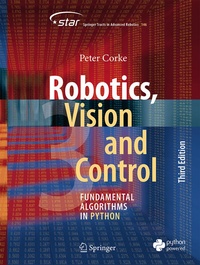
This textbook provides a comprehensive, but tutorial, introduction to robotics, computer vision, and control. It is written in a light but informative conversational style, weaving text, figures, mathematics, and lines of code into a narrative that covers robotics and computer vision-separately, and together as robotic vision. Over 1600 code examples show how complex problems can be decomposed and solved using just a few simple lines of code.
This edition is based on Python and is accompanied by fully open-source Python-based Toolboxes for robotics and machine vision. The new Toolboxes enable the reader to easily bring the algorithmic concepts into practice and work with real, non-trivial, problems on a broad range of computing platforms. For the beginning student the book makes the algorithms accessible, the Toolbox code can be read to gain understanding, and the examples illustrate how it can be used. The code can also be the starting point for new work, for practitioners, students, or researchers, by writing programs based on Toolbox functions, or modifying the Toolbox code itself.
Reviews / Votes
"The book, nearly 800 pages, has 16 chapters. ... Almost every chapter includes wrap-ups, recommendations for further reading, and exercises, and sometimes additional resources. ... There are numerous color illustrations. The book has many features, including exercises that help pedagogy. This updated third edition will be very useful for students, researchers, and professionals interested in robotics and its practical applications." (S. V. Nagaraj, Computing Reviews, March 25, 2024)
More details
Other editions
Additional editions
Person
Peter Corke is a robotics educator and researcher. He is known for his work in vision-based control and field robotics, as well as open-source robotics software and educational resources such as the QUT Robot Academy. He is a distinguished professor at the Queensland University of Technology and a technical advisor to several robotics companies. He was the Australian University Teacher of the Year in 2017 and is a fellow of the IEEE, the Australian Academy of Technology and Engineering, and the Australian Academy of Science. He received his PhD from the University of Melbourne.
