

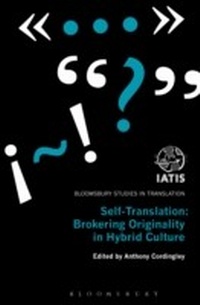
Self-Translation
Brokering Originality in Hybrid Culture
1st Edition
Published on 17. January 2013
216 pages
978-1-4411-4729-5 (ISBN)
Description

Self-Translation: Brokering originality in hybrid
culture provides critical, historical and interdisciplinary analyses of
self-translators and their works. It investigates the challenges which the
bilingual oeuvre and the experience of the self-translator pose to conventional
definitions of translation and the problematic dichotomies of "original" and
"translation", "author" and "translator". Canonical self-translators, such
Samuel Beckett, Vladimir Nabokov and Rabindranath Tagore, are here discussed in
the context of previously overlooked self-translators, from Japan to South
Africa, from the Basque Country to Scotland. This book seeks therefore to offer
a portrait of the diverse artistic and political objectives and priorities of
self-translators by investigating different cosmopolitan, post-colonial and
indigenous practices. Numerous contributions to this volume extend the scope of
self-translation to include the composition of a work out of a multilingual
consciousness or society. They demonstrate how production within hybrid
contexts requires the negotiation of different languages within the self,
generating powerful experiences, from crisis to liberation, and texts that
offer key insights into our increasingly globalized culture.
culture provides critical, historical and interdisciplinary analyses of
self-translators and their works. It investigates the challenges which the
bilingual oeuvre and the experience of the self-translator pose to conventional
definitions of translation and the problematic dichotomies of "original" and
"translation", "author" and "translator". Canonical self-translators, such
Samuel Beckett, Vladimir Nabokov and Rabindranath Tagore, are here discussed in
the context of previously overlooked self-translators, from Japan to South
Africa, from the Basque Country to Scotland. This book seeks therefore to offer
a portrait of the diverse artistic and political objectives and priorities of
self-translators by investigating different cosmopolitan, post-colonial and
indigenous practices. Numerous contributions to this volume extend the scope of
self-translation to include the composition of a work out of a multilingual
consciousness or society. They demonstrate how production within hybrid
contexts requires the negotiation of different languages within the self,
generating powerful experiences, from crisis to liberation, and texts that
offer key insights into our increasingly globalized culture.
Reviews / Votes
Original, insightful and contradictory, these essays set up a site of debate where self-translation becomes far more than a marginal oddity: it is key to the configuration of Translation Studies. Self-translation is shown to be a question not of texts, but of what happens to the subject in the overlaps of cultures: it is translation of the self, and thus of a self in translation. The marginal oddity is henceforth the assumption of an original. This book is by far the most varied and comprehensive treatment of the topic of self-translation to date. The book showcases the rich and diverse research being undertaken, as perspectives from a variety of disciplines as well as new approaches to translation scholarship are brought to bear upon the act of self-translation.More details
Series
Edition
1. Auflage
Language
English
Place of publication
New York
United States
Publishing group
Bloomsbury Publishing PLC (Digital)
Target group
College/higher education
Professional and scholarly
ISBN-13
978-1-4411-4729-5 (9781441147295)
Copyright in bibliographic data and cover images is held by Nielsen Book Services Limited or by the publishers or by their respective licensors: all rights reserved.
Schweitzer Classification
Other editions
Additional editions
Book
01/2013
Bloomsbury Academic USA
€234.00
Shipment within 15-20 days
Book
01/2013
Bloomsbury Academic USA
€71.50
Shipment within 15-20 days
Person
Content
Notes on Contributors \ Introduction Anthony Cordingley \ Part
I. Self-translation and Literary History \ 1. The Self-Translator as
Rewriter Susan Bassnett \ 2.
On Mirrors, Dynamics & Self-Translations J.C. Santoyo \ 3. History and self-translation Jan Hokenson \ Part II. Interdisciplinary
Perspectives: Sociology, Psychoanalysis, Philosophy \ 4. A Sociological
Glance at Self-Translation and Self-Translators Rainier Grutman \ 5. The Passion of
Self-Translation: A Masocritical Perspective Anthony Cordingley \ 6. Translating Philosophy: Vilem
Flusser's Practice of Multiple Self-Translation Rainer Guldin \ Part III.Post-colonial
Perspectives \ 7. Translated otherness, self-translated in-betweenness: Hybridity as medium versus hybridity
as object in Anglophone African writing Susanne Klinger \ 8.'Why bother with the original?': Self-translation
and Scottish Gaelic poetry Corinna
Krause \ 9. Indigenization
and Opacity: Self-translation in the Okinawan/Ryukyuan writings of Takara Ben
and Medoruma Shun Mark Gibeau \ Part IV. Cosmopolitan Identities/Texts \ 10.Self-translation,
Self-reflection, Self-derision: Samuel Beckett's Bilingual Humour Will Noonan 11. Writing in Translation: A
New Self in a Second Language Elin-Maria Evangelista \ 12.Between
languages: metalinguistic elements in fiction and multilingual self-dialogue Aurelia Klimkiewicz \ Bibliography Index
I. Self-translation and Literary History \ 1. The Self-Translator as
Rewriter Susan Bassnett \ 2.
On Mirrors, Dynamics & Self-Translations J.C. Santoyo \ 3. History and self-translation Jan Hokenson \ Part II. Interdisciplinary
Perspectives: Sociology, Psychoanalysis, Philosophy \ 4. A Sociological
Glance at Self-Translation and Self-Translators Rainier Grutman \ 5. The Passion of
Self-Translation: A Masocritical Perspective Anthony Cordingley \ 6. Translating Philosophy: Vilem
Flusser's Practice of Multiple Self-Translation Rainer Guldin \ Part III.Post-colonial
Perspectives \ 7. Translated otherness, self-translated in-betweenness: Hybridity as medium versus hybridity
as object in Anglophone African writing Susanne Klinger \ 8.'Why bother with the original?': Self-translation
and Scottish Gaelic poetry Corinna
Krause \ 9. Indigenization
and Opacity: Self-translation in the Okinawan/Ryukyuan writings of Takara Ben
and Medoruma Shun Mark Gibeau \ Part IV. Cosmopolitan Identities/Texts \ 10.Self-translation,
Self-reflection, Self-derision: Samuel Beckett's Bilingual Humour Will Noonan 11. Writing in Translation: A
New Self in a Second Language Elin-Maria Evangelista \ 12.Between
languages: metalinguistic elements in fiction and multilingual self-dialogue Aurelia Klimkiewicz \ Bibliography Index
