

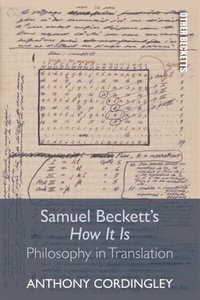
Samuel Beckett's How It Is
Description

The first sustained exegesis of a neglected masterpiece of twentieth-century literature, Samuel Beckett's How It Is
- Offers the first comprehensive treatment of Beckett's most poorly understood novel, identifying the breadth of its philosophical and literary sources
- Makes extensive use of manuscript evidence and newly accessible notes from Beckett's reading in philosophy
- Guides the reader through Beckett's philosophical and theological sources, highlighting his innovative and original dialectics between the pre-Socratics, Plato, Aristotle, the Ancient Stoics, the early Church Fathers and desert mystics, seventeenth-century mystics and Rationalists
This book maps out the novel's complex network of intertexts, sources and echoes, interprets its highly experimental writing and explains the work's great significance for twentieth-century literature. It offers a clear pathway into this remarkable bilingual novel, identifying Beckett's use of previously unknown sources in the history of Western philosophy, from the ancient and modern periods, and challenging critical orthodoxies. Through careful archival scholarship and attention to the dynamics of self-translation, the book traces Beckett's transformation of his narrator's 'ancient voice', his intellectual heritage, into a mode of aesthetic representation that offers the means to think beyond intractable paradoxes of philosophy. This shift in the work's relation to tradition marks a hiatus in literary modernism, a watershed moment whose deep and enduring significance may now be appreciated.
More details
Other editions
Additional editions
Content
- Intro
- List of Illustrations
- Series Editor's Preface
- List of Abbreviations
- Introduction
- 1 A Poetics of Translation: Dante, Goethe and the Paideia
- 2 Pythagorean Mysticism / Democritean Wisdom
- 3 The Physical Cosmos: Aristotelian Dialectics
- 4 From the Cradle to the Cave: A Comedy of Ethics from Plato to Christian Asceticism (via Rembrandt)
- 5 Mystic Paths, Inward Turns
- 6 Pascal's Miraculous Tongue
- 7 Spinoza, Leibniz or a World 'less exquisitely organized'
- Acknowledgements
- Bibliography
- Index
