

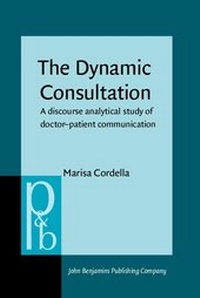
The Dynamic Consultation
A discourse analytical study of doctor-patient communication
1st Edition
Published on 13. October 2004
XVI, 254 pages
978-90-272-9518-7 (ISBN)
Description

This book introduces a unique model of medical discourse that identifies the forms of talk - voices - that doctors and patients use during the consultation, and studies the dynamic interaction as it unfolds particularly in follow-up visits. Natural recordings, semi-structured interviews, questionnaires and ethnographic observations provide the data for the research, which was carried out in an Outpatient Clinic in Santiago, Chile. Using an interactional sociolinguistic approach, analysis of the data identifies doctor-patient communication as a micro-performance of broader socio-cultural realities, in which social status, power, knowledge and personal beliefs and values all find expression in the consultative setting. Importantly, while both doctor and patient voices are shown to contribute to an essentially asymmetrical exchange, the study also identifies the holistic and empathic Fellow Human voice, which places doctors and patients on a more equal footing. In connection with this voice, the Spanish concept of simpatía is also discussed.While the model in this study was developed within a specific socio-cultural framework, it is hoped that it will be adapted and modified more widely and contribute to a better understanding between doctors and their patients.
More details
Other editions
Additional editions
Marisa Cordella
The Dynamic Consultation
A discourse analytical study of doctor-patient communication
Book
10/2004
John Benjamins Publishing Co
€104.94
Shipment within 10-15 days
Person
Content
- The Dynamic Consultation
- Editorial page
- Title page
- LCC page
- Dedication page
- Table of contents
- Preface
- Note
- References
- Acknowledgments
- 1. Introduction
- 2. Discourse, society and doctor-patient communication
- 2.1. A multi-disciplinary approach: Interactional socio-linguistics
- 2.1.1. Footing
- 2.2. Power, society and discourse
- 2.2.1. Discourse, power and simpatía
- 2.3. Everyday and institutional talk
- 2.4. Micro and macro realities of a socio-cultural group
- 2.5. Bio-medical and socio-relational approaches to doctor-patient communication
- 2.6. Doctor-patient communication: The medical and linguistic perspectives
- 2.6.1. Medical approaches to doctor-patient communication
- 2.6.2. Linguistic approaches: The doctor's perspective
- 2.6.3. Linguistic approaches: The patient's perspective
- 2.7. Sociological factors and doctor-patient communication
- 2.8. Conclusion
- Note
- 3. Doctor-patient communication
- 3.1. Discourse analysis: Interactional socio-linguistics and ethnographic approaches
- 3.2. Research design
- 3.3. Research questions
- 3.4. The Chilean health care system
- 3.5. The research site: The PUC Outpatient Clinic
- 3.5.1. The consultation room at PUC
- 3.6. Permissions
- 3.7. Stage I: Observation
- 3.8. Stage II: Questionnaire
- 3.9. Stage III: Semi-structured interview
- 3.10. Stage IV: Tape-recording of the medical consultation
- 3.11. The participants
- 3.11.1. The researcher
- 3.11.2. The doctors
- 3.11.3. The patients
- 3.12. Data analysis
- 3.13. The volume of data
- 3.14. Voices in doctor-patient communication
- 3.14.1. Analysis of doctors' voices
- 3.14.2. Analysis of patients' voices
- 3.14.3. Limitations to the number of voices
- 3.15. Ethical issues
- Notes
- 4. The Doctor voice
- 4.1. Seeking information
- 4.2. Assessment and review
- 4.3. Alignment to authority
- 4.4. Summary
- 4.5. Conclusion
- Note
- 5. The Educator voice
- 5.1. Communicating medical facts
- 5.1.1. Information regarding available test results
- 5.1.2. Information regarding proposed tests
- 5.1.3. Information regarding the functioning of the human body
- 5.2. Responding to patient discomfort
- 5.3. Summary
- 5.4. Communicating medical treatment and management
- 5.4.1. Spanish markers of inevitability
- 5.4.2. Spanish markers of conditional inevitability
- 5.4.3. The impersonal pronoun
- 5.4.4. Persuasive education
- 5.5. Summary
- 5.6. Statistical findings
- 5.7. Absence of the Educator voice
- 5.8. Conclusion
- 6. The Fellow Human voice
- 6.1. Facilitating the telling of patients' stories
- 6.2. Assisting the telling of patients' stories
- 6.2.1. Utterance extension
- 6.2.2. Predictable utterance completion
- 6.2.3. Helpful utterance completion
- 6.3. Creating empathy with the patient
- 6.3.1. Agreement discourse markers
- 6.3.2. Emotional reciprocity
- 6.4. Showing special attentiveness to patients' stories
- 6.4.1. Mirroring
- 6.4.2. Clarifying a previous utterance
- 6.5. Asking questions unrelated to the patient's health
- 6.6. Statistical findings
- 6.7. Conclusion
- Notes
- 7. Patients' voices
- 7.1. Introduction
- 7.2. The voice of Health-related storytelling
- 7.3. The voice of Competence
- 7.3.1. The Complier
- 7.3.2. The Apologizer
- 7.3.3. The Challenger
- 7.4. The voice of Social Communicator
- 7.5. The voice of Initiator
- 7.6. Statistical findings
- 7.7. Results of Stage III: Semi-structured interview
- 7.8. Conclusion
- Note
- 8. Patterns of footing
- 9. The Dynamic Consultation
- 9.1. Doctors' and patients' talk: Animator, author, principal
- 9.1.1. Doctor voice and Educator voice
- 9.1.2. Fellow Human voice
- 9.1.3. The voices of patients' stories
- 9.2. Asymmetry, power and the use of voices
- 9.2.1. Asymmetry in the institution
- 9.2.2. Asymmetrical questioning
- 9.2.3. Asymmetrical disapproval
- 9.2.4. Asymmetrical knowledge
- 9.3. Knowledge, power and simpatía
- 9.4. Affiliative discourse and simpatía
- 9.5. One consultation, two participants: An interactional work
- 9.6. Competence in the medical setting
- 9.7. A dynamic model of doctor-patient communication
- Note
- 10. Concluding remarks
- Bibliography
- Appendices
- Appendix 1
- Aproximate total word count of doctors and patients
- Appendix 2a (English version)
- PATIENT QUESTIONNAIRE
- Appendix 2b (Spanish version)
- CUESTIONARIO PARA EL PACIENTE
- Appendix 3a (English version)
- DOCTOR QUESTIONNAIRE
- Appendix 3b (Spanish version)
- CUESTIONARIO PARA EL MEDICO
- Appendix 4
- Symbols used in discourse transcriptions
- Appendix 5a (English version)
- EXPLANATORY STATEMENT FOR PATIENT AND DOCTOR
- Appendix 5b (Spanish version)
- DECLARACIÓN ACLARATORIA PARA PACIENTE Y MEDICO
- Appendix 6a (English version)
- CONSENT FORM
- Appendix 6b (Spanish version)
- CONSENTIMIENTO
- Index
