

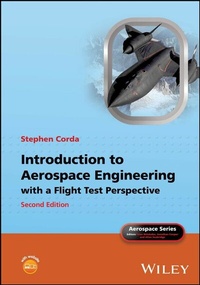
Introduction to Aerospace Engineering with a Flight Test Perspective
Description

Comprehensive textbook integrating the fundamentals of flight testing with introductory concepts in aerospace engineering
Introduction to Aerospace Engineering with a Flight Test Perspective provides a solid foundation in the fundamentals of aerospace engineering while illuminating many aspects of real-world flight, covering topics such as aerodynamics, propulsion, performance, and stability and control. End-of-chapter problems are included along with a solutions manual for instructors.
The Second Edition includes two new chapters, one providing a timely introduction to hypersonics and the other introducing the fundamentals of spaceflight.
Introduction to Aerospace Engineering with a Flight Test Perspective discusses topics including:
- Historical perspectives of the first flights of airplanes, rotorcraft, and spacecraft
- Introductory concepts of airplanes, rotorcraft, unmanned aerial vehicles, and lighter-than-air vehicles
- Placement of the reader in the aircraft cockpit to fly and learn the basics of flight test
- Fundamentals of subsonic, transonic, supersonic, and hypersonic flight, with explanations of the theories of lift and the generation of drag
- Types of non-airbreathing rocket propulsion, including liquid propellant rocket engines and solid rocket motors, as well as air-breathing propulsion, including propeller-driven and jet engines
- Concepts of aircraft performance in cruising, climbing, gliding, and turning flight
- Longitudinal and lateral-directional stability and control
- An introduction to hypersonic vehicles, aero-thermodynamics, and propulsion
- Orbital mechanics, covering Kepler's laws, the two-body problem, types of trajectories and orbits, and atmospheric entry
Introduction to Aerospace Engineering with a Flight Test Perspective is an excellent accompaniment to any introductory course in aerospace engineering taught at civilian universities, military academies, and test pilot schools. The text may also be used in more advanced courses in flight testing, aerodynamics, performance, and design.
More details
Other editions
Additional editions
Person
Stephen Corda has over 40 years of experience in hypersonics, aerospace vehicle design, and experimental flight testing. He has held engineering, academic, management, and flight test positions at The Johns Hopkins University Applied Physics Laboratory, the NASA Dryden (now Armstrong) Flight Research Center, the U.S. Air Force Test Pilot School, the U.S. Naval Academy, the University of Tennessee Space Institute, The Spaceship Company, Stratolaunch, and the Lawrence Livermore National Laboratory.
Content
About the Author xix
Series Preface xxi
Preface to the Second Edition xxiii
About the Companion Website xxv
1 First Flights 1
2 Introductory Concepts 31
3 Foundations of Aerodynamics 117
4 Airfoils and Wings 197
5 Supersonic Flight 309
6 Propulsion 379
7 Performance 477
8 Stability and Control 599
9 Hypersonic Flight 707
10 Spaceflight 781
Appendix 851
A Constants 851
B Conversions 852
C Properties of the 1976 US Standard Atmosphere 853
Index 857
