

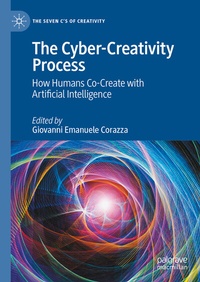
The Cyber-Creativity Process
Description

This edited book explores the process of creating using the seven C's of creativity framework. It discusses the creative process as a collaboration between humans and Artificial Intelligence (AI), here identified as the cyber-creativity process. Through nine chapters written by leading scholars in the field, this collection delves into the rapidly emerging area of Generative-AI (Gen-AI) applications and sheds light on the parts of the creative process that will remain fundamentally human throughout the foreseeable future, as well as those that will benefit more from AI-augmentation.
Drawing on the dynamic definition of creativity, the contents encompass the Dynamic Universal Creative Process (DUCP) and the DA VINCI model, the design principles of Gen-AI algorithms, the cyber-creativity process in education, journalism, design, fashion, music, and its implications on intellectual property protection.
A timely reflection on the complex and evolving relation between creativity and technology, this volume will interest academics, researchers, and students alike across humanities, social and hard sciences.
More details
Other editions
Additional editions
Person
Giovanni Emanuele Corazza is Full Professor at the Alma Mater Studiorum University of Bologna, Italy, founder of the Marconi Institute for Creativity (MIC), and Member of the Board of the International Society for the Study of Creativity and Innovation (ISSCI). His interdisciplinary research interests intersect the fields of creativity, anticipation, and ethical technological transitions.
Content
1. The Cyber-Creative DA VINCI Process.- 2. The Design Principles of Gen-AI Algorithms.- 3. A Principled Approach to Human Creativity x AI in Education.- 4. Pivoting to Land Co-Creative AI Tools in Newsrooms.- 5. The Three Waves Paradigm: Tracing the Evolution of Artificial Intelligence in Design.- 6. The Transformative Influence of Artificial Intelligence on the Fashion Industry.- 7. Co-creating Music with Machines: Some Possibilities.- 8. Human, All Too Human: A Philosophical Investigation on Intellectual Property Rights for AI-based Creativity.- 9. Conclusion: Looking Back from 2100.
