

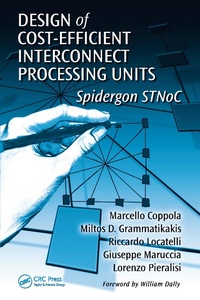
Design of Cost-Efficient Interconnect Processing Units
Spidergon STNoC
1st Edition
Published on 14. October 2020
288 pages
978-1-351-83582-4 (ISBN)
Description

Streamlined Design Solutions Specifically for NoC
To solve critical network-on-chip (NoC) architecture and design problems related to structure, performance and modularity, engineers generally rely on guidance from the abundance of literature about better-understood system-level interconnection networks. However, on-chip networks present several distinct challenges that require novel and specialized solutions not found in the tried-and-true system-level techniques.
A Balanced Analysis of NoC Architecture
As the first detailed description of the commercial Spidergon STNoC architecture, Design of Cost-Efficient Interconnect Processing Units: Spidergon STNoC examines the highly regarded, cost-cutting technology that is set to replace well-known shared bus architectures, such as STBus, for demanding multiprocessor system-on-chip (SoC) applications. Employing a balanced, well-organized structure, simple teaching methods, numerous illustrations, and easy-to-understand examples, the authors explain:
how the SoC and NoC technology works
why developers designed it the way they did
the system-level design methodology and tools used to configure the Spidergon STNoC architecture
differences in cost structure between NoCs and system-level networks
From professionals in computer sciences, electrical engineering, and other related fields, to semiconductor vendors and investors - all readers will appreciate the encyclopedic treatment of background NoC information ranging from CMPs to the basics of interconnection networks. The text introduces innovative system-level design methodology and tools for efficient design space exploration and topology selection. It also provides a wealth of key theoretical and practical MPSoC and NoC topics, such as technological deep sub-micron effects, homogeneous and heterogeneous processor architectures, multicore SoC, interconnect processing units, generic NoC components, and embeddings of common communication patterns.
To solve critical network-on-chip (NoC) architecture and design problems related to structure, performance and modularity, engineers generally rely on guidance from the abundance of literature about better-understood system-level interconnection networks. However, on-chip networks present several distinct challenges that require novel and specialized solutions not found in the tried-and-true system-level techniques.
A Balanced Analysis of NoC Architecture
As the first detailed description of the commercial Spidergon STNoC architecture, Design of Cost-Efficient Interconnect Processing Units: Spidergon STNoC examines the highly regarded, cost-cutting technology that is set to replace well-known shared bus architectures, such as STBus, for demanding multiprocessor system-on-chip (SoC) applications. Employing a balanced, well-organized structure, simple teaching methods, numerous illustrations, and easy-to-understand examples, the authors explain:
how the SoC and NoC technology works
why developers designed it the way they did
the system-level design methodology and tools used to configure the Spidergon STNoC architecture
differences in cost structure between NoCs and system-level networks
From professionals in computer sciences, electrical engineering, and other related fields, to semiconductor vendors and investors - all readers will appreciate the encyclopedic treatment of background NoC information ranging from CMPs to the basics of interconnection networks. The text introduces innovative system-level design methodology and tools for efficient design space exploration and topology selection. It also provides a wealth of key theoretical and practical MPSoC and NoC topics, such as technological deep sub-micron effects, homogeneous and heterogeneous processor architectures, multicore SoC, interconnect processing units, generic NoC components, and embeddings of common communication patterns.
More details
Series
Edition
1. Auflage
Language
English
Place of publication
London
United Kingdom
Publishing group
Taylor & Francis Ltd
Target group
Professional and scholarly
Product notice
Reflowable
Illustrations
86 Illustrations, black and white
ISBN-13
978-1-351-83582-4 (9781351835824)
Copyright in bibliographic data and cover images is held by Nielsen Book Services Limited or by the publishers or by their respective licensors: all rights reserved.
Schweitzer Classification
Other editions
Additional editions
Marcello Coppola | Miltos D. Grammatikakis | Riccardo Locatelli
Design of Cost-Efficient Interconnect Processing Units
Spidergon STNoC
Book
09/2008
1st Edition
CRC Press
€193.13
Shipment within 15-20 days
Persons
Marcello Coppola (STMicroelectronics, Grenoble, France) (Author) , Miltos D. Grammatikakis (ISD SA, Heraklion, Greece) (Author) , Riccardo Locatelli (STMicroelectronics, Grenoble Cedex, France) (Author) , Giuseppe Maruccia (STMicroelectronics, Grenoble, France) (Author) , Lorenzo Pieralisi (STMicroelectronics, Grenoble, France) (Author)
Content
Towards Multicores: Technology and Software Complexity. On-Chip Bus vs Network-on-Chip. NoC Topology. The Spidergon STNoC. SoC and NoC Design Methodology and Tools. Conclusions and Future Work.
