

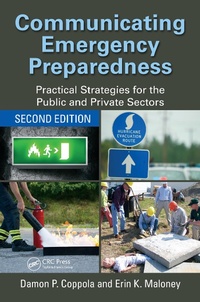
Communicating Emergency Preparedness
Practical Strategies for the Public and Private Sectors, Second Edition
2nd Edition
Published on 28. April 2017
278 pages
978-1-351-76187-1 (ISBN)
Description

This fully revised edition of Communicating Emergency Preparedness: Practical Strategies for the Public and Private Sectors includes timely case studies, events, and references to articles and opinions about the direction of emergency preparedness communication. The authors draw upon their professional endeavors to inject a new sense of practicality to the text. New images displaying emergency preparedness campaigns are used to further illustrate the materials being presented. For instructors and practitioners alike, this book continues to provide the how-to instruction that is often required, and will only improve upon the success of the first edition in doing so.
Reviews / Votes
'Doing individual and community disaster preparedness can be hard work -- those who think it isn't that hard would probably be surprised at how ineffective their efforts were if effectiveness evaluations were done. Frequently trying to get the biggest bang for the buck (such as sending fliers out to everyone -- which most people do not read) is at odds with trying to really get to those in a community who are the most at risk and most vulnerable and working with them to find realistic ways of increasing preparedness and decreasing vulnerability. This is where Coppola and Maloney's book on Communicating Emergency Preparedness is invaluable. This book shows how social science research and Madison Avenue advertising and marketing savvy can be brought together to engage in truly effective efforts to get people to do the hard thing -- change behavior and adopt more of a disaster preparedness mind-set that could some day be helpful in an emergency, if not save their lives. If you would like to see your community better prepared for disaster then this is a book you should read.' - Dr. B. Wayne Blanchard, retired manager of the FEMA Emergency Management Higher Education Program'Damon P. Coppola and Erin K. Maloney identify and respond to the barriers that hinder efforts to improve individual and community resilience. They build on the results of risk communication and risk perception research to create effective messaging goals, tools and techniques. The result is a book grounded in theory that provides a practical, structured approach to planning and implementing a disaster resilience and preparedness campaign." - Dr. John R. Harrald, Virginia Tech Global Forum for Urban and Regional Resilience and The George Washington University 'Doing individual and community disaster preparedness can be hard work -- those who think it isn't that hard would probably be surprised at how ineffective their efforts were if effectiveness evaluations were done. Frequently trying to get the biggest bang for the buck (such as sending fliers out to everyone -- which most people do not read) is at odds with trying to really get to those in a community who are the most at risk and most vulnerable and working with them to find realistic ways of increasing preparedness and decreasing vulnerability. This is where Coppola and Maloney's book on Communicating Emergency Preparedness is invaluable. This book shows how social science research and Madison Avenue advertising and marketing savvy can be brought together to engage in truly effective efforts to get people to do the hard thing -- change behavior and adopt more of a disaster preparedness mind-set that could some day be helpful in an emergency, if not save their lives. If you would like to see your community better prepared for disaster then this is a book you should read.' - Dr. B. Wayne Blanchard, retired manager of the FEMA Emergency Management Higher Education Program
'Damon P. Coppola and Erin K. Maloney identify and respond to the barriers that hinder efforts to improve individual and community resilience. They build on the results of risk communication and risk perception research to create effective messaging goals, tools and techniques. The result is a book grounded in theory that provides a practical, structured approach to planning and implementing a disaster resilience and preparedness campaign." - Dr. John R. Harrald, Virginia Tech Global Forum for Urban and Regional Resilience and The George Washington University
'For instructors and practitioners alike, this new and expanded edition of "Communicating Emergency Preparedness" continues to provide the 'real world practical' how-to instruction that is often required, and will only improve upon the success of the first edition in doing so.' - James A. Cox, Editor-in-Chief, Midwest Book Review
More details
Edition
2nd edition
Language
English
Place of publication
London
United Kingdom
Publishing group
Taylor & Francis Ltd
Target group
Professional and scholarly
Product notice
Reflowable
Illustrations
25 s/w Abbildungen, 2 s/w Tabellen
2 Tables, black and white; 25 Illustrations, black and white
File size
6,13 MB
ISBN-13
978-1-351-76187-1 (9781351761871)
Copyright in bibliographic data and cover images is held by Nielsen Book Services Limited or by the publishers or by their respective licensors: all rights reserved.
Schweitzer Classification
Other editions
Additional editions
Damon P. Coppola | Erin K. Maloney
Communicating Emergency Preparedness
Practical Strategies for the Public and Private Sectors, Second Edition
Book
04/2017
2nd Edition
Routledge
€232.00
Shipment within 10-20 days
Damon P. Coppola | Erin K. Maloney
Communicating Emergency Preparedness
Practical Strategies for the Public and Private Sectors, Second Edition
Book
04/2017
2nd Edition
Routledge
€95.90
Shipment within 15-20 days
Persons
Damon P. Coppola is author of several emergency management academic and professional texts, including Introduction to International Disaster Management, Introduction to Homeland Security, and Introduction to Emergency Management. He is also co-author of several FEMA Emergency Management Institute Higher Education Courses, including Crisis and Risk Communications and Hazards Risk Management. As Partner with the Washington, DC-based emergency management consulting firm Bullock & Haddow, LLC, Mr. Coppola has planned, designed, and conducted large-scale disaster preparedness campaigns for governments at the local, national, and international levels, for private corporations, and for organizations in the nonprofit sector.
Erin K. Maloney is a director of research in the FDA-funded Tobacco Center of Regulatory Science (TCORS) at the University of Pennsylvania, and an adjunct instructor in the Department of Communication Studies at West Chester University in Pennsylvania and the Milken Institute School of Public Health at the George Washington University. Through her work in the TCORS, her postdoctoral research fellowship at Memorial Sloan-Kettering Cancer Center's Department of Psychiatry and Behavioral Science, and her graduate work, she consulted on and participated in the design, implementation, and evaluation of a variety of health and environmental interventions at both the community and organizational levels. Her work has applied communication principles across a wide variety of disciplines, and has been published in prestigious peer-reviewed journals, including Journal of Applied Social Psychology, Human Communication Research, Health Communication, Palliative and Supportive Care, and Radiology.
Erin K. Maloney is a director of research in the FDA-funded Tobacco Center of Regulatory Science (TCORS) at the University of Pennsylvania, and an adjunct instructor in the Department of Communication Studies at West Chester University in Pennsylvania and the Milken Institute School of Public Health at the George Washington University. Through her work in the TCORS, her postdoctoral research fellowship at Memorial Sloan-Kettering Cancer Center's Department of Psychiatry and Behavioral Science, and her graduate work, she consulted on and participated in the design, implementation, and evaluation of a variety of health and environmental interventions at both the community and organizational levels. Her work has applied communication principles across a wide variety of disciplines, and has been published in prestigious peer-reviewed journals, including Journal of Applied Social Psychology, Human Communication Research, Health Communication, Palliative and Supportive Care, and Radiology.
Content
Table of Contents
Acknowledgements
Introduction
Chapter 1: individual Preparedness: In Theory and In Practice
Chapter 2: Managing Risk, Emergencies, and Disasters
Chapter 3: The Campaign - Step 1: Early Planning
Chapter 4: Step 2- Develop a Campaign Strategy
Chapter 5: Campaign Implementation and Evaluation
Chapter 6: Program Support
Chapter 7: Emergency Management Public Education Case Studies
Acknowledgements
Introduction
Chapter 1: individual Preparedness: In Theory and In Practice
Chapter 2: Managing Risk, Emergencies, and Disasters
Chapter 3: The Campaign - Step 1: Early Planning
Chapter 4: Step 2- Develop a Campaign Strategy
Chapter 5: Campaign Implementation and Evaluation
Chapter 6: Program Support
Chapter 7: Emergency Management Public Education Case Studies
