

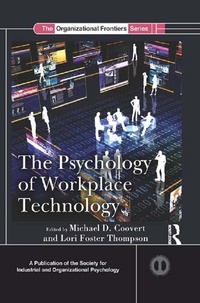
The Psychology of Workplace Technology
1st Edition
Published on 24. July 2013
360 pages
978-1-135-00766-9 (ISBN)
Description

Recent advances in technology have dramatically altered the manner in which organizations function, transforming the way people think about and perform their work. The implications of these trends continue to evolve as emerging innovations adapt to and are adapted by organizations, workers, and other components of the socio-technical systems in which they are embedded. A rigorous consideration of these implications is needed to understand, manage, and drive the reciprocal interplay between technology and the workplace. This edited volume brings together top scholars within and outside of the field of industrial and organizational (I-O) psychology to explore the psychological and organizational effects of contemporary workplace technologies. A special section is included at the end of the book by four experts in the field entitled Reflections and Future Directions.
Reviews / Votes
"Editors Coovert (Univ. of South Florida) and Thompson (North Carolina State Univ.) have compiled a timely collection on the psychological ramifications of technology in the workplace. ... This volume is unique in coverage and will interest anyone concerned with the implications of technology in the workplace. Summing Up: Recommended." - G.E. Kaupins, Boise State Unversity, in CHOICE, January 2014"Writing will create forgetfulness in the learners' souls, because they will not use their memories; they will trust to the external written characters and not remember of themselves....They will appear to be omniscient and will generally know nothing." Thus argued Socrates, as reported in Phaedrus (Plato, 370 BCE). New technology always provokes controversy. There is much to do. It's time for us not only to trust the external written characters but also, as is done here, to keep investigating the human dimensions and impacts of the tools we use." -- Milton D. Hakel, Ph.D., Bowling Green State University
"Technology is an ubiquitous force driving the nature of work and organizational behavior, yet, with few exceptions, it has had a remarkably stealthy presence in industrial and organizational psychology for far too long. This book, with its exceptional array of topics and leading authors, is long overdo. It examines the broad sweep of technology applications and impacts -- current and future -- that shape behavior in the workplace. It is highly recommended."--Steve W.J. Kozlowski, Professor of Organizational Psychology, Michigan State University
"Coovert and Thompson have assembled an outstanding list of authors in this edited volume who have discussed how technology for better or worse affects the workplace and how I/O psychologists can use technology-based tools to enhance tools selection, training, performance management, teamwork, and leadership development. In addition, the authors have pointed out the potential pitfalls and ways to avoid them. In light of continuous technological improvements, this volume includes chapters on topics on which technology is just beginning to impinge - virtual teams, work place monitoring, employee stress, health, and well-being as well as chapters that focus on what the future is likely to bring. This book is important reading for anyone who practices I/O psychology using technology in the workplace." -- Nancy T. Tippins, Ph.D., Valtera Corporation
More details
Series
Language
English
Place of publication
London
United Kingdom
Publishing group
Taylor & Francis Ltd
Target group
College/higher education
Product notice
Reflowable
Illustrations
4 s/w Abbildungen, 3 s/w Tabellen, 4 s/w Photographien bzw. Rasterbilder
3 Tables, black and white; 4 Halftones, black and white; 4 Illustrations, black and white
File size
3,05 MB
ISBN-13
978-1-135-00766-9 (9781135007669)
Copyright in bibliographic data and cover images is held by Nielsen Book Services Limited or by the publishers or by their respective licensors: all rights reserved.
Schweitzer Classification
Other editions
Additional editions
Michael D. Coovert | Lori Foster Thompson
The Psychology of Workplace Technology
Book
05/2014
1st Edition
Routledge
€89.37
Shipment within 10-20 days
Michael D. Coovert | Lori Foster Thompson
The Psychology of Workplace Technology
Book
07/2013
1st Edition
Routledge
€215.41
Article not available at the moment
Persons
Michael D. Coovert joined the industrial-organizational psychology faculty at the University of South Florida (USF)and founded the Center for Psychology and Technology. His research includes human-systems integration, the impact of technology on individuals and organizations, quantitative methods, and performance measurement. Dr. Coovert has over 100 scientific publications, 175 presentations, and has directed 40 funded projects. He has received the Presidential Excellence Award from USF and also received the university's Jerome Kirvanik Distinguished Teacher Award given once a year to its outstanding teacher. As an aviation enthusiast and pilot, Dr. Coovert can often be found in the sky.
Lori Foster Thompson is a professor of psychology at North Carolina State University, where she leads the IOTech4D lab devoted to research at the intersection of work, psychology, technology, and global development. Her scholarship focuses on how technology and industrial-organizational psychology can together enrich and improve work carried out for, with, and by people in lower-income settings, for the purpose of addressing the most pressing economic, social, and environmental challenges facing our world today. In 2010, she was appointed an EU Erasmus Mundus Scholar in Humanitarian Work Psychology. She has been inducted into North Carolina State University's Academy of Outstanding Teachers and in 2012 was named one of the university's 24 inaugural University Faculty Scholars.
Besides this book, Lori has edited a new book from Routledge (2013) with Julie Olson-Buchanan and Laura Koppes Bryan entitled Using Industrial-Organizational Psychology for the Greater Good.
Lori Foster Thompson is a professor of psychology at North Carolina State University, where she leads the IOTech4D lab devoted to research at the intersection of work, psychology, technology, and global development. Her scholarship focuses on how technology and industrial-organizational psychology can together enrich and improve work carried out for, with, and by people in lower-income settings, for the purpose of addressing the most pressing economic, social, and environmental challenges facing our world today. In 2010, she was appointed an EU Erasmus Mundus Scholar in Humanitarian Work Psychology. She has been inducted into North Carolina State University's Academy of Outstanding Teachers and in 2012 was named one of the university's 24 inaugural University Faculty Scholars.
Besides this book, Lori has edited a new book from Routledge (2013) with Julie Olson-Buchanan and Laura Koppes Bryan entitled Using Industrial-Organizational Psychology for the Greater Good.
Content
Series Foreword Eduardo Salas, University of Central Florida Chapter 1: Introduction: Toward a Synergistic Relationship between Psychology and Technology Michael D. Coovert and Lori Foster ThompsonSection I: Traditional Topics Chapter 2: Technology-Based Selection Alan D. Mead, Julie B. Olson-Buchanan, and Fritz Drasgow Chapter 3: Advances in Training Technology: Meeting the Workplace Challenges of Talent Development, Deep Specialization, and Collaborative Learning J. Kevin Ford and Tyler Meyer Chapter 4: Technology and Performance Appraisal James L. Farr, Joshua Fairchild, and Scott E. Cassidy Chapter 5: Teams and Technology Jonathan Miles and John R. Hollenbeck Chapter 6: Leadership and Technology: A Love-Hate Relationship Denise Potosky and Michael W. LomaxSection II: Human Factors Chapter 7: Human Factors Peter. A. Hancock Chapter 8: Usability Science II: Measurement Douglas J. Gillan and Randolph G. Bias Section III: Emerging Areas Chapter 9: Robots: The New Teammates Elizabeth S. Redden, Linda R. Elliott, and Michael J. Barnes Chapter 10: Workplace Monitoring and Surveillance Research Since '1984': A Review Agenda Bradley J. Alge and S. Duane Hansen Chapter 11: The Impact of Technology on Employee Stress, Health, and Well-Being Ashley E. Nixon and Paul E. Spector Chapter 12: Global Development through the Psychology of Workplace Technology Tara S. Behrend, Alexander E. Gloss, and Lori Foster Thompson Chapter 13: Online Social Media in the Workplace: A Conversation with Employees Richard N. Landers and Andrea S. GoldbergSection IV: Reflections and Future Directions Section Introduction Michael D. Coovert and Lori Foster Thompson Chapter 14: Looking Back, Looking Forward: Technology in the Workplace Wayne F. Cascio Chapter 15: Reflections on Technology and the Changing Nature of Work Ann Howard Chapter 16: Intersections between Technology and I-O Psychology Walter C. Borman
