

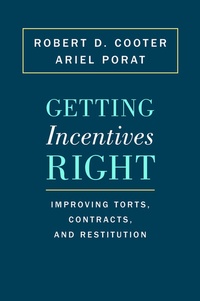
Getting Incentives Right
Improving Torts, Contracts, and Restitution
1st Edition
Published on 16. June 2015
240 pages
978-1-4008-5039-6 (ISBN)
Description

How tort, contract, and restitution law can be reformed to better serve the social good
Lawyers, judges, and scholars have long debated whether incentives in tort, contract, and restitution law effectively promote the welfare of society. If these incentives were ideal, tort law would reduce the cost and frequency of accidents, contract law would lubricate transactions, and restitution law would encourage people to benefit others. Unfortunately, the incentives in these laws lead to too many injuries, too little contractual cooperation, and too few unrequested benefits. Getting Incentives Right explains how law might better serve the social good.
In tort law, Robert Cooter and Ariel Porat propose that all foreseeable risks should be included when setting standards of care and awarding damages. Failure to do so causes accidents that better legal incentives would avoid. In contract law, they show that making a promise often causes the person who receives it to change behavior and undermine the cooperation between the parties. They recommend several solutions, including a novel contract called "anti-insurance." In restitution law, people who convey unrequested benefits to others are seldom entitled to compensation. Restitution law should compensate them more than it currently does, so that they will provide more unrequested benefits. In these three areas of law, Getting Incentives Right demonstrates that better law can promote the well-being of people by providing better incentives for the private regulation of conduct.
Lawyers, judges, and scholars have long debated whether incentives in tort, contract, and restitution law effectively promote the welfare of society. If these incentives were ideal, tort law would reduce the cost and frequency of accidents, contract law would lubricate transactions, and restitution law would encourage people to benefit others. Unfortunately, the incentives in these laws lead to too many injuries, too little contractual cooperation, and too few unrequested benefits. Getting Incentives Right explains how law might better serve the social good.
In tort law, Robert Cooter and Ariel Porat propose that all foreseeable risks should be included when setting standards of care and awarding damages. Failure to do so causes accidents that better legal incentives would avoid. In contract law, they show that making a promise often causes the person who receives it to change behavior and undermine the cooperation between the parties. They recommend several solutions, including a novel contract called "anti-insurance." In restitution law, people who convey unrequested benefits to others are seldom entitled to compensation. Restitution law should compensate them more than it currently does, so that they will provide more unrequested benefits. In these three areas of law, Getting Incentives Right demonstrates that better law can promote the well-being of people by providing better incentives for the private regulation of conduct.
All prices
More details
Edition
Course Book
Language
English
Place of publication
Princeton, NJ
United States
Publishing group
De Gruyter
Target group
Professional and scholarly
Edition type
Digital original
Product notice
Reflowable
Illustrations
11 line illus. 4 tables.
File size
1,62 MB
ISBN-13
978-1-4008-5039-6 (9781400850396)
Schweitzer Classification
Other editions
Additional editions
Book
12/2016
Princeton University Press
€29.10
Article not available at the moment
Book
02/2014
Princeton University Press
€55.71
Article exhausted; check different version
Persons
Robert D. Cooter is the Herman F. Selvin Professor of Law at the University of California, Berkeley. His books include Solomon's Knot, The Strategic Constitution (both Princeton), and Law and Economics. Ariel Porat is the Alain Poher Professor of Law at Tel Aviv University and the Fischel-Neil Distinguished Visiting Professor of Law at the University of Chicago. His books include Tort Liability under Uncertainty, Torts, and Contributory Fault in the Law of Contracts.
Content
Acknowledgments vii
Introduction 1
I. Torts and Misalignments 13
1. Prices, Sanctions, and Discontinuities 17
2. The Injurer's Self-Risk Puzzle 32
3. Negligence Per Se and Unaccounted Risks 47
4. Lapses and Substitution 61
5. Total Liability for Excessive Harm 74
II. Contracts and Victims' Incentives 89
6. Unity in the Law of Torts and Contracts 92
7. Anti-Insurance 105
8. Decreasing Liability Contracts and the Assistant Interest 128
III. Restitution and Positive Externalities 149
9. A Public Goods Theory of Restitution 151
10. Liability Externalities and Mandatory Choices 165
11. The Relationship between Nonlegal Sanctions and Damages 187
Conclusion 207
Table of Cases 211
Table of Books and Articles 213
Subject Index 220
Introduction 1
I. Torts and Misalignments 13
1. Prices, Sanctions, and Discontinuities 17
2. The Injurer's Self-Risk Puzzle 32
3. Negligence Per Se and Unaccounted Risks 47
4. Lapses and Substitution 61
5. Total Liability for Excessive Harm 74
II. Contracts and Victims' Incentives 89
6. Unity in the Law of Torts and Contracts 92
7. Anti-Insurance 105
8. Decreasing Liability Contracts and the Assistant Interest 128
III. Restitution and Positive Externalities 149
9. A Public Goods Theory of Restitution 151
10. Liability Externalities and Mandatory Choices 165
11. The Relationship between Nonlegal Sanctions and Damages 187
Conclusion 207
Table of Cases 211
Table of Books and Articles 213
Subject Index 220

