

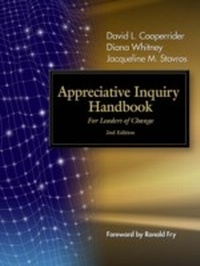
The Appreciative Inquiry Handbook
For Leaders of Change
2nd Edition
Published on 10. January 2008
496 pages
978-1-60509-900-2 (ISBN)
Description

In this thoroughly revised and updated edition of one of the most popular change methods in the world, Cooperrider et al. track the recent changes in the field and explain how AI can contribute to sustainability and the triple bottom line.
One of today's most popular change methods, Appreciative Inquiry (AI) has been used to undertake transformational initiatives in dozens of organizations, ranging from McDonalds to the U.S. Navy to Save the Children.
The assumption of AI is simple. Every organization has things that work right-things that give it life when it is vital, effective, and successful. AI begins by identifying this positive core and connecting organizational visions, plans, and structures to it in ways that heighten energy and inspire action for change.
This book presents all of the concepts, examples, and aids necessary to engage groups of all sizes in Appreciative Inquiry. The authors provide background information on what AI is and how it works and offer sample project plans, designs, agendas, course outlines, interview guidelines, participant worksheets, a list of resources, and more.
This second edition has been extensively revised, updated, and expanded, including new case studies, new tools and supplemental articles, an expanded bibliography and resource list, and an entirely new chapter on case applications. And throughout, the authors focus on how AI can support an organizational focus on sustainability and the triple bottom line of people, prosperity, and planet.
One of today's most popular change methods, Appreciative Inquiry (AI) has been used to undertake transformational initiatives in dozens of organizations, ranging from McDonalds to the U.S. Navy to Save the Children.
The assumption of AI is simple. Every organization has things that work right-things that give it life when it is vital, effective, and successful. AI begins by identifying this positive core and connecting organizational visions, plans, and structures to it in ways that heighten energy and inspire action for change.
This book presents all of the concepts, examples, and aids necessary to engage groups of all sizes in Appreciative Inquiry. The authors provide background information on what AI is and how it works and offer sample project plans, designs, agendas, course outlines, interview guidelines, participant worksheets, a list of resources, and more.
This second edition has been extensively revised, updated, and expanded, including new case studies, new tools and supplemental articles, an expanded bibliography and resource list, and an entirely new chapter on case applications. And throughout, the authors focus on how AI can support an organizational focus on sustainability and the triple bottom line of people, prosperity, and planet.
More details
Other editions
Additional editions
David Cooperrider | Diana Whitney | Jacqueline Stavros
The Appreciative Inquiry Handbook. For Leaders of Change
For Leaders of Change
Book
01/2008
2nd Edition
Berrett-Koehler
€56.00
Shipment within 3-4 weeks
Persons
David L. Cooperrider is Professor and Chairman of the Department of Organizational Behavior at the Weatherhead School of Management, Case Western Reserve University. He is the author or coauthor of nine books. His 1987 article Appreciative Inquiry Into Organizational Life (with Suresh Srivastva) introduced the concept of Appreciative Inquiry.
Content
List of Tables, Figures, and Exhibits
Foreword
Preface
Acknowledgments
Introduction
Essential Elements of Appreciative Inquiry
Chapter 1: The Theoretical Basis of Appreciative Inquiry
Chapter 2: Appreciative Inquiry Process: How it Works
Chapter 3: Introducing, Defining and Planning an Appreciative Inquiry Initiative
Application of the 4-D Cycle of Appreciative Inquiry
Chapter 4: Discovery: What Gives Life?
Chapter 5: Dream: What Might Be?
Chapter 6: Design: How Can It Be?
Chapter 7: Destiny: What Will Be?
Learning Applications and Resources
Chapter 8: Sample Interview Guides and Summary Report
Chapter 9: AI Case Applications
Chapter 10: AI Worksheets
Chapter 11: The AI Classics: Selected Articles
Appreciative Inquiry Bibliography
Glossary of Terms
Index
Statement of Taos Institute
Taos Institute Publications
Statement of Appreciative Inquiry Consulting
Positive Organizational Scholarship
About the Authors
Foreword
Preface
Acknowledgments
Introduction
Essential Elements of Appreciative Inquiry
Chapter 1: The Theoretical Basis of Appreciative Inquiry
Chapter 2: Appreciative Inquiry Process: How it Works
Chapter 3: Introducing, Defining and Planning an Appreciative Inquiry Initiative
Application of the 4-D Cycle of Appreciative Inquiry
Chapter 4: Discovery: What Gives Life?
Chapter 5: Dream: What Might Be?
Chapter 6: Design: How Can It Be?
Chapter 7: Destiny: What Will Be?
Learning Applications and Resources
Chapter 8: Sample Interview Guides and Summary Report
Chapter 9: AI Case Applications
Chapter 10: AI Worksheets
Chapter 11: The AI Classics: Selected Articles
Appreciative Inquiry Bibliography
Glossary of Terms
Index
Statement of Taos Institute
Taos Institute Publications
Statement of Appreciative Inquiry Consulting
Positive Organizational Scholarship
About the Authors
