

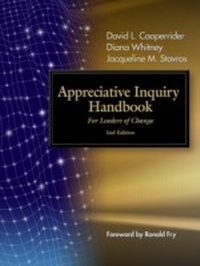
Appreciative Inquiry Handbook
For Leaders of Change
1st Edition
Published on 1. January 2008
498 pages
978-1-57675-562-4 (ISBN)
Description

One of today's most popular change methods, Appreciative Inquiry (AI) has been used to undertake transformational initiatives in dozens of organizations. The authors offer sample project plans, designs, agendas, and more in this revised, updated, and expanded edition.
More details
Other editions
Additional editions
David Cooperrider | Diana Whitney | Jacqueline Stavros
The Appreciative Inquiry Handbook. For Leaders of Change
For Leaders of Change
Book
01/2008
2nd Edition
Berrett-Koehler
€56.00
Shipment within 3-4 weeks
Content
- Intro
- Detailed Contents
- Introduction
- PART 1 Essential Elements of Appreciative Inquiry
- Chapter 1: The Theoretical Basis of Appreciative Inquiry
- AI: A Brief Introduction
- Mini-lecture I: Five Principles of AI
- Mini-lecture II: Positive Image-Positive Action
- Mini-lecture III: Social Constructionism
- Mini-lecture IV: Beyond Problem Solving to AI
- Mini-lecture V: Vocabularies of Human Deficit
- Mini-lecture VI: Toward a Theory of Affirmative Organization
- Mini-lecture VII: Assessing Organizational Inner Dialogue
- Mini-lecture VIII: History as Positive Possibility
- Mini-lecture IX: Why AI Works: The Liberation of Power
- Chapter 2: The Appreciative Inquiry Process: How It Works Overview
- Overview
- The Positive Core
- Affirmative Topic Choice: A Fateful Act
- Who to Involve?
- The ABCs of Topic Choice: How to Do It
- Characteristics of Good Topics
- The Discovery Phase
- The Dream Phase
- The Design Phase
- The Destiny Phase
- Chapter 3: Introducing, Defining and Planning an Appreciative Inquiry Initiative
- Introducing AI
- Defining the Project Purpose, Process, and Plan
- Samples:
- PART 2 Application of the 4-D Cycle of Appreciative Inquiry
- Chapter 4: Discovery: What Gives Life?
- Key Steps in Data Collection
- Case Clippings: Texas Insurance
- Chapter 5: Dream: What Might Be?
- Creating the Dream Activity
- Evolution of Dialogue to Create Vision Consensus
- Sample Dream Questions
- AI Summit: Using Large Groups to Mobilize Positive Change
- Case Clippings: Roadway Express
- Chapter 6: Design: How Can It Be?
- Social Architecture for Organizing
- Criteria for Good Provocative Propositions
- Sample Provocative Propositions
- The Spirit of Designing: Recent Developments
- Case Clippings: Tendercare
- Chapter 7: Destiny: What Will Be?
- Rethinking Destiny
- Creating Appreciative Learning Cultures
- Destiny: An Improvisational Capacity
- Case Clippings: Hunter Douglas Window Fashions Division
- PART 3 Learning Applications and Resources
- Chapter 8: Sample Interview Guides and Summary Report
- Chapter 9: AI Case Applications
- Chapter 10: AI Worksheets
- Chapter 11: The AI Classics: Selected Articles
- Appreciative Inquiry in Organizational Life
- Resources for Getting AI Started: An Example OD Proposal
- Strategic Inquiry Appreciative Intent: Inspiration to SOAR
- Appreciative Inquiry Bibliography
- AI Web Sites
- Glossary of Terms
- A
- C
- D
- E
- F
- G
- H
- I
- L
- M
- N
- O
- P
- S
- T
- U
- W
- Index
- A
- B
- C
- D
- E
- F
- G
- H
- I
- J
- L
- M
- N
- O
- P
- Q
- R
- S
- T
- U
- V
- W
- Y
- Z
- Statement of Taos Institute
- Taos Institute Publications
- Positive Organizational Scholarship
- Statement of Appreciative Inquiry Consulting
- About the Authors
