

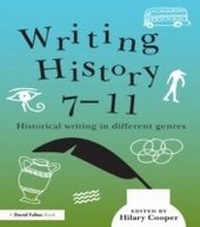
Writing History 7-11
Historical writing in different genres
1st Edition
Published on 5. June 2014
190 pages
978-1-317-66451-2 (ISBN)
Description

Writing History 7-11 supports students and primary teachers helping them to explore ways in which activities involving the talk that underpins historical enquiry can be developed into reading and exciting, extended, reflective writing.
The step that teachers and pupils take from 'talk for learning' to 'talk for writing' is a vital one. In this book the authors argue that all aspects of historical enquiry leading to writing involve discussion and dialogue which permeate every aspect of 'doing history'. From this perspective they set out a theoretical framework for understanding the role of talk and reading in developing pupils' critical thinking and confident reflective writing, then demonstrate through a series of case studies, in which teachers, university lecturers and pupils work together, how the theory is put into practice in the classroom.
Themes include:
How to support children in writing in a variety of interesting genres
How to make links between the National Curriculum (2013) for History and for English
How to plan for breadth and depth studies in the new National Curriculum
How activities in History 5 - 11 can be developed into exciting extended writing
The second half of the book draws upon case studies from a number of real primary classrooms with children of different ages. Each case study shows how teaching was planned to develop children's confidence and enjoyment in discussion and to scaffold reasoned, written explanation and argument. Topics presented are all relevant to the new curriculum framework and include talking and reading about:
Time, change and significance over 6000 years - writing a television script
Celtic Britain and the Roman Army - writing a travel brochure about Celtic Britain
The destruction of Roman towns - writing a Saxon poem
An archaeological investigation of a body in a Danish peat bog - writing a newspaper report
Did any countries benefit from WW11? - writing an argued viewpoint
The expansion westwards of European settlers - writing a flap book exploring different perspectives.
This indispensable book provides not only sources for pupils to use in their writing, but also models and exemplars of different styles and voices to draw upon.
The step that teachers and pupils take from 'talk for learning' to 'talk for writing' is a vital one. In this book the authors argue that all aspects of historical enquiry leading to writing involve discussion and dialogue which permeate every aspect of 'doing history'. From this perspective they set out a theoretical framework for understanding the role of talk and reading in developing pupils' critical thinking and confident reflective writing, then demonstrate through a series of case studies, in which teachers, university lecturers and pupils work together, how the theory is put into practice in the classroom.
Themes include:
How to support children in writing in a variety of interesting genres
How to make links between the National Curriculum (2013) for History and for English
How to plan for breadth and depth studies in the new National Curriculum
How activities in History 5 - 11 can be developed into exciting extended writing
The second half of the book draws upon case studies from a number of real primary classrooms with children of different ages. Each case study shows how teaching was planned to develop children's confidence and enjoyment in discussion and to scaffold reasoned, written explanation and argument. Topics presented are all relevant to the new curriculum framework and include talking and reading about:
Time, change and significance over 6000 years - writing a television script
Celtic Britain and the Roman Army - writing a travel brochure about Celtic Britain
The destruction of Roman towns - writing a Saxon poem
An archaeological investigation of a body in a Danish peat bog - writing a newspaper report
Did any countries benefit from WW11? - writing an argued viewpoint
The expansion westwards of European settlers - writing a flap book exploring different perspectives.
This indispensable book provides not only sources for pupils to use in their writing, but also models and exemplars of different styles and voices to draw upon.
More details
Language
English
Place of publication
London
United Kingdom
Publishing group
Taylor & Francis Ltd
Target group
College/higher education
Professional and scholarly
Illustrations
21 s/w Abbildungen, 32 s/w Tabellen
32 Tables, black and white; 21 Illustrations, black and white
File size
6,68 MB
ISBN-13
978-1-317-66451-2 (9781317664512)
Copyright in bibliographic data and cover images is held by Nielsen Book Services Limited or by the publishers or by their respective licensors: all rights reserved.
Schweitzer Classification
Other editions
Additional editions
Book
05/2014
1st Edition
Routledge
€208.33
Shipment within 15-20 days
Book
05/2014
1st Edition
Routledge
€64.90
Shipment within 15-20 days
Person
Hilary Cooper is Emeritus Professor of History and Pedagogy at the University of Cumbria and co-edits the The International Journal of Historical Learning, Teaching and Research. She has published widely and has an international reputation in her field. She is author of the bestselling History 5-11 now in its second edition.
Content
Part 1 Theoretical framework for understanding the role of talk and reading in developing confident reflective writing 1 Historians' Themes and Genres, Hilary Cooper 2 Genre and Children Writing History: reflective and discursive learning, Jon Nichol 3 Oracy: speaking and listening, Jon Nichol 4 Talk, reading and writing in breadth and depth studies, Hilary Cooper 5 Theory into Practice, Hilary Cooper Part 2 Case Studies: models for practice 6 Using Sources To Create Narrative, Hugh Moore 7 Writing about time, Hilary Cooper 8 It depends on your point of view: exploring different representations of the past Penelope Harnett, Sarah Whitehouse and Jane Carter 9 Pupils Developing their Interpretations of the Past, Sue Temple 10 Discursive and Reflective Writing- into the Classroom, John Nichol
