

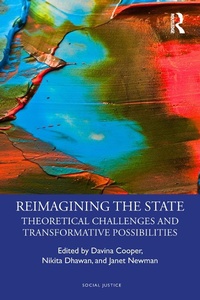
Reimagining the State
Theoretical Challenges and Transformative Possibilities
1st Edition
Published on 30. July 2019
290 pages
978-1-351-20910-6 (ISBN)
Description

This book examines what value, if any, the state has for the pursuit of progressive politics; and how it might need to be reimagined and remade to deliver transformative change.
Is it possible to reimagine the state in ways that open up projects of political transformation? This interdisciplinary collection provides alternative perspectives to the 'antistatism' of much critical writing and contemporary political movement activism. Contributors explore ways of reimagining the state that attend critically to the capitalist, neoliberal, gendered and racist conditions of contemporary polities, yet seek to hold onto the state in the process. Drawing on postcolonial, poststructuralist, feminist, queer, Marxist and anarchist thinking, they consider how states might be reread and reclaimed for radical politics. At the heart of this book is state plasticity - the capacity of the state conceptually and materially to take different forms. This plasticity is central to transformational thinking and practice, and to the conditions and labour that allow it to take place. But what can reimagining do; and what difficulties does it confront?
This book will appeal to academics and research students concerned with critical and transformative approaches to state theory, particularly in governance studies, politics and political theory, socio-legal studies, international relations, geography, gender/sexuality, cultural studies and anthropology.
Is it possible to reimagine the state in ways that open up projects of political transformation? This interdisciplinary collection provides alternative perspectives to the 'antistatism' of much critical writing and contemporary political movement activism. Contributors explore ways of reimagining the state that attend critically to the capitalist, neoliberal, gendered and racist conditions of contemporary polities, yet seek to hold onto the state in the process. Drawing on postcolonial, poststructuralist, feminist, queer, Marxist and anarchist thinking, they consider how states might be reread and reclaimed for radical politics. At the heart of this book is state plasticity - the capacity of the state conceptually and materially to take different forms. This plasticity is central to transformational thinking and practice, and to the conditions and labour that allow it to take place. But what can reimagining do; and what difficulties does it confront?
This book will appeal to academics and research students concerned with critical and transformative approaches to state theory, particularly in governance studies, politics and political theory, socio-legal studies, international relations, geography, gender/sexuality, cultural studies and anthropology.
More details
Series
Edition
1. Auflage
Language
English
Place of publication
London
United Kingdom
Publishing group
Taylor & Francis Ltd
Target group
College/higher education
Illustrations
6 Illustrations, black and white
ISBN-13
978-1-351-20910-6 (9781351209106)
Copyright in bibliographic data and cover images is held by Nielsen Book Services Limited or by the publishers or by their respective licensors: all rights reserved.
Schweitzer Classification
Other editions
Additional editions
Davina Cooper | Nikita Dhawan | Janet Newman
Reimagining the State
Theoretical Challenges and Transformative Possibilities
Book
08/2019
1st Edition
Routledge
€193.50
Shipment within 15-20 days
Davina Cooper | Nikita Dhawan | Janet Newman
Reimagining the State
Theoretical Challenges and Transformative Possibilities
Book
08/2019
1st Edition
Routledge
€56.50
Shipment within 15-20 days
Persons
Davina Cooper is a Research Professor in Law and Political Theory, Dickson Poon School of Law, King's College London.
Read our interview with Davina here: https://www.routledge.com/go/featured-author-davina-cooper
Nikita Dhawan is Professor of Political Science and Gender Studies at the University of Giessen, Germany.
Janet Newman is Professor Emeritus in the Faculty of Arts and Social Sciences at the Open University, UK.
Read our interview with Davina here: https://www.routledge.com/go/featured-author-davina-cooper
Nikita Dhawan is Professor of Political Science and Gender Studies at the University of Giessen, Germany.
Janet Newman is Professor Emeritus in the Faculty of Arts and Social Sciences at the Open University, UK.
Content
Acknowledgements
List of contributors
Introduction
Davina Cooper
PART I
The politics of reimagination
1 The political work of reimagination
Janet Newman
2 Reimagining the state: Marxism, feminism, postcolonialism
Shirin M. Rai
3 State as pharmakon
Nikita Dhawan
PART II
Performing re-readings
4 Why Africa's 'weak states' matter: A postcolonial critique of Euro-Western discourse on African statehood and sovereignty
Anna Maria Kraemer
5 The ethical state?
Maria do Mar Castro Varela
6 Christian Israel
Didi Herman
7 Using the master's tools: Rights and radical politics
Ruth Kinna
PART III
Prefigurative practices
8 Anticipatory representation: Thinking art and museums as platforms of resourceful statecraft
Chiara De Cesari
9 Conceptual prefiguration and municipal radicalism: Reimagining what it could mean to be a state
Davina Cooper
10 Regulating with social justice in mind: An experiment in reimagining the state
Morag McDermont and the Productive Margins Collective
PART IV
Reimagining otherwise
11 Harmful thoughts: Reimagining the coercive state?
John Clarke
12 Border abolition and how to achieve it
Nick Gill
13 Refusal first, then reimagination: Presenting the Burn in Flames Post-Patriarchal Archive in Circulation
Sarah Browne and Jesse Jones
Concluding reflections
Janet Newman and Nikita Dhawan
List of contributors
Introduction
Davina Cooper
PART I
The politics of reimagination
1 The political work of reimagination
Janet Newman
2 Reimagining the state: Marxism, feminism, postcolonialism
Shirin M. Rai
3 State as pharmakon
Nikita Dhawan
PART II
Performing re-readings
4 Why Africa's 'weak states' matter: A postcolonial critique of Euro-Western discourse on African statehood and sovereignty
Anna Maria Kraemer
5 The ethical state?
Maria do Mar Castro Varela
6 Christian Israel
Didi Herman
7 Using the master's tools: Rights and radical politics
Ruth Kinna
PART III
Prefigurative practices
8 Anticipatory representation: Thinking art and museums as platforms of resourceful statecraft
Chiara De Cesari
9 Conceptual prefiguration and municipal radicalism: Reimagining what it could mean to be a state
Davina Cooper
10 Regulating with social justice in mind: An experiment in reimagining the state
Morag McDermont and the Productive Margins Collective
PART IV
Reimagining otherwise
11 Harmful thoughts: Reimagining the coercive state?
John Clarke
12 Border abolition and how to achieve it
Nick Gill
13 Refusal first, then reimagination: Presenting the Burn in Flames Post-Patriarchal Archive in Circulation
Sarah Browne and Jesse Jones
Concluding reflections
Janet Newman and Nikita Dhawan
