

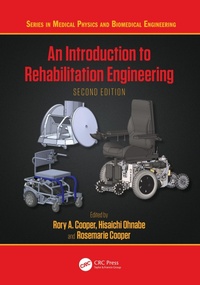
An Introduction to Rehabilitation Engineering
2nd Edition
Published on 12. November 2025
380 pages
978-1-040-42558-9 (ISBN)
Description

In response to the growing demand for a foundational resource in rehabilitation engineering, Dr. Cooper - renowned innovator and leader in the field - joins a team of knowledgeable contributors to present the fully updated Introduction to Rehabilitation Engineering, Second Edition. This comprehensive guide introduces both foundational principles and real-world applications of rehabilitation engineering (RE), making it an essential text for students, educators and professionals alike. Covering 18 in-depth chapters, this edition explores key areas such as wheeled mobility, prosthetics, orthotics, rehabilitation robotics, accessible transportation, universal design, digital accessibility and adaptive sports technologies. It integrates core concepts like the PHAATE model and participatory action design and engineering (PADE) with practical insight into standards, service delivery, ergonomics and universal design while providing a well-rounded understanding of how engineering can improve function, independence and quality of life.
Structured with clear learning objectives, chapter-end study questions and a comprehensive glossary, this book supports both academic instruction and lifelong learning. With a focus on usercentered design and interdisciplinary collaboration, it equips readers to meet the challenges of modern rehabilitation engineering with creativity, understanding and technical expertise. Whether beginning a journey in rehabilitation engineering or seeking to deepen knowledge, Introduction to Rehabilitation Engineering, Second Edition, offers a concise yet thorough foundation in a critical and rapidly evolving field - inviting further exploration, innovation and impact. These features make the book a valuable resource for students, practitioners and anyone interested in the field of rehabilitation engineering.
Key Features:
* Covers essential topics such as device design, service delivery models, universal design principles and technology transfer mechanisms.
* Emphasizes real-world applications of RE, including areas like wheelchair design, prosthetics and orthotics, web accessibility and communications technology, robotics in rehabilitation and adaptive sports, offering readers a tangible understanding of how these technologies impact daily life.
* Serves as a concise yet thorough introduction, providing readers with a solid foundational understanding of RE, while stimulating further exploration and research in the field.
Structured with clear learning objectives, chapter-end study questions and a comprehensive glossary, this book supports both academic instruction and lifelong learning. With a focus on usercentered design and interdisciplinary collaboration, it equips readers to meet the challenges of modern rehabilitation engineering with creativity, understanding and technical expertise. Whether beginning a journey in rehabilitation engineering or seeking to deepen knowledge, Introduction to Rehabilitation Engineering, Second Edition, offers a concise yet thorough foundation in a critical and rapidly evolving field - inviting further exploration, innovation and impact. These features make the book a valuable resource for students, practitioners and anyone interested in the field of rehabilitation engineering.
Key Features:
* Covers essential topics such as device design, service delivery models, universal design principles and technology transfer mechanisms.
* Emphasizes real-world applications of RE, including areas like wheelchair design, prosthetics and orthotics, web accessibility and communications technology, robotics in rehabilitation and adaptive sports, offering readers a tangible understanding of how these technologies impact daily life.
* Serves as a concise yet thorough introduction, providing readers with a solid foundational understanding of RE, while stimulating further exploration and research in the field.
More details
Series
Edition
2nd edition
Language
English
Place of publication
London
United Kingdom
Publishing group
Taylor & Francis Ltd
Target group
College/higher education
Professional and scholarly
Illustrations
25 Tables, black and white; 21 Line drawings, black and white; 92 Halftones, black and white; 113 Illustrations, black and white
File size
24,08 MB
ISBN-13
978-1-040-42558-9 (9781040425589)
Copyright in bibliographic data and cover images is held by Nielsen Book Services Limited or by the publishers or by their respective licensors: all rights reserved.
Schweitzer Classification
Other editions
Additional editions
Rory A. Cooper | Hisaichi Ohnabe | Rosemarie Cooper
An Introduction to Rehabilitation Engineering
Book
11/2025
2nd Edition
CRC Press
€131.20
Shipment within 10-20 days
Persons
Rory A. Cooper is an American bioengineer who currently serves as FISA/PVA Distinguished Professor, Past Chair, in the Department of Rehabilitation Science and Technology and professor of bioengineering, physical medicine and rehabilitation and orthopedic surgery at the University of Pittsburgh. In 2023, Cooper was presented with the National Medal of Technology and Innovation by President Joe Biden.
Hisaichi Ohnabe is a professor emeritus of Niigata University of Health & Welfare and an Adjunct Professor at the University of Pittsburgh.
Rosemarie Cooper, MPT, is Associate Director for Stakeholder Engagement at the Human Engineering Research Laboratories at the University of Pittsburgh.
Hisaichi Ohnabe is a professor emeritus of Niigata University of Health & Welfare and an Adjunct Professor at the University of Pittsburgh.
Rosemarie Cooper, MPT, is Associate Director for Stakeholder Engagement at the Human Engineering Research Laboratories at the University of Pittsburgh.
Content
Chapter 1: Participatory Action Design & Engineering. Chapter 2: Rehabilitation Engineering in Practice. Chapter 3: Accessible Home and Worksite Design. Chapter 4: Technology Transfer. Chapter 5: Standard for Assistive Technology. Chapter 6: Seating Biomechanics and Systems. Chapter 7: Tissue Integrity Movement. Chapter 8: Wheelchairs. Chapter 9: Therapeutic Electrical Simulation. Chapter 10: Accessible Vehicles and Transportation Systems. Chapter 11: Rehabilitation Robotics. Chapter 12: Major Limb Prosthetic Devices. Chapter 13: Orthotic Devices. Chapter 14: Aids for People Who Are Blind or Visually Impaired. Chapter 15: Maximising Participation for People with Hearing Loss. Chapter 16: Information-Communication Technology and Digital Accessibility. Chapter 17: Augmentative and Alternative Communication Technology. Chapter 18: Adaptive Sports and Recreation Technology.
