

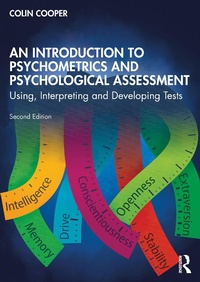
An Introduction to Psychometrics and Psychological Assessment
Using, Interpreting and Developing Tests
2nd Edition
Published on 9. May 2023
436 pages
978-1-000-86894-4 (ISBN)
Description

An Introduction to Psychometrics and Psychological Assessment is the successor to Cooper's prize-winning book Psychological Testing: Theory and Practice. This expanded and updated volume shows how psychological questionnaires and tests can be chosen, administered, scored, interpreted and developed. In providing students, researchers, test users, test developers and practitioners in the social sciences, education and health with an evaluative guide to choosing, using, interpreting and developing tests, it provides readers a thorough grasp of the principles (and limitations) of testing, together with the necessary methodological detail.
This book has three distinctive features. First, it stresses the basic logic of psychological assessment without getting bogged down with mathematics; the spreadsheet simulations and utilities which are integrated into the text allow users to explore how numbers behave, rather than reading equations. Readers will "learn by doing". Second, it covers both the theory behind psychological assessment and the practicalities of locating, designing and using tests and interpreting their scores. Finally, it is evaluative. Rather than just describing concepts such as test reliability or adaptive testing, it stresses the underlying principles, merits and drawbacks of each approach to assessment, and methods of developing and evaluating questionnaires and tests. Unusually for an introductory text, it includes coverage of several cutting-edge techniques, and this new edition expands the discussion on measurement invariance, methods of detecting/quantifying bias and hierarchical factor models, and features added sections on:
Best practices for translation of tests into other languages and problems of cultural bias
Automatic item generation
The advantages, drawbacks and practicalities of internet-based testing
Generalizability theory
Network analysis
Dangerous assumptions made when scoring tests
The accuracy of tests used for assessing individuals
The two-way relationship between psychometrics and psychological theory
Aimed at non-mathematicians, this friendly and engaging text will help you to understand the fundamental principles of psychometrics that underpin the measurement of any human characteristic using any psychological test. Written by a leading figure in the field and accompanied by additional resources, including a set of spreadsheets which use simulated data and other techniques to illustrate important issues, this is an essential introduction for all students of psychology and related disciplines. It assumes very little statistical background and is written for students studying psychological assessment or psychometrics, and for researchers and practitioners who use questionnaires and tests to measure personality, cognitive abilities, educational attainment, mood or motivation.
This book has three distinctive features. First, it stresses the basic logic of psychological assessment without getting bogged down with mathematics; the spreadsheet simulations and utilities which are integrated into the text allow users to explore how numbers behave, rather than reading equations. Readers will "learn by doing". Second, it covers both the theory behind psychological assessment and the practicalities of locating, designing and using tests and interpreting their scores. Finally, it is evaluative. Rather than just describing concepts such as test reliability or adaptive testing, it stresses the underlying principles, merits and drawbacks of each approach to assessment, and methods of developing and evaluating questionnaires and tests. Unusually for an introductory text, it includes coverage of several cutting-edge techniques, and this new edition expands the discussion on measurement invariance, methods of detecting/quantifying bias and hierarchical factor models, and features added sections on:
Best practices for translation of tests into other languages and problems of cultural bias
Automatic item generation
The advantages, drawbacks and practicalities of internet-based testing
Generalizability theory
Network analysis
Dangerous assumptions made when scoring tests
The accuracy of tests used for assessing individuals
The two-way relationship between psychometrics and psychological theory
Aimed at non-mathematicians, this friendly and engaging text will help you to understand the fundamental principles of psychometrics that underpin the measurement of any human characteristic using any psychological test. Written by a leading figure in the field and accompanied by additional resources, including a set of spreadsheets which use simulated data and other techniques to illustrate important issues, this is an essential introduction for all students of psychology and related disciplines. It assumes very little statistical background and is written for students studying psychological assessment or psychometrics, and for researchers and practitioners who use questionnaires and tests to measure personality, cognitive abilities, educational attainment, mood or motivation.
Reviews / Votes
'Colin Cooper's book is a masterpiece of lucidity and a must-have for students, researchers, and practitioners alike. Psychological testing can be a challenging topic, given the mathematical underpinnings of the field, and Cooper deftly navigates the territory between technical details and approachable exposition. A valuable and comprehensive resource, fully updated in its second edition, and well-suited as a textbook for university courses in psychological assessment.'Robert F. Krueger, PhD, Distinguished McKnight University Professor, University of Minnesota
'Colin Cooper is a leading authority on psychometrics with an uncanny ability to convey high-level technical concepts. To this day, I keep learning from his texts and so I am delighted to welcome the publication of this - substantially updated - second edition. It is the first textbook I recommend to anyone wishing to get acquainted with the science of psychometrics.'
K. V. Petrides, Professor of Psychology and Psychometrics (UCL)
'Colin Cooper's book is superb - the work of a true expert in psychometrics. Not only is it comprehensive and rigorous, it tackles often neglected issues (e.g., the role played by factor analysis and the conceptual nature of psychological measurement). It is practical, too, with data sets and exercises provided. Cooper's wit infuses the pages which makes for an enjoyable read.'
Philip J. Corr, Professor of Psychology, School of Health and Psychological Sciences, University of London
'Professor Colin Cooper taught students the principles of psychometrics and psychological testing for 30 years. Also, he edited related journals for almost as long. It has resulted in this extremely valuable book which is characterized by unique and quality content, natural flow, substance, and expert knowledge. It will be invaluable to both undergraduate and postgraduate students, as well as practitioners who are seeking emphatically not a statistics text.'
Malgorzata Fajkowska, Head of the Laboratory of Personality Psychology, Institute of Psychology, Polish Academy of Sciences
More details
Edition
2nd edition
Language
English
Place of publication
London
United Kingdom
Publishing group
Taylor & Francis Ltd
Target group
College/higher education
Illustrations
47 Tables, color; 44 Line drawings, color; 44 Illustrations, black and white
ISBN-13
978-1-000-86894-4 (9781000868944)
Copyright in bibliographic data and cover images is held by Nielsen Book Services Limited or by the publishers or by their respective licensors: all rights reserved.
Schweitzer Classification
Other editions
Additional editions
Colin Cooper
An Introduction to Psychometrics and Psychological Assessment
Using, Interpreting and Developing Tests
Book
05/2023
2nd Edition
Routledge
€100.90
Shipment within 10-20 days
Colin Cooper
An Introduction to Psychometrics and Psychological Assessment
Using, Interpreting and Developing Tests
Book
05/2023
2nd Edition
Routledge
€229.30
Shipment within 10-20 days
Person
A proud Cornishman, Colin Cooper obtained his BSc and PhD degrees in psychology from the University of Exeter in the UK. He worked on developing methods for selecting pilots and for assessing flexible thinking in senior officers before taking a lectureship at the University of Ulster in Coleraine, Northern Ireland. He moved to Queen's University, Belfast, where he taught and researched individual differences, psychometrics and statistics for 20 years. He took early retirement in 2012 and emigrated to Ontario, Canada, where he is currently editor-in-chief of two journals and president of the International Society for the Study of Individual Differences. He has published extensively in the areas of individual differences and psychometrics, and in his spare time enjoys classical music, writing, travel and walking.
Content
Preface
Chapter 1: Introduction to Psychometrics
Chapter 2: Tests, Scales and Testing
Chapter 3: The meaning of measurement
Chapter 4: Administering and scoring Questionnaires and Tests
Chapter 5: Interpreting Scores
Chapter 6: Correlations
Chapter 7: Random errors of measurement
Chapter 8: Systematic Influences and Generalisability Theory
Chapter 9: Test Validity, Bias and Invariance
Chapter 10: Introduction to factor analysis
Chapter 11: Performing and interpreting factor analyses
Chapter 12: Alternative factor analysis designs
Chapter 13: Developments in Factor Analysis
Chapter 14: Network Analysis
Chapter 15: Item response theory
Chapter 16: Test and scale construction
Chapter 17: Problems with test scores
Chapter 18: Psychometrics in context
References
Index
Chapter 1: Introduction to Psychometrics
Chapter 2: Tests, Scales and Testing
Chapter 3: The meaning of measurement
Chapter 4: Administering and scoring Questionnaires and Tests
Chapter 5: Interpreting Scores
Chapter 6: Correlations
Chapter 7: Random errors of measurement
Chapter 8: Systematic Influences and Generalisability Theory
Chapter 9: Test Validity, Bias and Invariance
Chapter 10: Introduction to factor analysis
Chapter 11: Performing and interpreting factor analyses
Chapter 12: Alternative factor analysis designs
Chapter 13: Developments in Factor Analysis
Chapter 14: Network Analysis
Chapter 15: Item response theory
Chapter 16: Test and scale construction
Chapter 17: Problems with test scores
Chapter 18: Psychometrics in context
References
Index
