

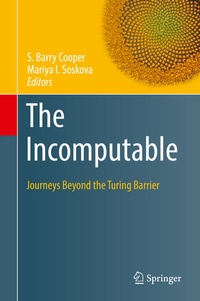
The Incomputable
Description

This book questions the relevance of computation to the physical universe. Our theories deliver computational descriptions, but the gaps and discontinuities in our grasp suggest a need for continued discourse between researchers from different disciplines, and this book is unique in its focus on the mathematical theory of incomputability and its relevance for the real world. The core of the book consists of thirteen chapters in five parts on extended models of computation; the search for natural examples of incomputable objects; mind, matter, and computation; the nature of information, complexity, and randomness; and the mathematics of emergence and morphogenesis.
This book will be of interest to researchers in the areas of theoretical computer science, mathematical logic, and philosophy.
Reviews / Votes
"The incomputable explores selected recent research into various aspects of computability. This includes abstract models of computation, how quantum algorithms could in some sense redefine aspects of computability, and how the notion of computability relates to the physical world and physical processes. The book leads with a tribute to the late Ivan Soskov, a Bulgarian computer scientist who dedicated his professional career to studying computability theories, particularly computability over abstract structures." (G. R. Mayforth,Computing Reviews, March, 2018)More details
Other editions
Additional editions
Persons
Prof. S. Barry Cooper was a Professor of Pure Mathematics at the University of Leeds. He was the founding President of the Computability in Europe Association, and a prolific author and editor in the domain of computability. He championed Alan Turing's achievements in logic and computer science, and in particular he motivated and organized cross-disciplinary collaborations, among them the events, publications and broadcasts of the Alan Turing Year in 2012.
Dr. Mariya I. Soskova is an associate professor in the Dept. of Mathematical Logic and Applications in Sofia University. She was recently a visiting scholar at the University of California, and a visiting seminar professor at the Dept. of Mathematics at the University of Wisconsin, Madison.
Content
Part I, Challenging Turing: Extended Models of Computation.- Ivan Soskov: A Life in Computability.- Physical Logic.- From Quantum Foundations via Natural Language Meaning to a Theory of Everything.- Part II, The Search for "Natural" Examples of Incomputable Objects.- Some Recent Research Directions in the Computably Enumerable Sets.- Uncomputability and Physical Law.- Algorithmic Economics: Incomputability, Undecidability and Unsolvability in Economics.- Part III, Mind, Matter and Computation.- Is Quantum Physics Relevant for Life?.- Trouble with Computation: A Refutation of Digital Ontology.- Part IV, The Nature of Information: Complexity and Randomness.- Complexity Barriers as Independence.- Quantum Randomness: From Practice to Theory and Back.- Calculus of Cost Functions.- Part V -- The Mathematics of Emergence and Morphogenesis.- Turing's Theory of Morphogenesis: Where We Started, Where We Are and Where We Want to Go.- Construction Kits for Biological Evolution.
