

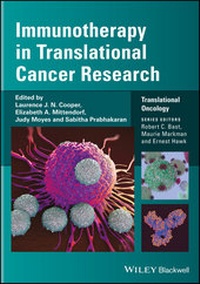
Immunotherapy in Translational Cancer Research
Description

A volume in the Translational Oncology series, Immunotherapy in Translational Cancer Research explores the recent developments in the role that immunotherapy plays in the treatment of a wide range of cancers. The editors present key concepts, illustrative examples, and suggest alternative strategies in order to achieve individualized targeted therapy. Comprehensive in scope, Immunotherapy in Translational Cancer Research reviews the relevant history, current state, and the future of burgeoning cancer-fighting therapies. The book also includes critical information on drug development, clinical trials, and governmental resources and regulatory issues.
Each chapter is created to feature: development of the immunotherapy; challenges that have been overcome in order to scale up and undertake clinical trials; and clinical experience and application of research. This authoritative volume is edited by a team of noted experts from MD Anderson Cancer Center, the world's foremost cancer research and care center and:
* Offers a comprehensive presentation of state-of-the-art cancer immunotherapy research that accelerates the pace of clinical cancer care
* Filled with the concepts, examples, and approaches for developing individualized therapy
* Explores the breath of treatments that reflect the complexity of the immune system itself
* Includes contributions from a panel international experts in the field of immunotherapy
Designed for physicians, medical students, scientists, pharmaceutical executives, public health and public policy government leaders and community oncologists, this essential resource offers a guide to the bidirectional interaction between laboratory and clinic immunotherapy cancer research.
More details
Other editions
Additional editions
Persons
Laurence J. N. Cooper, Associate Professor, Department of Pediatrics, The University of Texas MD Anderson Cancer Center, Houston, USA.
Elizabeth A. Mittendorf, Professor, Department of Breast Surgical Oncology, The University of Texas MD Anderson Cancer Center, Houston, USA.
Judy Moyes, Department of Pediatric Research, The University of Texas MD Anderson Cancer Center, Houston, USA.
Sabitha Prabhakaran, Clinical Research Scientist, Department of Breast Surgical Oncology, The University of Texas MD Anderson Cancer Center, Houston, USA.
Content
Editors vi
Contributors vii
Introduction ix
1 Translation in Immunology: The Role of Translational Biomarkers to Guide Clinical Use of Immunotherapy for Cancer 1
Saranya Chumsri and Keith L. Knutson
2 Monoclonal Antibody Therapy 12
Elizabeth A. Mittendorf and Sabitha Prabhakaran
3 Somatic Mutations and Immunotherapy 24
Eric Tran
4 Checkpoint Blockade 37
Tracy A. Proverbs-Singh Jedd Wolchok and Alexandra Snyder
5 Myeloid Leukemia Vaccines 54
Paul M. Armistead and Jonathan S. Serody
6 Cancer Vaccines for Solid Tumors 72
Timothy J. Vreeland Garth S. Herbert and George E. Peoples
7 Immunotherapy with Non-Genetically Modified T Cells 91
Cassian Yee
8 Immunotherapy with Genetically Modified T Cells 101
Liora Schultz and Crystal Mackall
9 Immunomodulation with Adjuvants and Cytokines 115
Dae won Kim and Adi Diab
10 Immune Cell Migration in Cancer and Immunotherapy 132
Timothy Murray and Daniel E. Speiser
11 Repurposing of Drugs for Immunotherapy 143
Jyothishmathi Swaminathan and Vidya Gopalakrishnan
12 Immunomodulation with Radiation 161
Jonathan E. Schoenhals Taylor R. Cushman, Alexandra P. Cadena Sandra Demaria and James W. Welsh
13 Good Manufacturing Practices Facilities for Cellular Therapy 177
Andrew D. Fesnak and Bruce L. Levine
14 T Cell Receptor Mimic Antibodies 186
Gheath Alatrash and Jeffrey J. Molldrem
15 Stem Cell Transplantation for Treatment of Malignancy 201
Lohith S. Bachegowda and Richard E. Champlin
16 Natural Killer Cell-Based Immunotherapy 215
Jennifer A. Foltz Jeffrey S. Miller and Dean A. Lee
17 Immunologic Monitoring in Immuno-Oncology 228
William R. Gwin and Mary L. Disis
18 Cell-Based Therapies for Canine Cancer 252
Nicola J. Mason and M. Kazim Panjwani
19 Interaction between Targeted Therapy and Immunotherapy 268
Peter A. Prieto Miles C. Andrews, Alexandria P. Cogdill, and Jennifer A. Wargo
Index 286
CHAPTER 1
Translation in Immunology: The Role of Translational Biomarkers to Guide Clinical Use of Immunotherapy for Cancer
Saranya Chumsri1 and Keith L. Knutson2
1 Department of Hematology and Oncology, Mayo Clinic, Jacksonville, FL, USA
2 Department of Immunology, Mayo Clinic, Jacksonville, FL, USA
Introduction
For over a century, the role of the immune system in controlling and eradicating tumors has been a subject of intense debate. Since the 1800s, it has been recognized that the immune system also plays an important pathologic protumor role in tumor initiation and progression. Virchow commented on the interaction between inflammation, leukocytes, and cancer in his article from 1863 [1]. More than a hundred years later, we are still extricating the complexities of the interaction between cancers and the host immune system. More recently, Schreiber, Old, and Smyth described the process in which cancer and the immune system interact with each other, termed "cancer immunoediting" [2]. Cancer immunoediting describes a contiguous process that the immune system influences and shapes developing tumors. This process can result in successful rejection of the tumor or generate a tumor through immunologic evasion, the latter of which we now know can occur by multiple mechanisms and more often than not through any one of a number of immune suppressive pathways [3].
Despite the long-standing interest in host antitumor immunity, it was only recently that immunotherapy emerged as one of the effective treatment options for cancer. In the past decade, several new immunotherapies, such as immune checkpoint blockade agents, tumor antigen-targeted monoclonal antibodies, and a cell-based dendritic vaccine, were approved by the U.S. Food and Drug Administration (FDA) for the treatment of multiple cancer types. In particular, the immune checkpoint blockade agents, which are treatments that target cytotoxic T-lymphocyte associated protein 4 (CTLA-4), programmed cell death protein 1 (PD-1), and programmed cell death ligand 1 (PDL-1), have gained impetus as potent anticancer therapies and have shown promising results across several tumor types, leading to a widespread revolution in cancer treatments and a massive shift in laboratory investigations. Since this form of therapy targets the host's regulatory components of the immune system rather than specific oncogenic mutations or tumor cells themselves, immune checkpoint blockade has been shown to be effective across multiple cancer types. Furthermore, given that the immune system has the capacity for long-term memory, patients who respond to this form of immunotherapy frequently have durable responses, which can protect against disease progression for months and years [4-6].
While the early results of immune checkpoint blockade have been quite promising, only about a third of patients benefit from single agent therapy, accounting for both partial and complete responses, defined by the FDA as the objective response rate (ORR). Not all tumor types are equally responsive to immune checkpoint blockade, for reasons that as of yet remain unclear. Emerging studies suggest that combination treatments adding additional immunotherapies or other modalities to immune checkpoint blockade results in ORRs that appear to be higher in many cases. However, in most cases the superiority of combination therapy over monotherapy is still not well proven. Chen and Mellman et al. introduced the concept of the cancer-immunity cycle, which describes the interactions and processes of how the immune system recognizes and eradicates cancer cells [7]. To ensure effective antitumor activities, a series of stepwise events, including release of cancer cell antigens, antigen presentation, priming and activation, trafficking of T cells to tumors, infiltration of T cells into tumors, recognition of cancer cells by T cells, and killing of cancer cells, must be initiated and properly expanded. This cancer-immunity cycle hypothesis provides potential opportunities to intervene, and provides rationale for combination therapy consisting of multiple immunotherapies to improve clinical responses [8]. Additionally, several other combination approaches, including with chemotherapy, antiangiogenic therapy, and hormonal therapy, are being considered [5, 9, 10]. In this chapter, potential and established biomarkers that can be used as prognostic indicators or as identifiers of patients who will benefit more from these immune checkpoint blockade agents are reviewed. Thus, the impressive therapeutic activity of immune checkpoint blockade, seen in recent years, has solidified the science of translational biomarkers, which enable more rapid, sensible deployment of novel clinical approaches for the select groups of patients who are most likely to benefit.
Biomarkers for anti-CTLA-4
Cytotoxic T-lymphocyte associated protein 4 (CTLA-4) is an immune checkpoint that down-regulates immune responses. CTLA-4 functions predominantly early in the cancer-immunity cycle during T cell activation and enhances the immunosuppressive activity of regulatory T cells (Treg cells) [11, 12]. In contrast to PD-1 or PDL-1, which is typically thought to modulate antigen-experienced effector cells in inflammatory environments, CTLA-4 engages in the priming phase and regulates the amplitude of early activation of naïve and memory T cells [13]. Ipilimumab was the first immune checkpoint blockade agent approved by FDA, is a humanized monoclonal antibody against CTLA-4, and is indicated for advanced melanoma. However, the response rate for single-agent ipilimumab is merely 10%, and ipilimumab has several concerning mechanistic-based toxicities [14]. Common serious toxicities associated with ipilimumab are dermatitis, enterocolitis, endocrinopathies, liver abnormalities, and uveitis [15]. Therefore, it is critical to identify biomarkers that can be used to select patients who are more likely to benefit from this toxic therapy.
Several serum biomarkers, such as lactate dehydrogenase (LDH), C-reactive protein (CRP), vascular endothelial growth factor (VEGF), and soluble CD25 (sCD25), have been shown to be associated with ipilimumab treatment in patients with advanced melanoma [16-19]. Higher baseline levels of LDH and VEGF were associated with reduced ipilimumab treatment response in patients with metastatic melanoma. However, subsequent reductions in LDH, CRP, and Tregs as well as an increase in absolute lymphocyte count after ipilimumab treatment were significantly associated with improved overall survival (OS) and disease control rate. sCD25 acts as a decoy receptor for IL-2. While recombinant IL-2 improves efficacy of ipilimumab, sCD25 inhibits the anticancer effects of ipilimumab, and the high level of baseline sCD25 appears to confer resistance to ipilimumab [16]. However, most of these studies were small retrospective database reviews, and at this time, no confirmatory clinical trials have been done to support the routine use of these biomarkers for the selection of patients who should receive ipilimumab.
Given that ipilimumab exerts its antitumor activity through activation and increasing proliferation of T cells, serial measurements of absolute lymphocyte counts (ALC) in the blood after treatment have also been investigated as a pharmacodynamic biomarker of ipilimumab [20, 21]. After ipilimumab therapy, an ALC = 1000/µL at week seven or an increase in ALC from baseline at week twelve was significantly associated with improved OS [18, 22, 23]. Besides a simple absolute count of lymphocytes, which can be heterogeneous, CD4+ICOS+ T cells, an activated T cell subset, have been used to track immune response after ipilimumab therapy as a pharmacodynamics marker. Four independent studies demonstrated that patients who had a sustained increase in CD4+ICOS+ T cells over twelve weeks after ipilimumab therapy had significant improvement in OS [24-28]. This consistent finding is intriguing because ICOS (inducible T cell costimulatory) costimulation is associated with Th2 immune responses, suggesting the possibility that antibodies are involved in the clinical activity of CTLA-4 blockade [29].
Since T cells recognize processed peptides presented by host major histocompatibility complex molecules, mutations in cancers can produce unique peptides that can be recognized by T cells, termed mutated neoantigens [30]. The antigenicity of these neoantigens may affect the function of the protein, and a passenger mutation with no functional role may still generate sufficient immune responses, although the potential for immune escape based on antigen loss is still possible. However, a greater mutational load in the tumors can potentially produce more neoantigens, which will result in a larger repertoire of existing tumor-specific T cells, and less chances of antigen-loss variant escape. Given the fact that immune checkpoint blockade agents exert their activity by unleashing these preexisting tumor-specific T cells, it was initially hypothesized that tumors with higher mutational loads would respond better to this form of therapy [30]. This hypothesis was substantiated based on the early results of studies with ipilimumab, which has activity in the cancer with the highest mutational load, melanoma. In two melanoma studies of ipilimumab, patients who responded to ipilimumab had a statistically significant higher median mutation load in their tumors compared to patients...
