

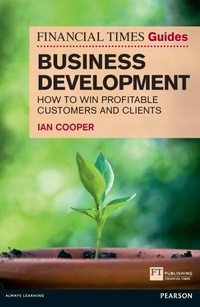
Financial Times Guide to Business Development, The
Description

With over 500 tips, tactics, techniques and thought provoking business questions, this is the authoritative guide to attracting more customers, profit, revenue and business success.
Whether you are a budding entrepreneur, existing business owner, manager or director, this is the most comprehensive, pragmatic, common sense collection of business development techniques ever brought together into one book. It is structured so that you can easily find and dip into specific topics or view the whole book from a more overall strategic standpoint.
More details
Other editions
Additional editions
Person
Ian Cooper is one of Europe's most experienced business development consultants, presenters and skills trainers. He is also one of the world's leading advisors specialising in business development within the professional services sector. He has advised and helped over 800 organisations of all sizes over 27 years to attract and win huge amounts of business. Ian is also a successful entrepreneur in his own right having started, developed and run several business ventures. An experienced author, Ian has written and contributed to over 10 books, on a range of topics.
http://www.iancooperfinancialtimesguidetobusinessdevelopmentbook.com/
Content
Contents List
Introduction
Chapter 1 - The 21 Common Sense Business Development Truths
1. Focus On Converting Leads, Not Just Generating Leads
2. Exceed Customer Expectations
3. Speak To Potential Customers And Clients ... And Speak To Them Nicely
4. Be Open For Business
5. Don't Let Your Administration Get In The Way
6. There's No Job More Important Than Helping Customers or Clients Part With Their Cash
7. Don't Let Technology Get In The Way
8. Quality And Word Of Mouth Counts For Everything
9. Actively Strive For Consistency
10. Recruitment Is Part Of Business Development
11. Keep In Touch With Your Existing Customers And Clients
12. Master Social Online Media
13. Test Your Ideas, Concepts And Prices
14. Plan, But Keep Things Simple
15. Take Complaints Seriously
16. Make Your Customer Or Client Environment Appropriate
17. Train Your People To Spot Opportunities
18. Get Out Of Your Office Or Premises And Mix And Mingle
19. Find A Niche And Specialise
20. Model What Works Best
21. Be Squeaky Clean
Chapter 2 - Asking The Right Business Questions: A Toolkit For Business Development
The 5 Impact Questions
The 100 Business Development Questions
Chapter 3 - The 20 Business Development Pricing Tools, Truths And Techniques
1. Winning Business Is Not The Most Important Thing - Being Profitable Is.
2. Price Is A Communications Issue, Not A Financial Or Accounting One.
3. Focus On Value And Service And Not Just Price.
4. Bundle In And Include As Much As You Can.
5. Unbundle And Charge Things Separately.
6. Don't Fall Into The Price Trap.
7. Consider Increasing Your Prices.
8. Use Division And Comparison.
9. Get Others To Justify Your Prices.
10. Price With Guarantees.
11. Price For Specialisation.
12. Price For Profile And Experience.
13. Price Based On Feedback And Testing.
14. Price For Prestige.
15. Price For Know-How.
16. Price With The Competition In Mind.
17. If You Must Have A Loss Leader, Make It Count.
18. Consider Special Deals, Promotions, Sales And Discounts.
19. Price For Easy Payment.
20. Pricing With Magic Numbers.
Chapter 4 - Introducing The Business Development Priorities
Priority 1 - Convert Leads, Opportunities And Enquiries Into Profitable Business.
Priority 2 - Develop More Business From Existing Customers And Clients.
Priority 3 - Externalise Business Development Efforts To Generate New Opportunities, Leads And Enquiries.
Chapter 5 - Priority 1 - Convert Leads, Opportunities And Enquiries Into Profitable Business.
The 10 Commandments Of Converting Leads And Enquiries.
The 5 Step Conversion System.
Chapter 6 - Priority 2 - Develop More Business From Existing Customers And Clients.
The Five Golden Rules:
Golden Rule 1 - Know Your Customers And Clients.
Golden Rule 2 &
