

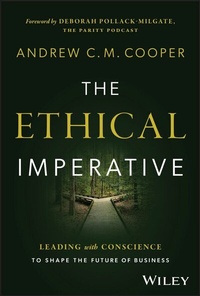
The Ethical Imperative
Description

2025 Axiom Business Book Award Winner-Business Ethics Shortlisted, The Business Book Awards-Leadership
Discover a groundbreaking blueprint for the future of business
In an era marked by increasing profiteering and inequality, The Ethical Imperative: Leading with Conscience to Shape the Future of Business offers a compelling alternative vision-one where companies champion the collective prosperity of employees, shareholders, and communities. Author Andrew Cooper, a distinguished executive, leverages over twenty academic studies and fifty years of research to challenge the status quo. He exposes the critical threat of public disengagement from businesses and institutions, urging a departure from outdated, profit-only models that harm corporations, consumers, and communities alike.
You'll find:
- Five actionable strategies you can employ immediately to transform your organization into a beacon of trust and social responsibility
- Techniques for navigating the age of social media and creating an authentic, honest, and sustainable brand
- Actionable tools to help your organization move beyond exclusively short-term profit-driven models of growth
Packed with engaging stories, practical tools, and insights from a seasoned leader determined to revolutionize corporate culture, this book is an essential resource for business managers, executives, entrepreneurs, and anyone aspiring to infuse their commercial endeavors with ethical principles.
Join Andrew Cooper in shaping a future where business is synonymous with compassion, equity, and enduring prosperity. The Ethical Imperative is more than a book-it's a movement towards the next phase of corporate evolution. Be part of this transformative journey.
More details
Other editions
Additional editions
Person
ANDREW C.M. COOPER is a Fortune 500 executive, attorney, inventor, lecturer, writer, and board director. He is the Associate General Counsel for strategic transactions and mergers and acquisitions at Meta Platforms, Inc. He also serves on the boards of seven professional and charitable organizations.
Content
Foreword ix
Introduction: The Conflagration 1
PART I The Burning House 7
Chapter 1 Forgotten Towns 9
Chapter 2 Forgotten People 20
Chapter 3 Adapt Today, Thrive Tomorrow 39
PART II The Conscientious Executive 53
Chapter 4 Move Beyond Comfort 55
Chapter 5 Good Habits and the Price of Renewal 67
Chapter 6 Dig Deep for Inspiration 81
Chapter 7 Value the Invisible 97
Chapter 8 Attenborough's Lesson 107
Chapter 9 Buckner's Law 122
PART III Level Up the Leadership Power Curve 137
Chapter 10 Move 1: Dynamic Omnidirectional Relationship Investment 139
Chapter 11 Move 2: Human Capital Investment 158
Chapter 12 Move 3: Habitat Discordance 178
Chapter 13 Move 4: The Maximization Default 188
Chapter 14 Move 5: A Reliable Brand 198
Chapter 15 Virtuous Cycles 208
Notes 219
Acknowledgments 231
About the Author 233
Index 235
Introduction: The Conflagration
The structure, they say, went up like a match. It had been grandfathered through generations of building codes, and on February 9, 2021, at 4:30 a.m., it became a mushroom cloud above the small neighborhood of Sandhill in Walterboro, South Carolina. The smoke coming from the 100 block of Ann Court could be seen for miles.1
Its occupant was nowhere to be found.
The Colleton County fire department later discovered that my cousin Meme was inside. Her government name was Wilhelmina Young Nesbitt.2 Meme had naturally long and silken black hair that hung low down her back. Her piercing hazel eyes were deep and inviting, and her cheekbones were raised and proud such that she appeared to be smiling even when she was not. But from what I can remember, she was almost always sad.
At only 53 years old, Meme became the first fire fatality of the year in the small town of Walterboro-population 5,400. Perhaps it was failing infrastructure. They say the roof of the home, an ugly umber color that stood out from its neighbors, had already collapsed in the rear of the building before the firefighters arrived. Or, perhaps, it was something else.
Officially, the death was an accident, but the truth is that Meme died from a maelstrom of failures. The community she grew up in, my community, offered few opportunities for her. Few jobs with health benefits, poor mental health services, and a virtually nonexistent state social safety net that created a void that nearby relatives could not fill.
When I was a boy, Meme came to church dressed from head to toe in black. In our small, Free Will Baptist Church, her attire was somewhat unusual for a "regular" service. There, in my grandfather's church, she veiled herself, walked to the pulpit, and kneeled in front of the congregation while chanting gibberish just as Pastor Gregory Clayton (also my cousin) reached a crescendo in his preaching. My father, Reverend A. L. Cooper, who then went by his initials to avoid confusion with me, sat on the rostrum with other clergy offering a searing gaze of concern.
Pastor Clayton stopped cold in the middle of his sermon. I can't remember the topic, but I was about nine years old then, and probably wasn't listening anyway. What subsequently ensued was over an hour of direct, corporate prayer and "laying of hands" for Meme-the entire church together. One minister suggested we "cast out the demon within her." I can remember thinking, even at a young age, that the thing Meme actually needed in addition to prayer was serious mental health intervention, the kind that was not available in Walterboro.
The episode, and Meme's untimely demise, is emblematic of systemic failure. She came from a poor community. Local services were inadequate and even her home buckled under the neglect of resources. She and I were both products of the same, undervalued social construct. We were America's working poor and therefore unseen. But, as Michael Caine's character says in the movie The Dark Knight Rises, "Sometimes the pit sends something back." Unlike Meme, I made it out. And, three decades later it occurred to me that, in the panoply of preventable deaths, I have a real opportunity to save people like Meme.
Since the day I left my family's single-wide trailer on Viola Court, I could not stop thinking about my reasons for leaving. All that I loved was in Walterboro, but all that I needed was not. So, I left for Washington DC; then to Atlanta, Georgia; then to Kansas City, Missouri; and on to Louisville, Kentucky-each place yielding a credential and a host of life lessons. But Walterboro was never far from my thoughts. At 32, I became the youngest general counsel of an American airline, and subsequently a senior lawyer for the world's largest social media company. Each turn focused my heart on the important role corporations can, and do, play in our daily lives.
In 2018, when I joined the corporate leadership team of United Parcel Service Airlines, I had no clue that pandemic, social unrest, and even political turmoil would be immense challenges to navigate during my tenure. But there, in the thick Kentucky bluegrass-through lockdowns, social anxiety stoked by the killing of Breonna Taylor, and political unrest emanating from Washington DC-I cut my teeth on leadership. First, I had no employees to supervise, then I had three, then eight, then 30, and then I joined a leadership team of 20,000. And each day I saw a little bit of Wilhelmina in each of my employees. Some worked mightily to make ends meet, others to get an education or health coverage, and still others to secure a promotion to buy a modest home and achieve the proverbial American dream. Each relied on the possibility borne out of work, and it was my job to lead for them.
America's Millennial generation, my generation, are often maligned as entitled and whiny, but in 2020 we became the largest generation in the U.S. workforce, and I believe we have an urgent message for America's corporate leaders. The message is clear to me because I have been on the messaging apps, received the direct messages on social media, and engaged on a consistent basis with my contemporaries, many of whom are inclined to burn down the edifice of America's free enterprise system as swiftly as Meme's house. If we want to preserve the very best of American enterprise, then corporate America must become better, and soon.
There is no shortage of critics who would prefer to see the enormous wealth of private firms diminished. To be sure, they point to valid examples of greed and excess. But they overlook the enormous social good and social mobility enabled by enterprise. I have a front-row seat to the good companies can do, if only they will. For example, during the 2019-2021 COVID-19 pandemic, I worked with thousands of UPS workers around the globe to deliver over 1 billion vaccines during the unprecedented global health crisis.3 It was a feat no government could accomplish alone. More catastrophes like COVID are on the horizon as climate change, natural habitat destruction, and ecological disasters present challenges that only large and competent organizations will have the capacity to solve.
On July 19, 2022, the United Kingdom recorded a temperature of 40.3°C (104.5°F). At the time, it was the highest ever recorded temperature in UK history.4 But it was foretold. Five years earlier, the International Monetary Fund urgently reported that domestic policies alone cannot fully insulate countries from the consequences of climate change. "Higher temperatures," the IMF stated, "will push the biophysical limits of ecosystems, potentially triggering more frequent natural disasters, fueling migration pressures and conflict risk."5 Today, western governments appear impotent, and the "hope and change" of the fleeting Obama years have lost their luster, leaving young people to turn to extreme economic ideas. This is the environment in which I assumed corporate leadership, and the need to level up could not be clearer.
Millennials, like me, have come of age in a conflagration of crises-not unlike Meme. In this environment, profits and positive earnings raise more questions about how results were achieved, rather than the results themselves.
Organizations that navigate what authors William Strauss and Neil Howe call the next generational "turning" will either have a thriving business or go up in flames like 100 Ann Court. It is an existential challenge, and the solutions require a new breed of leader willing to look inside the besieged homes of consumers to see, as Jack Swigert famously said on the Apollo 13 mission, "Houston we have a problem." Today, we need corporate leaders to make decisions with greater appreciation of impact, and I need you to be one of them-a conscientious leader who appreciates the human element in a total cost equation.
When I was younger, my father and I were on a long drive together. We were leaving our home in coastal South Carolina, to a town in the interior; one of those places where there was only one church and a gas station. We would often get into philosophical debates on the road.
My dad was a cynic. He contended that young people would end up just like the generations before them. Millennials, in his view, would not change much about the world. Of course, I couldn't let that go. An acolyte of Gene Roddenberry's work (the maker of Star Trek), I was programmed from a young age to be hopeful.
I responded with visceral anger that Millennials would change all of the things that were wrong with the world: racism, hate, inequality. My dad just smiled at me and shook his head disapprovingly. "You'll see," he said. "You'll be just like all the other generations before you. Just keep living."
Time will tell who is right-my dad or me. Or, perhaps, neither of us is right. A split decision is a possible outcome as well. Still, the weight of this question hangs over the entirety of society as we approach a generational junction. The direction we turn will have major implications for America's corporations and free enterprise as we know it.
In the American economy, the start of the twenty-first century can be characterized as a time of rising inequality, where those living in the Walterboros of the world struggle to maintain their financial footing. Social mobility is giving way to a permanent underclass. Corporate leaders seemingly...
