

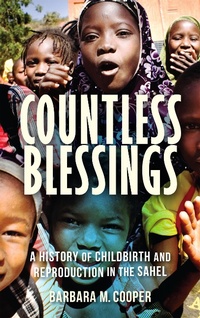
Countless Blessings
Description

How do women in Niger experience pregnancy and childbirth differently from women in the United States or Europe? Barbara M. Cooper sets out to understand childbirth in a country with the world's highest fertility rate and an alarmingly high rate of maternal and infant mortality. Cooper shows how the environment, slavery and abolition, French military rule, and the rapid expansion of Islam have all influenced childbirth and fertility in Niger from the nineteenth century to the present day. She sketches a landscape where fear of infertility generates intense competition between communities, ethnicities, and co-wives and creates a culture where concerns about infertility dominate concerns about overpopulation, where illegitimate children are rejected, and where the education of girls is sacrificed in the name of avoiding shame. Given a medical system poorly adapted to women's needs, a precarious economy, and a political context where it is impossible to address sexuality openly, Cooper discovers that it is little wonder that pregnancy and birth are a woman's greatest pride as well as a source of grave danger.
"Beautifully written, insightful, and full of empathy. A must read for anyone seeking to understand the damaging consequences of neglecting women's and infants' health." -Johanna Schoen, author of Abortion after Roe
"Few experiences are more potent than reproduction. Countless Blessings brilliantly unwinds the full import of this potency, tracing a history of demography, bodily peril, parental joy, and social, religious, and political meaning. Cooper's tremendous skill and creativity as a scholar enable us to see the political stakes of reproduction, even as they are grounded in the intimacies of embodied experience." -Julie Livingston, author of Self-Devouring Growth: A Planetary Parable as Told from Southern Africa
" Countless Blessings shows how women in Niger and in West Africa have long navigated the various states of social value, personhood, spirituality, and childbirth, and it paints a remarkable picture of how contested and embodied the social and material concerns of childbirth remain for women today." -Ampson Hagan, Univeristy of North Carolina-Chapel Hill, IJAHS
More details
Other editions
Additional editions
Person
Barbara M. Cooper is Professor of History and Department Chair at Rutgers University. She is author of Marriage in Maradi: Gender and Culture in a Hausa Society in Niger and Evangelical Christians in the Muslim Sahel, which was awarded the Herskovits Prize for the best book published in African studies.
Content
Acknowledgements
Glossary of ethnonyms, acronyms and foreign terms
Introduction
1. Environment, Seduction and Fertility
2. Tensions in the Wake of Conquest: Gender and Reproduction after Abolition
3. Personhood, Socialization and Shame
4. Colonial Accounting
5. Perils of Pregnancy and Childbirth
6. Producing Healthy Babies and Healthy Laborers
7. Feminists, Islamists and Demographers
8. Let's talk about Bastards
9. Contemporary Sexuality and Childbirth
Conclusion: Traveling Companions and Entrustments in Contemporary Niger
Works Cited
Index
