

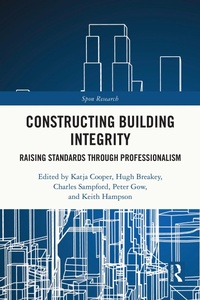
Constructing Building Integrity
Raising Standards through Professionalism
1st Edition
Published on 11. March 2026
320 pages
978-1-040-84874-6 (ISBN)
Description

Constructing Building Integrity examines how ethical and professional standards can be raised in the residential apartment sector. Recent incidents in a number of countries, culminating in London's Grenfell tower inferno that claimed 72 lives have highlighted systemic failures in the building industry's professional and regulatory standards frameworks. These disasters raise serious questions over how consumer confidence and public trust can be improved when outcomes for multi-level, multi-owned apartment buildings remain sub-optimal.
To address this issue, the book explores how cross-professional interactions, regulatory oversight, public accountability and the 'integrity systems' that govern individual professions' ethical and professional standards can be strengthened to enhance professionalism and improve consumer outcomes.
Focusing primarily on Australia but with wider relevance, the book draws on interdisciplinary research and insights from academics and industry experts. It discusses how integrity system components function and interact, how ethical risks and challenges impede their effectiveness, and what additional mechanisms can strengthen them. It provides timely guidance for built environment students, industry professionals, regulators, and businesses active in the sector on how product quality and professionalism can be enhanced across the life-cycle of residential apartment buildings.
To address this issue, the book explores how cross-professional interactions, regulatory oversight, public accountability and the 'integrity systems' that govern individual professions' ethical and professional standards can be strengthened to enhance professionalism and improve consumer outcomes.
Focusing primarily on Australia but with wider relevance, the book draws on interdisciplinary research and insights from academics and industry experts. It discusses how integrity system components function and interact, how ethical risks and challenges impede their effectiveness, and what additional mechanisms can strengthen them. It provides timely guidance for built environment students, industry professionals, regulators, and businesses active in the sector on how product quality and professionalism can be enhanced across the life-cycle of residential apartment buildings.
More details
Series
Edition
1. Auflage
Language
English
Place of publication
London
United Kingdom
Publishing group
Taylor & Francis Ltd
Target group
College/higher education
Professional and scholarly
Product notice
Reflowable
Illustrations
18 Tables, black and white; 26 Line drawings, black and white; 26 Illustrations, black and white
File size
11,89 MB
ISBN-13
978-1-040-84874-6 (9781040848746)
Copyright in bibliographic data and cover images is held by Nielsen Book Services Limited or by the publishers or by their respective licensors: all rights reserved.
Schweitzer Classification
Other editions
Additional editions
Katja Cooper | Hugh Breakey | Charles Sampford
Constructing Building Integrity
Raising Standards through Professionalism
Book
approx. 03/2026
1st Edition
Routledge
€249.00
Not yet published
Persons
Dr Katja Cooper is a Research Fellow at Griffith University's Institute for Ethics, Governance and Law (IEGL) in Brisbane, Australia. After completing her PhD 'The Rudd/Gillard Government, Asylum Seekers and the Politics of Norm Contestation' at the University of Queensland in 2020, she joined IEGL as an interdisciplinary researcher and project manager for the Australian Research Council Linkage Project 'Constructing Building Integrity: Raising Standards through Professionalism'. In addition to lead and co-authoring numerous publications on professional ethics in the construction and aquaculture industries, Katja has worked on a range of research projects examining Australia's refugee and asylum seeker policies, transitional justice in the Asia-Pacific region, extended nuclear deterrence, and Australia-China relations.
Dr Hugh Breakey is Deputy Director and Principal Research Fellow in moral philosophy at Griffith University's Institute for Ethics, Governance and Law in Brisbane, Australia. Hugh's work spans the philosophical sub-disciplines of political theory, normative ethics, applied philosophy, and legal theory. He has extensive experience in the application of ethical, legal, and political philosophy to a wide array of challenging practical fields, including institutional governance, integrity systems and corruption, climate change, sustainable tourism, blue economy industries, peacekeeping, safety industries, property and intellectual property, professional ethics, human rights, ethical decision-making and international law. Hugh has consulted for several Australian government agencies, including ASIC, FASEA and the Professional Standards Councils.
Professor Charles Sampford topped politics, philosophy and law at Melbourne, combining them in his Oxford DPhil (1986). As Griffith's Foundation Dean of Law from 1991, he established the curriculum and research culture that, within 21 years, earned the Law School a QS global ranking of 43rd in the world. Charles led the 1998 bid for the Key Centre for Ethics, Law, Justice and Governance (the only law or governance centre to receive Australian Research Council centre funding) and was its Foundation Director. Since September 2004, he has been the Director of the Institute for Ethics, Governance and Law, a strategic research centre at Griffith established on the initiative of the United Nations University that brings together Griffith, ANU and others. Foreign fellowships include a Senior Fellowship at St John's College Oxford (1997) and Senior Fulbright Award to Harvard (2000). He led the Fulbright Symposium in 1999. He has written over 150 articles and chapters and has completed 32 books and edited collections in ethics, governance and law. In June 2008, his work on ethics and integrity systems was recognised by the ARC as one of the 20 researchers across all disciplines who had the greatest impact (Graeme Clarke Outcomes Forum in Parliament House, Canberra). He was Convenor of the ARC Governance Research Network from 2004-10, a Director of the World Bank's Global Integrity Alliance (2006-10) and Convenor then Co-convenor of the Global Integrity Summit (2014-19). Charles is also a Barrister and company director and has been consulted on governance issues by numerous governments, parliamentary committees, international agencies and NGOs.
Peter Gow retired as Deputy Director General of Industry Regulation and Building Commissioner in Western Australia after a career in structural engineering, contracting policy and dispute resolution and building industry reform. He has served on state and federal housing and building sector advisory bodies and was a board member of the Australian Building Codes Board for fifteen years. He co-authored the National Registration Framework for building occupations and chairs the Board Steering Committee on structural performance standards. He chairs the Professional Standards Committee for Engineers Australia and the project control group for the Constructing Building Integrity research project.
Prof. Keith Hampson established and is CEO of the Australian Sustainable Built Environment National Research Centre (SBEnrc) which develops projects informed by industry partner needs, secures national funding, project manages the collaborative research and oversees 'research into practice' initiatives. Keith serves as Immediate Past President of the International Council for Research and Innovation in Building and Construction (CIB). Keith holds degrees in Civil Engineering (Hons) and an MBA from QUT and a PhD focusing on industry innovation from Stanford University, USA. He has been elected fellow of the Australian Academy of Technology and Engineering (FTSE), International Fellow of The Royal Swedish Academy of Engineering Sciences (IVA), Engineers Australia (HonFIEAust) and the Australian Institute of Company Directors (FAICD).
Dr Hugh Breakey is Deputy Director and Principal Research Fellow in moral philosophy at Griffith University's Institute for Ethics, Governance and Law in Brisbane, Australia. Hugh's work spans the philosophical sub-disciplines of political theory, normative ethics, applied philosophy, and legal theory. He has extensive experience in the application of ethical, legal, and political philosophy to a wide array of challenging practical fields, including institutional governance, integrity systems and corruption, climate change, sustainable tourism, blue economy industries, peacekeeping, safety industries, property and intellectual property, professional ethics, human rights, ethical decision-making and international law. Hugh has consulted for several Australian government agencies, including ASIC, FASEA and the Professional Standards Councils.
Professor Charles Sampford topped politics, philosophy and law at Melbourne, combining them in his Oxford DPhil (1986). As Griffith's Foundation Dean of Law from 1991, he established the curriculum and research culture that, within 21 years, earned the Law School a QS global ranking of 43rd in the world. Charles led the 1998 bid for the Key Centre for Ethics, Law, Justice and Governance (the only law or governance centre to receive Australian Research Council centre funding) and was its Foundation Director. Since September 2004, he has been the Director of the Institute for Ethics, Governance and Law, a strategic research centre at Griffith established on the initiative of the United Nations University that brings together Griffith, ANU and others. Foreign fellowships include a Senior Fellowship at St John's College Oxford (1997) and Senior Fulbright Award to Harvard (2000). He led the Fulbright Symposium in 1999. He has written over 150 articles and chapters and has completed 32 books and edited collections in ethics, governance and law. In June 2008, his work on ethics and integrity systems was recognised by the ARC as one of the 20 researchers across all disciplines who had the greatest impact (Graeme Clarke Outcomes Forum in Parliament House, Canberra). He was Convenor of the ARC Governance Research Network from 2004-10, a Director of the World Bank's Global Integrity Alliance (2006-10) and Convenor then Co-convenor of the Global Integrity Summit (2014-19). Charles is also a Barrister and company director and has been consulted on governance issues by numerous governments, parliamentary committees, international agencies and NGOs.
Peter Gow retired as Deputy Director General of Industry Regulation and Building Commissioner in Western Australia after a career in structural engineering, contracting policy and dispute resolution and building industry reform. He has served on state and federal housing and building sector advisory bodies and was a board member of the Australian Building Codes Board for fifteen years. He co-authored the National Registration Framework for building occupations and chairs the Board Steering Committee on structural performance standards. He chairs the Professional Standards Committee for Engineers Australia and the project control group for the Constructing Building Integrity research project.
Prof. Keith Hampson established and is CEO of the Australian Sustainable Built Environment National Research Centre (SBEnrc) which develops projects informed by industry partner needs, secures national funding, project manages the collaborative research and oversees 'research into practice' initiatives. Keith serves as Immediate Past President of the International Council for Research and Innovation in Building and Construction (CIB). Keith holds degrees in Civil Engineering (Hons) and an MBA from QUT and a PhD focusing on industry innovation from Stanford University, USA. He has been elected fellow of the Australian Academy of Technology and Engineering (FTSE), International Fellow of The Royal Swedish Academy of Engineering Sciences (IVA), Engineers Australia (HonFIEAust) and the Australian Institute of Company Directors (FAICD).
Content
1. Introduction. Part 1: Introduction and Background. 2. Owners, Investors, or Consumers?. 3. Key Tensions in Professional Ethics: A Typology. Part 2: Ethics and Governance of Individual Professions. 4. Ethical Tensions and the Architectural Profession. 5. Integrity Issues Facing a New Profession: The Case of Australian Building Surveyors. 6. Codification of Values and Goals: The Case of Residential Construction Managers. 7. An Emerging Profession and an Evolving Regulatory Landscape: Ethical Tensions and Strata Managers. Part 3: Cross-Professional and Integrity System Component Interactions. 8. Professionalisation and the Role of (Self- and Meta-) Regulation. 9. The Role of Professional Associations in Influencing Standards in the Australian Building Industry. 10. A Comparative Analysis of the Integrity System Frameworks for Real Estate Agents and Property Valuers in Australia. 11. The Central Role of the Construction Manager to Influence Professional Integrity in the Residential Sector. Part 4: Systemic Approaches to Mapping Professional Integrity. 12. Towards Integrity Systems - Capturing the Factors that Influence Professional Integrity for Construction Managers, Engineers, Architects and Town Planners. 13. Investigating Integrity [1] - A Bayesian Network Approach. 14. Investigating Integrity [2] - An Actor-Network Approach. Part 5: Reforming the System. 15. Government's Leadership Role for Housing Sector Policy Reform. 16. Regulation of Building Professions. 17. Timely interventions: Anticipatory Governance Mechanisms for Acting in Advance of Opportunistic Behaviour. 18. Conclusion.
