

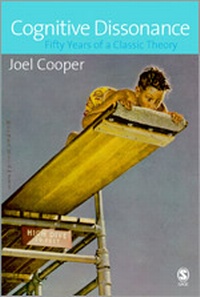
Cognitive Dissonance
50 Years of a Classic Theory
1st Edition
Published on 27. March 2007
216 pages
978-1-84920-344-9 (ISBN)
Description

'Dr. Joel Cooper has been at the very forefront of research on dissonance theory for decades now. In this book, he provides a brilliant and engagingly-written review of the 50-year history of dissonance research and a masterful account of the ensuing developments in the theory. The book will be an outstanding resource for readers familiar with dissonance research and an enlightening introduction for those who are not'
- Professor Russell H. Fazio, Ohio State University
Why is it that people who smoke continue to do so knowing how bad it is for them? What drives people to committing adultery even though they inherently believe this is wrong? What's the outcome of this contradiction in the mind?
Cognitive dissonance has been an important and influential theory since Leon Festinger published his classic work in 1957. It is known by every social psychologist, most psychologists of any stripe, and the lay public, making its way into such mainstream publications as The New York Times with increasing frequency and accuracy. Ultimately, dissonance has become one of the most popularly known expressions of social psychological insights, making its way into the literature in consumer, health and economic behavior, and has become a frequently used explanation of political behavior in the popular press and magazines.
In marking the 50th anniversary of the theory's inception, Joel Cooper - arguably the scholar most associated with dissonance research in the past few decades - has presented a beautiful, modern and comprehensive analysis of the state of dissonance theory. This book charts the progress of dissonance theory, assessing its impact not only within our understanding of psychology but in everyday experiences as well. It should be important reading for students in social psychology, either undergraduate or graduate, but equally relevant to a host of other readers who need to understand or share the same passions for appreciating the significance of cognitive dissonance in the human psyche.
- Professor Russell H. Fazio, Ohio State University
Why is it that people who smoke continue to do so knowing how bad it is for them? What drives people to committing adultery even though they inherently believe this is wrong? What's the outcome of this contradiction in the mind?
Cognitive dissonance has been an important and influential theory since Leon Festinger published his classic work in 1957. It is known by every social psychologist, most psychologists of any stripe, and the lay public, making its way into such mainstream publications as The New York Times with increasing frequency and accuracy. Ultimately, dissonance has become one of the most popularly known expressions of social psychological insights, making its way into the literature in consumer, health and economic behavior, and has become a frequently used explanation of political behavior in the popular press and magazines.
In marking the 50th anniversary of the theory's inception, Joel Cooper - arguably the scholar most associated with dissonance research in the past few decades - has presented a beautiful, modern and comprehensive analysis of the state of dissonance theory. This book charts the progress of dissonance theory, assessing its impact not only within our understanding of psychology but in everyday experiences as well. It should be important reading for students in social psychology, either undergraduate or graduate, but equally relevant to a host of other readers who need to understand or share the same passions for appreciating the significance of cognitive dissonance in the human psyche.
Reviews / Votes
Cooper (Princeton) does a superb job summarizing research on the concept of cognitive dissonance since it was first elucidated by Leon Festinger in the 1950s...Cooper brings a much-needed historical perspective to cognitive dissonance, and he peppers his discussion with interesting personal anecdotes. Political analysts as well as psychologists will be interested in the specific conditions that elicit cognitive dissonance."-CHOICE -- D.J. Winchester This book is fun to read!...Cooper takes care to delineate those studies that were particularly important in their purpose, particularly clever in their design, and most groundbreaking in their results. He makes a gripping story of the inception and march of progress in what could have been simply a long series of interesting research projects. In doing so, he made me nostalgic for a time when the field of psychology was alive with excitement and overrun with research topics that actually made sense to those outside a narrow specialty and that meant something to the citizenry." -Alan Cheney, PSYCCRITIQUES -- Alan Cheney * PSYCCRITIQUES *
All prices
More details
Language
English
Place of publication
London
United Kingdom
Target group
College/higher education
Professional and scholarly
ISBN-13
978-1-84920-344-9 (9781849203449)
Copyright in bibliographic data and cover images is held by Nielsen Book Services Limited or by the publishers or by their respective licensors: all rights reserved.
Schweitzer Classification
Other editions
Additional editions
Book
04/2007
1st Edition
SAGE Publications Inc
€243.90
Shipment within 10-20 days
Book
03/2007
1st Edition
SAGE Publications Inc
€104.20
Shipment within 10-20 days
Person
Joel M. Cooper is the owner/CEO at Red Scientific, Inc. He received a PhD in cognition and neural science in 2010 from the University of Utah.
Content
Cognitive Dissonance
In the Beginning
Criticism Propels the Theory Forward
The Motivational Property of Dissonance
Dissonance is not what it used to be
The New Look Model of Dissonance
The Self-Standards Model and the Emergence of the Self in Dissonance Theory
Vicarious Cognitive Dissonance
Experiencing Dissonance Through The Actions of Another
Culture, Race and Cognitive Dissonance
Cognitive Dissonance in Today's World
In the Beginning
Criticism Propels the Theory Forward
The Motivational Property of Dissonance
Dissonance is not what it used to be
The New Look Model of Dissonance
The Self-Standards Model and the Emergence of the Self in Dissonance Theory
Vicarious Cognitive Dissonance
Experiencing Dissonance Through The Actions of Another
Culture, Race and Cognitive Dissonance
Cognitive Dissonance in Today's World
