

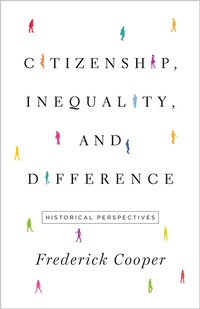
Citizenship, Inequality, and Difference
Historical Perspectives
1st Edition
Published on 21. August 2018
224 pages
978-1-4008-9042-2 (ISBN)
Description

A succinct and comprehensive history of the development of citizenship from the Roman Empire to the present day
Citizenship, Inequality, and Difference offers a concise and sweeping overview of citizenship's complex evolution, from ancient Rome to the present. Political leaders and thinkers still debate, as they did in Republican Rome, whether the presumed equivalence of citizens is compatible with cultural diversity and economic inequality. Frederick Cooper presents citizenship as "claim-making"--the assertion of rights in a political entity. What those rights should be and to whom they should apply have long been subjects for discussion and political mobilization, while the kind of political entity in which claims and counterclaims have been made has varied over time and space.
Citizenship ideas were first shaped in the context of empires. The relationship of citizenship to "nation" and "empire" was hotly debated after the revolutions in France and the Americas, and claims to "imperial citizenship" continued to be made in the mid-twentieth century. Cooper examines struggles over citizenship in the Spanish, French, British, Ottoman, Russian, Soviet, and American empires, and he explains the reconfiguration of citizenship questions after the collapse of empires in Africa and India. He explores the tension today between individualistic and social conceptions of citizenship, as well as between citizenship as an exclusionary notion and flexible and multinational conceptions of citizenship.
Citizenship, Inequality, and Difference is a historically based reflection on some of the most fundamental issues facing human societies in the past and present.
Citizenship, Inequality, and Difference offers a concise and sweeping overview of citizenship's complex evolution, from ancient Rome to the present. Political leaders and thinkers still debate, as they did in Republican Rome, whether the presumed equivalence of citizens is compatible with cultural diversity and economic inequality. Frederick Cooper presents citizenship as "claim-making"--the assertion of rights in a political entity. What those rights should be and to whom they should apply have long been subjects for discussion and political mobilization, while the kind of political entity in which claims and counterclaims have been made has varied over time and space.
Citizenship ideas were first shaped in the context of empires. The relationship of citizenship to "nation" and "empire" was hotly debated after the revolutions in France and the Americas, and claims to "imperial citizenship" continued to be made in the mid-twentieth century. Cooper examines struggles over citizenship in the Spanish, French, British, Ottoman, Russian, Soviet, and American empires, and he explains the reconfiguration of citizenship questions after the collapse of empires in Africa and India. He explores the tension today between individualistic and social conceptions of citizenship, as well as between citizenship as an exclusionary notion and flexible and multinational conceptions of citizenship.
Citizenship, Inequality, and Difference is a historically based reflection on some of the most fundamental issues facing human societies in the past and present.
More details
Language
English
Place of publication
Princeton, NJ
United States
Publishing group
De Gruyter
Target group
Professional and scholarly
Edition type
Digital original
Product notice
Reflowable
Illustrations
5 b/w illus.
File size
0,91 MB
ISBN-13
978-1-4008-9042-2 (9781400890422)
Schweitzer Classification
Other editions
Additional editions
Book
04/2021
Princeton University Press
€30.50
Shipment within 10-20 days
Book
05/2018
Princeton University Press
€43.40
Shipment within 10-20 days
Person
Frederick Cooper is professor of history at New York University. His many books include Empires in World History and Citizenship between Empire and Nation (both Princeton).
Content
Preface vii
Introduction Citizenship and Belonging 1
1 Imperial Citizenship from the Roman Republic to the Edict of Caracalla 27
2 Citizenship and Empire-Europe and Beyond 41
3 Empires, Nations, and Citizenship in the Twentieth Century 93
Conclusion Citizenship in an Unequal World 143
Notes 151
Index 195
