


Challenging the Qualitative-Quantitative Divide
Explorations in Case-Focused Causal Analysis
1st Edition
Published on 8. March 2012
288 pages
978-1-4411-0063-4 (ISBN)
Description

This book challenges the divide between qualitative and quantitative approaches that is now institutionalized within social science. Rather than suggesting the 'mixing' of methods, Challenging the Qualitative-Quantitative Divide provides a thorough interrogation of the arguments and practices characteristic of both sides of the divide, focusing on how well they address the common problems that all social research faces, particularly as regards causal analysis. The authors identify some fundamental weaknesses in both quantitative and qualitative approaches, and explore whether case-focused analysis - for instance, in the form of Qualitative Comparative Analysis, Analytic Induction, Grounded Theorising, or Cluster Analysis - can bridge the gap between the two sides.
Reviews / Votes
Highly Commended - Society for Educational Studies Annual Book Prize 2013 * The Society for Educational Studies * This book does three important things. It provides a useful account of how the qualitative-quantitative divide in research methods arose and became entrenched, it sets out the various reasons why we need to move beyond this divide, and it offers a vision and a demonstration of how this can be done using an approach that combines a focus on cases with the search for the causes of the social phenomena under investigation. It combines philosophical discussion with empirical illustration in an accessible way that will make readers reconsider their ideas about how to deal with depth and breadth in social research.More details
Series
Edition
1. Auflage
Language
English
Place of publication
New York
United States
ISBN-13
978-1-4411-0063-4 (9781441100634)
Copyright in bibliographic data and cover images is held by Nielsen Book Services Limited or by the publishers or by their respective licensors: all rights reserved.
Schweitzer Classification
Other editions
Additional editions
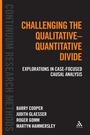
Barry Cooper | Judith Glaesser | Roger Gomm
Challenging the Qualitative-Quantitative Divide
Explorations in Case-focused Causal Analysis
Book
05/2012
Continuum Publishing Corporation
€54.50
Shipment within 15-20 days
Persons
Barry Cooper is Emeritus Professor of Education at Durham University, UK. From 2004-2007, he was co-editor of the British Educational Research Journal.
Judith Glaesser is Senior Lecturer in the School of Education at Durham University, UK.
Roger Gomm, now retired, was Lecturer in Health and Welfare at the Open University, UK. He has a long experience of ethnographic research in both the UK and internationally, and of bespoke evaluation research.
Martyn Hammersley is Professor of Educational and Social Research at the Centre for Childhood, Development and Learning at The Open University. He has carried out research in the sociology of education and the sociology of the media. However, much of his work has been concerned with the methodological issues surrounding social enquiry. He has written several books, including: Reading Ethnographic Research (1991); What's Wrong with Ethnography? (1992); The Politics of Social Research (1995); Taking Sides in Social Research (1999); Educational Research, Policymaking and Practice (2002), Questioning Qualitative Inquiry (2008), and Methodology, Who Needs It? (2011).
Judith Glaesser is Senior Lecturer in the School of Education at Durham University, UK.
Roger Gomm, now retired, was Lecturer in Health and Welfare at the Open University, UK. He has a long experience of ethnographic research in both the UK and internationally, and of bespoke evaluation research.
Martyn Hammersley is Professor of Educational and Social Research at the Centre for Childhood, Development and Learning at The Open University. He has carried out research in the sociology of education and the sociology of the media. However, much of his work has been concerned with the methodological issues surrounding social enquiry. He has written several books, including: Reading Ethnographic Research (1991); What's Wrong with Ethnography? (1992); The Politics of Social Research (1995); Taking Sides in Social Research (1999); Educational Research, Policymaking and Practice (2002), Questioning Qualitative Inquiry (2008), and Methodology, Who Needs It? (2011).
Content
Introduction
Part I: Problems with Quantitative and Qualitative Research
1. What's Wrong with Quantitative Research?
2. Quantitative Research on Meritocracy: The Problem of Inference from Outcomes to Opportunities
3. Qualitative Causal Analysis: Grounded Theorising and the Qualitative Survey
4. Qualitative Research and the Fallacies of Composition and Division: The Case of Ethnic Inequalities in Educational Achievement
Part II: Exploring Case-Focused Approaches to Causal Analysis
5. Set Theoretic versus Correlational Methods: the Case of Ability and Educational Achievement
6. Creating Typologies: Comparing Fuzzy Qualitative Comparative Analysis with Fuzzy Cluster Analysis
7. Analytic Induction versus Qualitative Comparative Analysis
Conclusion
References
Index
Part I: Problems with Quantitative and Qualitative Research
1. What's Wrong with Quantitative Research?
2. Quantitative Research on Meritocracy: The Problem of Inference from Outcomes to Opportunities
3. Qualitative Causal Analysis: Grounded Theorising and the Qualitative Survey
4. Qualitative Research and the Fallacies of Composition and Division: The Case of Ethnic Inequalities in Educational Achievement
Part II: Exploring Case-Focused Approaches to Causal Analysis
5. Set Theoretic versus Correlational Methods: the Case of Ability and Educational Achievement
6. Creating Typologies: Comparing Fuzzy Qualitative Comparative Analysis with Fuzzy Cluster Analysis
7. Analytic Induction versus Qualitative Comparative Analysis
Conclusion
References
Index
