

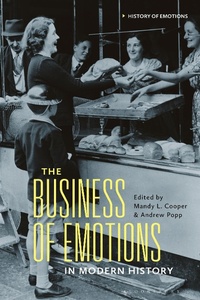
The Business of Emotions in Modern History
1st Edition
Published on 12. January 2023
288 pages
978-1-350-26250-8 (ISBN)
Description

The Business of Emotions in Modern History shows how businesses, from individual entrepreneurs to family firms and massive corporations, have relied on, leveraged, generated and been shaped by emotions for centuries. With a broad temporal and global coverage, ranging from the early modern era to the present day in Africa, Asia, Europe and North America, the essays in this volume highlight the rich potential for studying emotions and business in tandem.
In exploring how emotions and emotional situations affect business, and in turn how businesses affect the emotional lives of individuals and communities, this book allows us to recognise the emotional structures behind business decisions and relationships, and how to question them. From emotional labour in family firms, to affective corporate paternalism and the role of specific emotions such as trust, fear, anxiety love and nostalgia in creating economic connections, this book opens a rich new avenue of research for both the history of emotions and business history.
In exploring how emotions and emotional situations affect business, and in turn how businesses affect the emotional lives of individuals and communities, this book allows us to recognise the emotional structures behind business decisions and relationships, and how to question them. From emotional labour in family firms, to affective corporate paternalism and the role of specific emotions such as trust, fear, anxiety love and nostalgia in creating economic connections, this book opens a rich new avenue of research for both the history of emotions and business history.
More details
Series
Edition
1. Auflage
Language
English
Place of publication
London
United Kingdom
Publishing group
Bloomsbury Publishing PLC
Target group
Professional and scholarly
Illustrations
10 bw illus
ISBN-13
978-1-350-26250-8 (9781350262508)
Copyright in bibliographic data and cover images is held by Nielsen Book Services Limited or by the publishers or by their respective licensors: all rights reserved.
Schweitzer Classification
Other editions
Additional editions
Mandy L. Cooper | Andrew Popp
The Business of Emotions in Modern History
Book
08/2024
Bloomsbury Academic
€55.95
Shipment within 15-20 days
Persons
Mandy Cooper is Lecturer of History at the University of North Carolina at Greensboro, USA. Her current project shows how enduring practices, focused on emotional family ties, informed conceptions of business and government among the nation's political leaders in the decades between the American Revolution and Reconstruction.
Andrew Popp is Professor of History at Copenhagen Business School, Denmark, and Editor-in-Chief of Enterprise and Society: The International Journal of Business History. His book Entrepreneurial Families: Business, Marriage and Life in the Early Nineteenth-Century (2012) provided a sustained exploration of the relationshipbetween business and familial emotions.
Andrew Popp is Professor of History at Copenhagen Business School, Denmark, and Editor-in-Chief of Enterprise and Society: The International Journal of Business History. His book Entrepreneurial Families: Business, Marriage and Life in the Early Nineteenth-Century (2012) provided a sustained exploration of the relationshipbetween business and familial emotions.
Content
Introduction: At the Heart of the Market, Mandy L. Cooper and Andrew Popp, (University of North Carolina at Greensboro, USA, and Copenhagen Business School, Denmark)
Part I: Disciplinary Emotions
1. Accounting for the Middling Sorts: Emotions and the Family-Business, c1750-1832, Katie Barclay (University of Adelaide, Australia)
2. Emotional Strategies: Businesswomen in the Civil War Era United States, Mandy L. Cooper, (University of North Carolina at Greensboro, USA)
3. Selling Trust in the Antebellum Service Sector, Daniel Levinson Wilk (SUNY-Fashion Institute of Technology, USA)
4. The Cold War and the Making of Advertising in Post-War Turkey, Semih Gokatalay (University of California San Diego, USA)
Part II: Enabling Emotions
5. Marriage "à la mode du pays:" When Identity and Contractual Love Became a Pledge for the Signares' Business, Cheikh Sene (Université Paris 1 Panthéon-Sorbonne, France)
6. 'The commerce of affection': Masculinity and Emotional Bonds among Boston Merchants, Laura C. McCoy (Northwestern University, USA)
7. From Scotland with Love: The Creation of the Japanese Whisky Industry, 1918-1979, Alison J. Gibb and Niall G. MacKenzie (Adam Smith Business School, University of Glasgow, UK)
8. Malone's on the Southside: Hearing a Telling of Their Story, Andrew Popp (Copenhagen Business School, Denmark)
Part III: Unruly Emotions
9. The Worst Business in the World? The Emotional Historiography of the Arms Industry, Catherine Fletcher (Manchester Metropolitan University, UK)
10. Making Sense of Financal Crises in the Netherlands: The Emtional Economy of Bubbles (1637-1987), Joost Dankers (Utrecht University, The Netherlands), Ronald Kroeze (Vrije Universiteit Amsterdam, The Netherlands), Inger Leemans (Vrije Universiteit Amsterdam, The Netherlands), and Floris van Berckel Smit (Vrije Universiteit Amsterdam, The Netherlands)
11. Waiting for Fevers to Abate: Contagion and Fear in the Domestic Slave Trade, Robert Colby (Christopher Newport University, USA)
13. Selling Out or Staying True? Fear, Anxiety, and Debates about Feminist Entrepreneurship in the 1970s Women's Movement, Debra Michals (Merrimack College, USA)
Selected Bibliography
Index
Part I: Disciplinary Emotions
1. Accounting for the Middling Sorts: Emotions and the Family-Business, c1750-1832, Katie Barclay (University of Adelaide, Australia)
2. Emotional Strategies: Businesswomen in the Civil War Era United States, Mandy L. Cooper, (University of North Carolina at Greensboro, USA)
3. Selling Trust in the Antebellum Service Sector, Daniel Levinson Wilk (SUNY-Fashion Institute of Technology, USA)
4. The Cold War and the Making of Advertising in Post-War Turkey, Semih Gokatalay (University of California San Diego, USA)
Part II: Enabling Emotions
5. Marriage "à la mode du pays:" When Identity and Contractual Love Became a Pledge for the Signares' Business, Cheikh Sene (Université Paris 1 Panthéon-Sorbonne, France)
6. 'The commerce of affection': Masculinity and Emotional Bonds among Boston Merchants, Laura C. McCoy (Northwestern University, USA)
7. From Scotland with Love: The Creation of the Japanese Whisky Industry, 1918-1979, Alison J. Gibb and Niall G. MacKenzie (Adam Smith Business School, University of Glasgow, UK)
8. Malone's on the Southside: Hearing a Telling of Their Story, Andrew Popp (Copenhagen Business School, Denmark)
Part III: Unruly Emotions
9. The Worst Business in the World? The Emotional Historiography of the Arms Industry, Catherine Fletcher (Manchester Metropolitan University, UK)
10. Making Sense of Financal Crises in the Netherlands: The Emtional Economy of Bubbles (1637-1987), Joost Dankers (Utrecht University, The Netherlands), Ronald Kroeze (Vrije Universiteit Amsterdam, The Netherlands), Inger Leemans (Vrije Universiteit Amsterdam, The Netherlands), and Floris van Berckel Smit (Vrije Universiteit Amsterdam, The Netherlands)
11. Waiting for Fevers to Abate: Contagion and Fear in the Domestic Slave Trade, Robert Colby (Christopher Newport University, USA)
13. Selling Out or Staying True? Fear, Anxiety, and Debates about Feminist Entrepreneurship in the 1970s Women's Movement, Debra Michals (Merrimack College, USA)
Selected Bibliography
Index
