

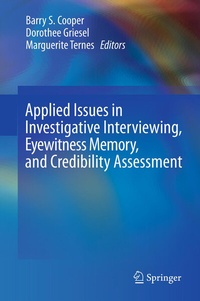
Applied Issues in Investigative Interviewing, Eyewitness Memory, and Credibility Assessment
Description

Contingent on funding being available, a Festschrift will be held in honor of Dr. John Yuille's career as a Forensic Psychologist. He has become one of the most visible and respected Canadian psychologists worldwide. In light of his upcoming retirement in December 2006, the Festschrift will recognize Dr. Yuille's achievements in the areas of eyewitness memory research (i.e., pioneering a new research paradigm that grants better validity), investigative interviewing (i.e., the development and use of the Step Wise Interview Protocol), and credibility assessment (i.e., introducing Statement Validity Analysis to North America). New directions for future work will be explored at the workshop. The focus of this Festschrift will be three-fold:
1. International. Dr. Yuille's work has influenced law enforcement practices and stimulated research in and outside of Canada. The international and multicultural aspects of the work that Dr. Yuille has inspired will be reflected and promoted by this workshop.
2. Interdisciplinary. Dr. Yuille is internationally known as an expert, consultant and trainer to law enforcement. As such, Dr. Yuille's work has also influenced other disciplines, e.g., the law, social work, oral history. The participants of this Festschrift will gain insight into other professionals' perspectives and foster potential collaborations on future projects.
3. Emphasis on applied research. A hallmark of Dr. Yuille's research has been the application of field and archival methods, which made his work directly applicable to forensically relevant contexts. The potential future directions of applied forensic research will be discussed at this Festschrift.
The importance of the subject at this time:
- A lack of integrative models in the literatures of eyewitness memory and the assessment of truthfulness and deception. Presenters of the Festschrift have recently developed such models and will discuss them at theFestschrift. Publishing these models and their discussions will spark further research to validate or modify them.
- New, pioneering field research based on such integrative models has recently been conducted. This book would be one of the first publications of the results.
More details
Other editions
Additional editions
Persons
Content
The challenge for forensic memory research: Methodolotry.- Credibility assessment, common law trials, and fuzzy logic.- The investigation and investigative interviewing of benefit fraud suspects in the UK: Historical and contemporary perspectives.- The sins of interviewing: Errors made by investigative interviewers and suggestions for redress.- Biopsychosocial perspectives on memory variability in eyewitnesses.- Children's memory in "scientific case studies" of child sexual abuse: A review.- Does testimonial inconsistency indicate memory inaccuracy and deception? Beliefs, empirical research, and theory.- Repeated interviews about repeated trauma from the distant past: A study of report consistency.- Discovering deceit: Applying laboratory and field research in the search for truthful and deceptive behaviour.- Is le mot juste? The contexualization of words by expert lie detectors.- Assessment criteria indicative of deception (ACID): An example of the new paradigm of differential recall enhancement.- The ABC's of CBCA: Verbal credibility assessment in practice.- An "eye" for an "I": The challenges and opportunities for spotting credibility in a digital world.
