

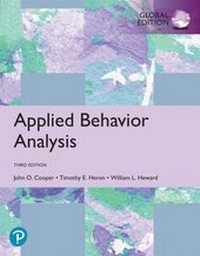
Applied Behavior Analysis, Global Edition
Description

The full text downloaded to your computer
With eBooks you can:
- search for key concepts, words and phrases
- make highlights and notes as you study
- share your notes with friends
eBooks are downloaded to your computer and accessible either offline through the Bookshelf (available as a free download), available online and also via the iPad and Android apps.
Upon purchase, you'll gain instant access to this eBook.
Time limit
The eBooks products do not have an expiry date. You will continue to access your digital ebook products whilst you have your Bookshelf installed.
All prices
More details
Other editions
Additional editions
Persons
John Cooper, Tim Heron, and Bill Heward were faculty members at The Ohio State University for a combined 90 years. Together they trained special education classroom teachers and leadership personnel guided by the philosophical, scientific, and technological principles of applied behavior analysis. The Ph.D. program in special education and applied behavior analysis that they and their colleagues developed at OSU was the first doctoral program accredited by the Association for Behavior Analysis International. John, Tim, and Bill each received the Alumni Award for Distinguished Teaching, OSU's highest honor for teaching excellence. They are joint recipients of the Ellen P. Reese Award for Communication of Behavioral Concepts from the Cambridge Center for Behavioral Studies.
John O. Cooper, Ed.D., is Professor Emeritus in the College of Education and Human Ecology at The Ohio State University. His research and teaching interests include precision teaching, inner behavior, fluency building, and verbal behavior. He is a past president of the Standard Celeration Society, past member of the Board of Directors for the Society for the Advancement of Behavior Analysis, and Applied Representative to the Executive Council and as Chairperson, Graduate Program Accreditation Committee of the Association for Behavior Analysis International.
Timothy E. Heron, Ed.D., is Professor Emeritus in the College of Education and Human Ecology at The Ohio State University. Tim's research interests include tutoring systems, inclusion of students with disabilities in general education classrooms, consultation, and self-correction instructional approaches. Tim is co-author of The Educational Consultant: Helping Professionals, Parents, and Students in Inclusive Classrooms, Fourth Edition (with Kathleen Harris, 2001). Since 2000, Tim has been an active Federal Aviation Administration, Gold Seal Certified Flight Instructor; has authored the text Instrument Flying: 10 Indispensable Principles to Know and Remember; and continues to apply the principles and procedures of applied behavior analysis to the next generation of aviators.
William L. Heward, Ed.D., BCBA-D, is Professor Emeritus in the College of Education and Human Ecology at The Ohio State University. Bill's interests include "low-tech" methods for increasing the effectiveness of group instruction and promoting the generalization and maintenance of newly learned skills. He has authored or co-authored five other books, including Exceptional Children: An Introduction to Special Education, Eleventh Edition (with Sheila Alber-Morgan and Moira Konrad, 2017), and Sign Here: A Contracting Book for Children and Their Parents (with Jill C. Dardig, 2016). A Fellow and Past President of the Association for Behavior Analysis International, Bill is a recipient of the Fred S. Keller Behavioral Education Award from Division 25 of the American Psychological Association and the Distinguished Psychology Department Alumnus Award from Western Michigan University.
Content
- 1. Definition and Characteristics of Applied Behavior Analysis
- 2. Basic Concepts and Principles
- 3. Selecting and Defining Target Behaviors
- 4. Measuring Behavior
- 5. Improving and Assessing the Quality of Behavioral Measurement
- 6. Constructing and Interpreting Graphic Displays of Behavioral Data
- 7. Analyzing Behavior Change: Basic Assumptions and Strategies
- 8. Reversal and Multielement Designs
- 9. Multiple Baseline and Changing Criterion Designs
- 10. Planning and Evaluating Applied Behavior Analysis Research
- 11. Positive Reinforcement
- 12. Negative Reinforcement
- 13. Schedules of Reinforcement
- 14. Positive Punishment
- 15. Negative Punishment
- 16. Motivating Operations
- 17. Stimulus Control
- 18. Verbal Behavior
- 19. Imitation, Modeling, and Observational Learning
- 20. Shaping
- 21. Chaining
- 22. Extinction
- 23. Differential Reinforcement
- 24. Antecedent Interventions
- 25.Functional Behavior Assessment
- 26. Token Economy, Group Contingencies, and Contingency Contracting
- 27. Self-Management
- 28. Generalization and Maintenance of Behavior Change
- 29. Ethical and Professional Responsibilities of Applied Behavior Analysts
