

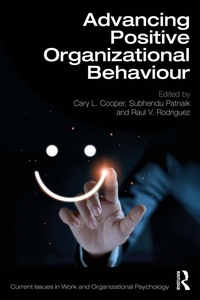
Advancing Positive Organizational Behaviour
Published on 15. April 2025
278 pages
978-1-040-34382-1 (ISBN)
Description

This comprehensive book provides an overview on the present status of positive organizational behaviour, offering insights on the growing body of research and scholarship, as well as suggestions for future directions in the field. Recent times have seen phenomenal and unprecedented changes in work settings, with many transitioning to hybrid or fully remote arrangements. In addition, unwarranted and unscrupulous application of technology, detrimental ramifications of work stress, and impaired well-being at work are posited to create an unsustainable work environment.
Bringing together leading experts from around the world, this collection synthesizes and captures the advancements within the discipline of positive organizational behaviour. It covers such topics as: psychological capital, work engagement interventions, self-efficacy, emotions and positive work behaviour, free will, resilience, work wellbeing, evolutionary psychology and positive workplace, cross-cultural positive organizational behaviour, common-good HRM practices, and methodological advances and challenges in positivity assessments.
The book offers a valuable resource for students and scholars of work/organizational psychology, organizational behaviour and applications of positive psychology. It is also a useful reference for organizations looking to understand and implement positive organizational policies in their workplaces.
Bringing together leading experts from around the world, this collection synthesizes and captures the advancements within the discipline of positive organizational behaviour. It covers such topics as: psychological capital, work engagement interventions, self-efficacy, emotions and positive work behaviour, free will, resilience, work wellbeing, evolutionary psychology and positive workplace, cross-cultural positive organizational behaviour, common-good HRM practices, and methodological advances and challenges in positivity assessments.
The book offers a valuable resource for students and scholars of work/organizational psychology, organizational behaviour and applications of positive psychology. It is also a useful reference for organizations looking to understand and implement positive organizational policies in their workplaces.
More details
Series
Language
English
Place of publication
London
United Kingdom
Publishing group
Taylor & Francis Ltd
Target group
College/higher education
Professional and scholarly
Illustrations
5 Tables, black and white; 10 Line drawings, black and white; 10 Illustrations, black and white
File size
3,42 MB
ISBN-13
978-1-040-34382-1 (9781040343821)
Copyright in bibliographic data and cover images is held by Nielsen Book Services Limited or by the publishers or by their respective licensors: all rights reserved.
Schweitzer Classification
Other editions
Additional editions

Book
05/2025
Routledge
Unfortunately, price unknown
Available (delivery time upon request)
Cary L. Cooper | Subhendu Patnaik | Raul V. Rodriguez
Advancing Positive Organizational Behaviour
Book
04/2025
1st Edition
Routledge
€206.60
Shipment within 10-20 days
Cary L. Cooper | Subhendu Patnaik | Raul V. Rodriguez
Advancing Positive Organizational Behaviour
Book
04/2025
1st Edition
Routledge
€63.20
Shipment within 10-20 days
Persons
Professor Sir Cary L. Cooper, CBE is the 50th Anniversary Professor of organizational psychology and health at the ALLIANCE Manchester Business School, University of Manchester, UK.
Subhendu Patnaik is an Assistant Professor of organizational behaviour and human resource management at the Management Development Institute, Gurgaon, India. He previously held the Sir Cary Cooper Professorship of organizational psychology and was the Chair at the Centre for Management Research (CMR), School of Business, Woxsen University, India.
Raul Villamarin Rodriguez is the Vice President at Woxsen University, India and holds the Steven Pinker Professor of cognitive psychology and Classavo Chair Professorship in integrative research and digital learning.
Subhendu Patnaik is an Assistant Professor of organizational behaviour and human resource management at the Management Development Institute, Gurgaon, India. He previously held the Sir Cary Cooper Professorship of organizational psychology and was the Chair at the Centre for Management Research (CMR), School of Business, Woxsen University, India.
Raul Villamarin Rodriguez is the Vice President at Woxsen University, India and holds the Steven Pinker Professor of cognitive psychology and Classavo Chair Professorship in integrative research and digital learning.
Content
About the Editors
About the Contributors
1. Editors Introduction: Advances in Positive Organizational Behaviour
Cary L. Cooper, Subhendu Patnaik and Raul V. Rodriguez
2. Positive Organizational Behavior and Psychological Capital (PsyCap): An Evidence-Based Twenty-Year Journey
Fred Luthans and Julie Dyrdek Broad
3. Positive Organizational Scholarship An Introduction
Kim Cameron
4. Wind of Change: Promising Work Engagement Interventions
Arnold B. Bakker and Tom L. Junker
5. Self-Efficacy
James E. Maddux and Thisali Mendis
6. A Five-Level Model of Positive Organizational Behavior and Emotions
Neal M. Ashkanasy and Momo D. Kromah
7. Optimizing Free Will within the Group Mind: A Hierarchical Extension of the Goal Breakthrough Model
Kennon M. Sheldon
8. Resilience in Organizational Settings
Thomas W. Britt and Chelsea LeNoble
9. Emerging Work Wellbeing Challenges
Paula Brough and Jafar Akbari
10. Evolutionary Psychology for a Positive Workplace
Stephen M. Colarelli, Carter Vespi, and Mable E. Clark
11. Cross-Cultural Positive Organizational Behaviour
Sharon Glazer and Catherine T. Kwantes
12. HEAL: Defining A New POB Construct
Vishal Gupta and Anmol Basant
13. Game, set and match! Creating An Organizational Growth Mindset and Positive Organizational Behavior Through Common-Good HRM
Brian Matthews, Michael Muller-Camen, and Jennifer Wieland
14. Methodological Developments and Challenges in Positive Trait Assessment
Gloria Liou, Andy Jiang and Louis Tay
15. PERMA+4 and Positive Organizational Psychology 2.0: Opportunities for Embracing Methodological and Technological Advances
Stewart I. Donaldson and Scott I. Donaldson
About the Contributors
1. Editors Introduction: Advances in Positive Organizational Behaviour
Cary L. Cooper, Subhendu Patnaik and Raul V. Rodriguez
2. Positive Organizational Behavior and Psychological Capital (PsyCap): An Evidence-Based Twenty-Year Journey
Fred Luthans and Julie Dyrdek Broad
3. Positive Organizational Scholarship An Introduction
Kim Cameron
4. Wind of Change: Promising Work Engagement Interventions
Arnold B. Bakker and Tom L. Junker
5. Self-Efficacy
James E. Maddux and Thisali Mendis
6. A Five-Level Model of Positive Organizational Behavior and Emotions
Neal M. Ashkanasy and Momo D. Kromah
7. Optimizing Free Will within the Group Mind: A Hierarchical Extension of the Goal Breakthrough Model
Kennon M. Sheldon
8. Resilience in Organizational Settings
Thomas W. Britt and Chelsea LeNoble
9. Emerging Work Wellbeing Challenges
Paula Brough and Jafar Akbari
10. Evolutionary Psychology for a Positive Workplace
Stephen M. Colarelli, Carter Vespi, and Mable E. Clark
11. Cross-Cultural Positive Organizational Behaviour
Sharon Glazer and Catherine T. Kwantes
12. HEAL: Defining A New POB Construct
Vishal Gupta and Anmol Basant
13. Game, set and match! Creating An Organizational Growth Mindset and Positive Organizational Behavior Through Common-Good HRM
Brian Matthews, Michael Muller-Camen, and Jennifer Wieland
14. Methodological Developments and Challenges in Positive Trait Assessment
Gloria Liou, Andy Jiang and Louis Tay
15. PERMA+4 and Positive Organizational Psychology 2.0: Opportunities for Embracing Methodological and Technological Advances
Stewart I. Donaldson and Scott I. Donaldson
