

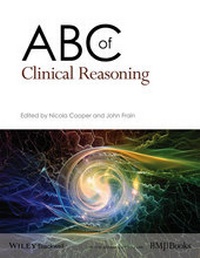
ABC of Clinical Reasoning
Description

Reviews / Votes
"Sound decision making is routinely cited asa cornerstone of clinical practice. But whattechniques actually underlie this process,and why does it ? all too often ? go wrong?The answers to these questions, and more,are provided by the authors of this book,who have successfully compressed theburgeoning subject of clinical reasoning intoa succinct and easily accessible textbook... The text attempts to cover a lot of groundfor such a slim volume and occasionalsections seem a little cramped. The overalleffect, though, is to enthusiastically andintelligently convey the importance of a so farunderappreciated yet vital aspect of clinicalpractice. Readers should not expect this text toprovide a complete summary of the subject(a comprehensive bibliography is supplied).Nor should they expect a single reading toprovide an instant remedy to deficienciesin their own decision making because, asthe editors state, developing sound clinicalreasoning is a ?lifelong? task. With that inmind, picking up this book would make anexcellent start."(BJGP Open, 24th February 2017)More details
Other editions
Additional editions
Persons
Content
CHAPTER 1
Clinical Reasoning: An Overview
Nicola Cooper1,2 and John Frain2
1 Derby Teaching Hospitals NHS Foundation Trust, UK
2 University of Nottingham, UK
OVERVIEW
- Clinical reasoning describes the thinking and decision-making processes associated with clinical practice
- The core elements of clinical reasoning include: evidence-based clinical skills, use and interpretation of diagnostic tests, understanding cognitive biases, human factors, metacognition (thinking about thinking), and patient-centred evidence-based medicine
- Diagnostic error is common and causes significant harm to patients. Errors in reasoning play a significant role in diagnostic error
- Sound clinical reasoning is directly linked to patient safety and quality of care
Introduction
Fellow author, Pat Croskerry, argues that although there are several qualities we would look for in a good clinician, the two absolute basic requirements for someone who is going to give you the best chance of being correctly diagnosed and appropriately managed are these: someone who is both knowledgeable and a good decision-maker. At the time of writing, medical schools and postgraduate training programmes teach and assess the knowledge and skills required to practise as a doctor, but few offer a comprehensive curriculum in decision-making. This is a problem because how doctors think, reason and make decisions is arguably their most critical skill.
This book covers the core elements of clinical decision-making - or clinical reasoning. It is designed not only for individuals but also as an introductory text for a course or as part of a curriculum in clinical reasoning. Chapter 9 specifically covers teaching clinical reasoning in undergraduate and postgraduate settings. In this chapter we define clinical reasoning, explain why it is important, and provide an overview of the different elements involved.
What is clinical reasoning?
Clinical reasoning describes the thinking and decision-making processes associated with clinical practice. According to Schön, it involves the 'naming and framing of problems' based on a personal understanding of the patient or client's situation. It is a clinician's ability to make decisions, often with others, based on the available clinical information, which includes history (sometimes from multiple sources), clinical examination findings and test results - against a backdrop of clinical uncertainty. Clinical reasoning also includes choosing appropriate treatments (or no treatment at all) and decision-making with patients and/or their carers. Box 1.1 gives a definition of clinical reasoning.
Box 1.1 A definition of clinical reasoning
'Clinical reasoning comprises the set of reasoning strategies that permit us to combine and synthesise diverse data in to one or more diagnostic hypotheses, make the complex trade-offs between the benefits and risks of tests and treatments, and formulate plans for patient management. Tasks such as generating diagnostic hypotheses, gathering and assessing clinical data, deciding on the appropriateness of diagnostic tests, assessing test results, assembling a coherent working diagnosis, and weighing the value of therapeutic approaches are a few of the components. Teaching these cognitive skills is a difficult matter even for outstanding clinician-teachers.'
From Kassirer JP and Kopelman RI. Learning clinical reasoning, 1st edn. Williams & Wilkins, 1991.
Figure 1.1 shows the different elements involved in clinical reasoning covered in this book, underpinned by a knowledge of basic and clinical sciences. Good clinical skills - in particular communication skills - are vital because the heart of the clinical reasoning process is often the patient's history and physical examination. Another element in clinical reasoning is understanding how to use and interpret diagnostic tests, something that is surprisingly rarely taught in a systematic way. Other elements include an understanding of cognitive psychology - how the human brain works with regards to decision-making - and human factors. We are unaware of the subconscious cognitive biases and errors to which we are prone in our everyday thinking and actions. Metacognition - thinking about thinking - is a critical skill that can be both learned and nurtured. It starts with an understanding of how we think, how our thinking and decision-making can be flawed, and how to mitigate this. Finally, reasoning does not end with a diagnosis. Patient-centred evidence-based medicine and shared decision-making (explored in Chapter 8) are also elements of clinical reasoning.
Figure 1.1 The elements involved in clinical reasoning, underpinned by a knowledge of basic and clinical sciences.
Clinical reasoning is a complex process that is not fully understood. It is only in recent years that doctors have begun to focus on their thinking processes, helped by advances in cognitive psychology that have given us models of decision-making that were not available before. In addition, while clinical reasoning is often conducted individually, it is often done in a team and also occurs in context - or 'problem spaces' as illustrated in Figure 1.2. These different contexts or points of view impact on our reasoning in ways we often do not realise.
Figure 1.2 Clinical reasoning in multiple problem spaces: factors influencing clinical decision-making.
Source: Higgs J and Jones MA. Clinical decision making and multiple problem spaces. In: Higgs J, Jones MA, Loftus S, Christensen N (eds), Clinical Reasoning in the Health Professions, 3rd edn. Elsevier, 2008. Reproduced with permission of Elsevier.
Why is clinical reasoning important?
Clinical reasoning is important because a wide variety of studies suggest that diagnostic error is common. Using various methods it is estimated that diagnosis is wrong 10-15% of the time, highest in the 'undifferentiated' specialties of emergency medicine, internal medicine and general practice. Diagnostic error causes significant harm - in the Harvard Medical Practice Study, which looked at adverse events, diagnostic error was much more likely to lead to serious disability than other types of error. In the USA, misdiagnosis now rivals surgical accidents as the leading cause of medico-legal claims.
There are many reasons why diagnostic error occurs. A comprehensive review of studies of misdiagnosis assigned three main categories, shown in Table 1.1. However, it has been estimated that roughly two-thirds of the root causes of diagnostic error involve errors in reasoning, most commonly when the available data are not synthesised correctly. This means that sound clinical reasoning is directly linked to patient safety and quality of care, and teaching it should be a priority.
Table 1.1 Root causes of diagnostic error.
Error category Examples No fault Unusual presentation of a diseaseMissing information System errors Technical, e.g. unavailable tests/results
Organisational, e.g. poor supervision of junior staff, error-prone processes, impossible workload Human cognitive error Faulty data gathering
Inadequate reasoning
History and examination
Clinical reasoning in medicine usually starts with a presenting complaint. We then listen to the patient's story - which could be from the patient or carers or eyewitnesses. During this process the clinician starts to generate different hypotheses as to what the problem might be. The history generates the most hypotheses. Clinical examination and in some cases tests narrow these down, as illustrated in Figure 1.3. For example, in breathlessness there is a wide differential. Experienced clinicians generate hypotheses early and are able to ask specific questions during the history in order to explore these hypotheses further. During the clinical examination the list of differentials becomes smaller if some findings are present or absent, and test results narrow things down even more - although as Chapter 3 explains, not in the way we might think.
Figure 1.3 Number of diagnostic hypotheses during the steps in making a diagnosis.
Source: Sox HC, Higgins MC, Owens DK. Medical Decision Making. Wiley-Blackwell, Oxford, 2013. Reproduced with permission of John Wiley & Sons, Ltd.
Although students are taught history and examination skills there may be little emphasis on the evidence-base or context of these vital skills. We make many assumptions about history and examination - a topic that is explored further in Chapter 2.
Probability and diagnostic tests
Information gathering can happen in seconds, as in the resuscitation room of an emergency department, or over a longer period of time, as in a clinic setting. After gathering information the clinician has to decide whether to treat, gather more information, or wait and see. Lots of factors come into play at...
