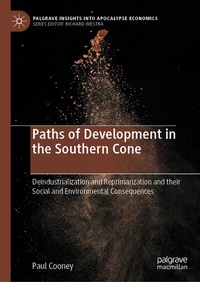
Paths of Development in the Southern Cone
Description

This book analyzes the recent development paths pursued by progressive
governments in Argentina and Brazil, namely deindustrialization and
reprimarization, and the social and environmental consequences thereof. A key
part of understanding the trajectories in both Argentina and Brazil has been the
role played by international institutions, especially the IMF and WTO, and also,
the ever-growing hegemony of transnational corporations in the global economy
and as a result, significantly limiting the possibilities of genuine development for
local populations.
Two major issues which extend beyond Latin America are: the expansion of
genetically modified crops and agrotoxics and the concern for global food security
and sovereignty; second, how reprimarization, associated with mining, cattle, soy
and petroleum, has been key in leading to the risk of desertification in the
Argentine pampas and also causing deforestation in the Amazon Rain forest,
described as the lungs of the planet, and thus has major implications for climate
change for the planet as a whole.
In addition, this book engages with a number of theoretical issues: development
and dependency in the periphery: neoliberal globalization, accumulation by
dispossession, ecological and environmental debates and the role of extractivismand rent. This book is aimed for both academics, activists and those politically
motivated to analyze, understand and push for social change from a critical
perspective, and also, those interested in a radical analysis of paths of
development, dependency and socioenvironmental issues in Latin America
today.
Reviews / Votes
"This book offers an illuminating, comprehensive and original account of the accumulation strategies and economic trajectories of Argentina and Brazil. The troubles and tribulations of industrialisation and deindustrialisation in these countries are examined in great detail, across a historical arch spanning several decades, and in the context of the changes in the world economy. This book is essential reading for anyone interested in the political economy of Argentina and Brazil." (-- Alfredo Saad-Filho, King's College London)
This book is a summation of Paul Cooney's last decade or so of work, explaining why the two most industrialised economies of South America are losing their core internally-oriented manufacturing potential, in favour of the export-oriented and extractivist circuits of capital (albeit with the latter suffering crises at the end of the global commodity super-cycle). The work is the most sophisticated about these two countries that I know of, and in the book, Cooney seeks to more formally introduce the 'reprimarization' concept. To do so, Cooney provides an excellent historical trajectory of these countries, focusing on both world economic dynamics and local class-forming processes. As well as anyone, he understands the dynamics within the main sectors: soy, cattle, mining, fossil fuels, and biofuels. He is particularly committed to a critique of the 'New Developmentalism' thesis of former Finance Minister Luiz Carlos Bresser-Pereira, a critique with which I fully agree. He also utilizes Marxist political economy very fruitfully, particularly by employing David Harvey's concepts of rent and dispossession. (-- Patrick Bond, University of The Witwatersrand, Johannesburg, South Africa Distinguished Professor of Political Economy, Wits School of Governance)
More details
Other editions
Additional editions