

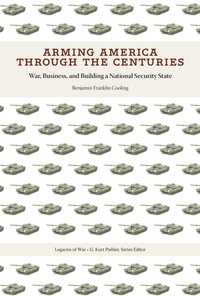
Arming America through the Centuries
Description

While many associate the concept commonly referred to as the "military-industrial complex" with President Dwight D. Eisenhower's 1961 farewell address, the roots of it existed two hundred years earlier. This concept, as Benjamin Franklin Cooling writes, was "part of historical lore" as a burgeoning American nation discovered the inextricable relationship between arms and the State. In Arming America through the Centuries, Cooling examines the origins and development of the military-industrial complex (MIC) over the course of American history. He argues that the evolution of America's military-industrial-business-political experience is the basis for a contemporary American Sparta. Cooling explores the influence of industry on security, the increasing prevalence of outsourcing, ever-present economic and political influence, and the evolving nature of modern warfare. He connects the budding military-industrial relations of the colonial era and Industrial Revolution to their formal interdependence during the Cold War down to the present-day resurrection of Great Power competition. Across eight chronological chapters, Cooling weaves together threads of industry, finance, privatization, appropriations, and technology to create a rich historical tapestry of US national defense in one comprehensive volume.
Integrating information from both recent works as well as canonical, older sources, Cooling's ambitious single-volume synthesis is a uniquely accessible and illuminating survey not only for scholars and policymakers but for students and general readers as well.
More details
Other editions
Additional editions
Person
Benjamin Franklin Cooling is professor of strategy and national security studies in the Eisenhower School for National Security and Resource Strategy at National Defense University. He has taught and written extensively on war, business and American society as well as military, naval, and air history.
Content
- Intro
- Contents
- Foreword | G. Kurt Piehler
- Preface
- Chapter 1. Colonial Security Shaped by War and Trade, to 1783
- Chapter 2. Manifest Destiny, Industrial Revolution, Public Enterprise, 1783-1860
- Chapter 3. Resourcing the Civil War and Arming the People, 1860-1865
- Chapter 4. Continental Defense, Imperial Pretensions, and Formation of the MIC, 1865-1917
- Chapter 5. Arsenal of Democracy in Two World Wars, 1917-1945
- Chapter 6. The Cold War MIC and Eisenhower's Warning, 1945-1990
- Chapter 7. Cold War Legacy and the Grave New World, 1991-2001
- Chapter 8. National Security since 2001
- Postscript. The National Security State for Posterity
- Notes
- Selected Bibliography
- Index
