

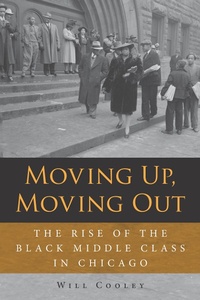
Moving Up, Moving Out
The Rise of the Black Middle Class in Chicago
Published on 19. October 2018
200 pages
978-1-60909-243-6 (ISBN)
Description

In Moving Up, Moving Out, Will Cooley discusses the damage racism and discrimination have exacted on black Chicagoans in the twentieth century, while accentuating the resilience of upwardly-mobile African Americans. Cooley examines how class differences created fissures in the black community and produced quandaries for black Chicagoans interested in racial welfare. While black Chicagoans engaged in collective struggles, they also used individualistic means to secure the American Dream. Black Chicagoans demonstrated their talent and ambitions, but they entered through the narrow gate, and whites denied them equal opportunities in the educational institutions, workplaces, and neighborhoods that produced the middle class. African Americans resisted these restrictions at nearly every turn by moving up into better careers and moving out into higher-quality neighborhoods, but their continued marginalization helped create a deeply dysfunctional city. African Americans settled in Chicago for decades, inspired by the gains their forerunners were making in the city. Though faith in Chicago as a land of promise wavered, the progress of the black middle class kept the city from completely falling apart. In this important study, Cooley shows how Chicago, in all of its glory and faults, was held together by black dreams of advancement. Moving Up, Moving Out will appeal to urban historians and sociologists, scholars of African American studies, and general readers interested in Chicago and urban history.
Reviews / Votes
In pushing the boundaries of segregation, the 'aspiring class' of Black Chicagoans suffered sustained harassment and violence from anonymous whites Cooley's book traces this oppression well into the twentieth century.(South Side Weekly) Cooley's study provides a fresh approach to a well-covered subject and is a welcome addition to the literature.
(Journal of American History) Moving Up, Moving Out tells an important and concise story that points to the interworkings of America's caste system.The study will work well in an undergraduate or graduate classroom interested in the workings of racial capitalism.The study will work well in an undergraduate or graduate classroom interested in the workings of racial capitalism Overall, Moving Up, Moving Out tells an important and concise story that points to the interworkings of America's caste system
(The Journal of African American History)
More details
Language
English
Place of publication
Ithaca
United States
Publishing group
Cornell University Press
Product notice
Reflowable
ISBN-13
978-1-60909-243-6 (9781609092436)
Copyright in bibliographic data and cover images is held by Nielsen Book Services Limited or by the publishers or by their respective licensors: all rights reserved.
Schweitzer Classification
Other editions
Additional editions
Book
10/2018
Northern Illinois University Press
€55.89
Shipment within 3-4 weeks
Person
Will Cooley is community faculty at Metropolitan State University in Minnesota.
Content
- Cover
- MOVING UP, MOVING OUT
- Title
- Copyright
- Dedication
- CONTENTS
- ACKNOWLEDGMENTS
- INTRODUCTION
- CHAPTER 1 HUSTLERS AND STRIVERS
- CHAPTER 2 MOVING ON OUT
- CHAPTER 3 CAN THE MIDDLE CLASS SAVE CHICAGO?
- CHAPTER 4 BLACK AMERICANS IN WHITE COLLARS
- CONCLUSION
- NOTES
- INDEX
