

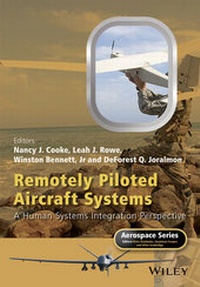
Remotely Piloted Aircraft Systems
Description

Reviews / Votes
"The book highlights the human components of Remotely Piloted Aircraft Systems, their interactions with the technology and each other, and the implications of human capabilities and limitations for the larger system." (ExpoFairs 15/03/2017)More details
Other editions
Additional editions
Persons
Nancy J. Cooke is a professor of Human Systems Engineering in The Polytechnic School, one of the Ira A. Fulton Schools of Engineering at Arizona State University and is Science Director of the Cognitive Engineering Research Institute in Mesa, AZ. Nancy Cooke's research interests include the study of individual and team cognition and its application to the development of cognitive and knowledge engineering methodologies, healthcare, homeland security systems, remotely-piloted aircraft, and emergency response systems. In particular, Cooke specializes in the development, application, and evaluation of methodologies to elicit and assess individual and team cognition (i.e., team situation awareness, coordination) and performance. Her work has been funded by AFOSR, ONR, and ARO.
Leah J. Rowe is a Senior Research Psychologist in the Warfighter Readiness Research Division with the Air Force Research Laboratory's Human Effectiveness Directorate in Dayton Ohio. She is the Technical Advisor in the Continuous Learning and Performance Assessment Branch where she leads researchers, engineers, and subject matter experts in training effectiveness research. Dr. Rowe and her team execute research in performance evaluation, personnel assessment, training requirements identification, and quantifying the impact of training interventions. She has been collaborating on RPAS research for the last six years and has focussed on team training and readiness. Dr. Rowe received her M.S. in Applied Psychology and Ph.D. in Industrial and Organizational Psychology.
Winston "Wink" Bennett, Jr. is the Technical Advisor for the Warfighter Readiness Research Division located at Wright Patterson AFB Ohio. He is an Air Force Research Laboratory Research Fellow and a Fellow of the American Psychological Association. He is currently conducting research related to the integration of live and virtual training to improve mission readiness and job proficiency. He is also leading research developing methods to monitor and routinely assess individual and team performance across live and virtual environments and evaluating game-based approaches for training, work design, and job restructuring. Wink maintains an active presence in the international research community through his work on various professional committees and his contributions in professional journals and forums. He is an Associate Editor for the Journal Military Psychology and serves as a contributing editor and/or as a reviewer for other professional journals. His involvement with the larger psychological research community ensures that communication amongst international military, industry and academic researchers remains consistent and of the highest quality. Wink received his Ph.D. in Industrial Organizational Psychology from Texas A&M University in 1995.
DeForest Joralmon is a Senior Research Scientist for L-3 Communications, Link Simulation and Training Division, working under contract to the Warfighter Readiness Research Division of the Air Force Research Laboratory. He holds a Bachelor of Science Degree in Telecommunications from Northern Arizona University, a Master of Mass Communication Degree from the Walter Cronkite School of Journalism and Telecommunication at Arizona State University, and a Ph.D. in Curriculum and Instruction from Arizona State University. His recent work is centered on conducting research and development of Remotely Piloted Aircraft, Joint Terminal Attack Controller, and Air Support Operations Center training rehearsal systems for the Integrated Combat Operations Training-Research Testbed. He also conducts Joint and Coalition Training, Rehearsal, and Exercise research. He has previously conducted applied research and development in the use of advanced multimedia instructional technologies and specifically produced interactive multimedia curriculum used for U.S. Department of Defence night vision device warfighter training.
