

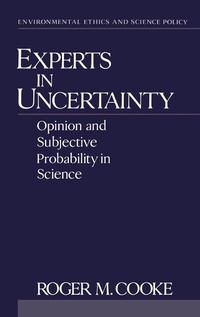
Experts in Uncertainty
Opinion and Subjective Probability in Science
Published in December 1991
334 pages
978-0-19-536237-4 (ISBN)
Description

This book is an extensive survey and critical examination of the literature on the use of expert opinion in scientific inquiry and policy making. The elicitation, representation, and use of expert opinion is increasingly important for two reasons: advancing technology leads to more and more complex decision problems, and technologists are turning in greater numbers to "expert systems" and other similar artifacts of artificial intelligence. Cooke here considers how expert opinion is being used today, how an expert's uncertainty is or should be represented, how people do or should reason with uncertainty, how the quality and usefulness of expert opinion can be assessed, and how the views of several experts might be combined. He argues for the importance of developing practical models with a transparent mathematic foundation for the use of expert opinion in science, and presents three tested models, termed "classical," "Bayesian," and "psychological scaling." Detailed case studies illustrate how they can be applied to a diversity of real problems in engineering and planning.
More details
Language
English
Place of publication
Oxford
United Kingdom
Illustrations
28 line illus.
File size
16,18 MB
ISBN-13
978-0-19-536237-4 (9780195362374)
Copyright in bibliographic data and cover images is held by Nielsen Book Services Limited or by the publishers or by their respective licensors: all rights reserved.
Schweitzer Classification
Other editions
Additional editions
Book
01/1992
Oxford University Press Inc
€307.00
Shipment within 15-20 days
Content
- Intro
- Contents
- Introduction
- PART I: EXPERTS AND OPINIONS
- 1. Think Tanks and Oracles
- Background
- The RAND Corporation
- Herman Kahn
- Scenario analysis
- The Delphi method
- Conclusions: Toward a methodology for expert opinion
- 2. Expert Opinion in Practice
- The Aerospace sector
- Military intelligence
- Probabilistic risk analysis
- Policy analysis
- 3. Probabilistic Thinking
- Thinking
- Representing uncertainty in artificial intelligence
- Fuzziness
- Conclusion
- 4. Heuristics and Biases
- Availability
- Anchoring
- Representativeness
- Control
- The base rate fallacy
- Overconfidence and calibration
- Conclusion
- 5. Building rational consensus
- Rational consensus
- Principles
- Conclusion
- PART II: SUBJECTIVE PROBABILITY
- 6. Savage's Normative Decision Theory
- The decision model
- The representation theorem
- Observation
- Supplement
- 7. Relative Frequencies and Exchangeability
- The frequentist account of learning by experience
- Expected frequency
- Exchangeability
- De Finetti's finite representation theorem
- Supplement
- 8. Elicitation and Scoring
- Elicitation
- Scoring
- Methodological problems
- Practical guidelines
- 9. Scoring Rules for Evaluating and Weighing Assessments
- Improper scoring rules
- Scoring rules for individual variables
- Proper scoring rules for average probabilities
- Asymptotic properties
- A menu of weights
- Heuristics of weighing
- Supplement
- 10. Two Experiments with Calibration and Entropy
- Calibration and knowledge
- brief review of the literature
- The mechanical engineer experiment
- The managers experiment
- Conclusion
- PART III: COMBINING EXPERT OPINIONS
- 11. Combining Expert Opinions
- Review of the Literature
- Weighted combinations of probabilities
- Bayesian combinations
- Psychological scaling
- Conclusion
- 12. The Classical Model
- Notation and definitions
- Basic model
- uncertain events
- Basic model
- continuous variables
- Variations and enhancements
- Issues
- Measuring and optimizing performance
- virtual weights
- Correlation
- Conclusions
- 13. The Bayesian Model
- Basic theory
- Notations and definitions
- The Mendel-Sheridan model
- assumptions
- Evaluation of model performance via bilinear loss functions
- A partially exchangeable Bayesian model
- Conclusions
- 14. Psychological Scaling Models: Paired Comparisons
- Generic issues
- Significant preference for one expert
- Significant preference for the set of experts
- The Thurstone model
- The Bradley-Terry model
- The negative exponential lifetime model
- Relation to principles for expert opinion in science
- 15. Applications
- Applications of the classical model
- The Royal Dutch Meteorological study
- Bayesian analysis
- Flange connections at a process plant-paired comparisons
- Flange connections at a process plant-the classical model
- Supplement
- 16. Conclusions
- Part I
- Part II
- Part III
- Appendix A. Mathematical Framework and Interpretation
- Mathematical framework
- Interpretation
- Conditional probability, independence, Bayes' theorem
- Expectation, moments, moment convergence
- Distributions
- Entropy, information, relative information
- Appendix B. Standard normal, inverse normal, Chi square, coefficient of agreement, coefficient of concordance
- References
- Author Index
- A
- B
- C
- D
- E
- F
- G
- H
- J
- K
- L
- M
- O
- P
- R
- S
- T
- V
- W
- Z
- Subject Index
- A
- B
- C
- D
- E
- F
- H
- I
- J
- K
- L
- M
- N
- O
- P
- Q
- R
- S
- T
- U
- V
- W
- Z
