

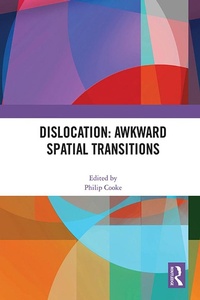
Dislocation: Awkward Spatial Transitions
1st Edition
Published on 17. May 2021
328 pages
978-1-000-38786-5 (ISBN)
Description

Today, the world is in the most serious turmoil it has experienced for many centuries. These multiple crises arise from the fundamental mistreatment by capitalist competition of the carrying capacity of the planet. Even before coronavirus, evidently morbid symptoms of over-development led many spatial planners to write of the threat of a new Dark Age. Many advocated a return to policy decentralisation as the Covid-19 crisis demonstrated once again the failure of 'global controller' mindsets to manage complex systems successfully.
Dislocation: Awkward Spatial Transitions is a critical exploration of where spatial development processes and rules have gone wrong across many economies. The chapters lay out which mindsets have been responsible for this and gives pointers to new practices that aim to ameliorate the effects of past failings. In the first nine chapters, a mapping of key elements of the prevailing omni-crisis are summarised. These range from an exegesis of the Anthropocene, the rise of populism, the transition to neoliberalist anti-planning, and migration as planning issues with pleas for evolutionary change in spatial policy and process dynamics. Finally, a group of chapters explores the flailing as territorial governances tried to plot the rise of creative cities, 4.0 era industry and services, and in the built form, the role of 'starchitects' in city renewal. In the last part, attention is devoted to territorial innovation, knowledge recombination, sustainable mobility and, finally, green entrepreneurship, as necessary elements of a post-coronavirus, climate change mitigation and sustainable mobility set of survival strategies.
The chapters in this book were originally published in the journal European Planning Studies.
Dislocation: Awkward Spatial Transitions is a critical exploration of where spatial development processes and rules have gone wrong across many economies. The chapters lay out which mindsets have been responsible for this and gives pointers to new practices that aim to ameliorate the effects of past failings. In the first nine chapters, a mapping of key elements of the prevailing omni-crisis are summarised. These range from an exegesis of the Anthropocene, the rise of populism, the transition to neoliberalist anti-planning, and migration as planning issues with pleas for evolutionary change in spatial policy and process dynamics. Finally, a group of chapters explores the flailing as territorial governances tried to plot the rise of creative cities, 4.0 era industry and services, and in the built form, the role of 'starchitects' in city renewal. In the last part, attention is devoted to territorial innovation, knowledge recombination, sustainable mobility and, finally, green entrepreneurship, as necessary elements of a post-coronavirus, climate change mitigation and sustainable mobility set of survival strategies.
The chapters in this book were originally published in the journal European Planning Studies.
More details
Edition
1. Auflage
Language
English
Place of publication
London
United Kingdom
Publishing group
Taylor & Francis Ltd
Target group
College/higher education
Product notice
Reflowable
ISBN-13
978-1-000-38786-5 (9781000387865)
Copyright in bibliographic data and cover images is held by Nielsen Book Services Limited or by the publishers or by their respective licensors: all rights reserved.
Schweitzer Classification
Other editions
Additional editions

Philip Cooke
Dislocation: Awkward Spatial Transitions
Book
09/2023
1st Edition
Routledge
€51.98
Shipment within 15-20 days
Book
05/2021
1st Edition
Routledge
€207.00
Shipment within 15-20 days
Person
Philip Cooke is Professor in the Mohn Center for Innovation and Regional Development at the Western Norway University of Applied Sciences, Bergen, Norway, and Editor of the journal European Planning Studies. He is the author of 250 academic papers and author/editor of over 30 books and holds honorary doctorates from the University of Lund (Sweden) and the University of Lappeenranta (Finland).
Content
1. Retrospect and prospect: from a new dark age to a new dawn of planning enlightenment
Philip Cooke
2. Between the frog and the eagle: claiming a 'Scholarship of Presence' for the Anthropocene
Maria Kaika
3. Neoliberalization, uneven development, and Brexit: further reflections on the organic crisis of the British state and society
Bob Jessop
4. Immigration strategies of cities: local growth policies and urban planning in Germany
Manfred Kuehn
5. Regional resilience: a stretched concept?
Klaas Froehlich and Robert Hassink
6. Regional innovation policies for new path development - beyond neo-liberal and traditional systemic views
Franz Toedtling and Michaela Trippl
7. New perspectives on the evolution of clusters
Fiorenza Belussi
8. Generative growth with 'thin' globalization: Cambridge's crossover model of innovation
Philip Cooke
9. The entrepreneurial university and the region: what role for entrepreneurship departments?
Rhiannon Pugh, Wadid Lamine, Sarah Jack and Eleanor Hamilton
10. Rethinking city transformation: Florence from art city to creative fashion city
Luciana Lazzeretti and Stefania Oliva
11. Situating architectural performance: 'star architecture' and its roles in repositioning the cities of Graz, Lucerne and Wolfsburg
Nadia Alaily-Mattar, Dominik Bartmanski, Johannes Dreher, Michael Koch, Martina Loew, Timothy Pape and Alain Thierstein
12. Firm Performance, Innovation Modes and Territorial Embeddedness
Sergio Leal Nunes and Raul Lopes
13. Knowledge bases in German regions: what hinders combinatorial knowledge dynamics and how regional innovation policies may help
Tatjana Bennat and Rolf Sternberg
14. The 'Dark Triad' story of widespread entrepreneurial decline and a future recovery discourse
Philip Cooke
15. Wishful thinking? Towards a more realistic role for universities in regional innovation policy
Louise Kempton
16. Place leadership and the challenge of transformation: policy platforms and innovation ecosystems in promotion of green growth
Markku Sotarauta and Nina Suvinen
Philip Cooke
2. Between the frog and the eagle: claiming a 'Scholarship of Presence' for the Anthropocene
Maria Kaika
3. Neoliberalization, uneven development, and Brexit: further reflections on the organic crisis of the British state and society
Bob Jessop
4. Immigration strategies of cities: local growth policies and urban planning in Germany
Manfred Kuehn
5. Regional resilience: a stretched concept?
Klaas Froehlich and Robert Hassink
6. Regional innovation policies for new path development - beyond neo-liberal and traditional systemic views
Franz Toedtling and Michaela Trippl
7. New perspectives on the evolution of clusters
Fiorenza Belussi
8. Generative growth with 'thin' globalization: Cambridge's crossover model of innovation
Philip Cooke
9. The entrepreneurial university and the region: what role for entrepreneurship departments?
Rhiannon Pugh, Wadid Lamine, Sarah Jack and Eleanor Hamilton
10. Rethinking city transformation: Florence from art city to creative fashion city
Luciana Lazzeretti and Stefania Oliva
11. Situating architectural performance: 'star architecture' and its roles in repositioning the cities of Graz, Lucerne and Wolfsburg
Nadia Alaily-Mattar, Dominik Bartmanski, Johannes Dreher, Michael Koch, Martina Loew, Timothy Pape and Alain Thierstein
12. Firm Performance, Innovation Modes and Territorial Embeddedness
Sergio Leal Nunes and Raul Lopes
13. Knowledge bases in German regions: what hinders combinatorial knowledge dynamics and how regional innovation policies may help
Tatjana Bennat and Rolf Sternberg
14. The 'Dark Triad' story of widespread entrepreneurial decline and a future recovery discourse
Philip Cooke
15. Wishful thinking? Towards a more realistic role for universities in regional innovation policy
Louise Kempton
16. Place leadership and the challenge of transformation: policy platforms and innovation ecosystems in promotion of green growth
Markku Sotarauta and Nina Suvinen
