

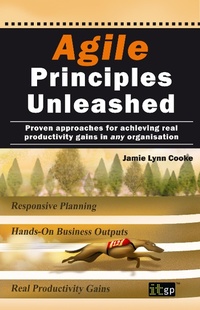
Agile Principles Unleashed
Proven Approaches for Achieving Real Productivity in Any Organisation
Published on 27. July 2010
390 pages
978-1-84928-058-7 (ISBN)
Description

Agile Principles Unleashed: Proven approaches for achieving real productivity gains in any organisation introduces every industry sector to the Agile approaches that have dramatically improved the IT, product development and manufacturing sectors over the past two decades. Agile Principles Unleashed clearly explains how the key principles of Agile approaches can be used to significantly increase productivity, quality and customer satisfaction in any organisation. Written in non-technical language specifically for business professionals, this book is an essential tool for anyone whose job it is to deliver high quality results on time and to budget.
More details
Other editions
Additional editions

Jamie Lynn Cooke
Agile Principles Unleashed
Proven Approaches for Achieving Real Productivity Gains in Any Organisation
Book
07/2010
IT Governance Publishing
€57.11
Article exhausted; check different version
Content
- Intro
- Contents
- Introduction
- Agile: an executive summary
- SECTION 1: A CASE STUDY
- A Case Study: Traditional versus Agile Approaches
- Website building in a competitive marketplace
- The traditional approach
- July
- August
- The next four months .
- December (one possible outcome)
- December (an alternative outcome)
- The Agile approach
- July
- August
- The next three months .
- November
- Product marketing in a competitive marketplace
- The traditional approach
- July
- August
- The next three months .
- The Agile approach
- Early July
- Mid-July
- August
- The next three months .
- November
- Order fulfilment in a competitive marketplace
- The traditional approach
- Stretching the seams
- Expected (and unexpected) delays
- Other issues
- The end result
- The Agile approach
- Early July
- Optimising the business processes
- Early August
- The next three months .
- November
- The end result
- But what about my organisation?
- The path forward
- SECTION 2: WHAT YOU NEED TO KNOW ABOUT AGILE
- Chapter 1: Agile in a Nutshell
- Understanding Agile principles
- Embracing change
- Responsive planning
- Frequent and continuous business value
- Direct stakeholder engagement
- Regular face-to-face communication
- Minimising waste
- Tangible outputs
- Empowering the team
- Quality by design
- Continuous improvement
- Agile in action
- Over-planning
- Insufficient communication
- 'All-at-once' delivery
- Over-planning
- Insufficient communication
- 'All-at-once' delivery
- Popular Agile methods
- Scrum
- Dynamic Systems Development Method
- Feature-Driven Development
- eXtreme Programming
- Lean manufacturing
- Who uses Agile?
- Yahoo!
- Nokia Siemens Networks
- BT
- Chapter 2: Why is Agile So Effective?
- Management of controllable risk
- Responsive planning
- Frequent and continuous business value
- Direct stakeholder engagement
- Regular face-to-face communication
- Minimising waste
- Tangible outputs
- Empowering the team
- Quality by design
- Minimal start-up costs
- Initial and ongoing returns
- Chapter 3: Why Don't More Organisations Use Agile?
- Chapter 4: Agile Sounds Good, But .
- SECTION 3: 12 AGILE PRINCIPLES THAT WILL REVOLUTIONISE YOUR ORGANISATION
- Chapter 5: Responsive Planning
- Why every up-front plan fails
- Apply, Inspect, Adapt
- Defining (and refining) your goals
- Paving the pathway
- Empowering the delivery team
- The critical decision points
- When to walk away
- Publicising your success
- Chapter 6: Business-value-Driven Work
- Real productivity
- Primary business-value outcomes
- Secondary business-value outcomes
- Dancing around the budget bonfire
- Over-delivery is wasted money
- Measuring cost/benefit
- Communicating actionable goals and priorities
- Drawing the line
- When priorities change
- It's more than the baton
- Chapter 7: Hands-on Business Outputs
- The 'try before you buy' power position
- There is no substitute for reality
- Mitigating risk
- Continuous delivery of valuable outputs
- When the end does not justify the means
- Chapter 8: Real-time Customer Feedback
- Every audience is a customer
- The false security of market testing
- Intrinsic customer satisfaction
- The 'expert by proxy' myth
- Hiring a customer
- Using the customer to manage your budget
- Chapter 9: Immovable Deadlines
- Why you should never move a deadline
- The power of imminent time-frames
- Early delivery means early payback
- Setting the next deadline
- Chapter 10: Management by Self-motivation
- 'I'm not going to do it - and you can't make me'
- The top-down and bottom-up management myths
- Top-down management myths
- Bottom-up management myths
- The power of self-organised teams
- Giving the team a higher purpose
- In my estimation .
- Trusting the team
- Why shorter deadlines lead to happier employees
- The end of overtime
- Success breeds motivation
- Chapter 11: 'Just-in-time' Communication
- When was the last time you attended a valuable meeting?
- Redefining the corporate meeting
- What can you do in five minutes?
- Knowledge transfer through pairing, co-location and cross-training
- Documentation is no substitute
- The most valuable meeting of all
- Chapter 12: Immediate Status Tracking
- The end of the monthly report
- The requirements backlog
- The delivery backlog
- The executive dashboard
- Burndown charts
- Measuring productivity by outputs
- Tracking overall progress in the requirements backlog
- Tracking day-to-day work in the delivery backlog
- The power of the 'burndown' chart
- The real-time executive dashboard
- Early and continuous delivery tracking
- Redefining risk management
- Chapter 13: Waste Management
- What is waste management?
- It's what you don't do that matters
- The power and peril of the value stream
- The waiting game
- Movement without added value
- Task-switching and time leakage
- Doing it right the first time
- 'Just-in-time' versus 'just-in-case'
- Maximising your resources
- Chapter 14: Constantly Measurable Quality
- How much does quality cost?
- Weight control and the bathroom scale
- True quality requires a culture change
- The impact of high communication
- Quality by design
- Fit-for-purpose outputs
- The (almost) real-time measuring stick
- Exponential returns on your quality investment
- Chapter 15: Rear-view Mirror Checking
- Slight imperfections
- You only need to glance at the mirror .
- What a retrospective is - and is not
- The self-correcting team
- Changing your travel plans
- Chapter 16: Continuous Improvement
- Become better - or become obsolete
- One step back - five steps forward
- Regular review and adjustment
- Quantifying and measuring improvement
- Bringing it all together
- SECTION 4: MAKING AGILE WORK IN YOUR ORGANISATION
- Chapter 17: Selecting Agile Approaches That Best Meet Your Needs
- The five fundamental questions
- Question 1: What are the biggest issues that my organisation is currently facing?
- Question 2: Are the people in my organisation ready for a significant change in the way they currently work?
- Question 3: To what extent can I influence the decision to use Agile approaches in the organisation?
- Question 4: Are the intended participants in the Agile approaches sufficiently aware of both the processes and their roles?
- Question 5: Which Agile approaches are best suited to my organisation?
- The Agile approaches selection tool
- Using Agile approaches for future activities
- Using Agile approaches for current activities
- Chapter 18: Introducing Agile Within Your Organisation
- Dip your toes or dive right in?
- Choosing the right kick-off point
- Agile-by-stealth
- A shared understanding of Agile
- Chapter 19: Using Agile Tools
- Responsive budgeting
- Expected business-value calculation
- The requirements backlog
- The burndown chart
- The delivery backlog
- Chapter 20: Expanding the Use of Agile in Your Organisation
- Bibliography
- Agile resources
- Cost/benefit calculation resources
- Other industry resources
- Author's Note on Agile Resources
- ITG Resources
