

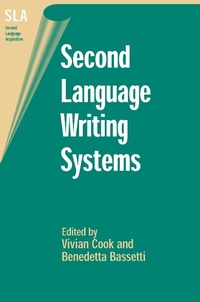
Second Language Writing Systems
Published on 23. May 2005
464 pages
978-1-78892-030-8 (ISBN)
Description

Second Language Writing Systems looks at how people learn and use a second language writing system, arguing that they are affected by characteristics of the first and second writing systems, to a certain extent independently of the languages involved. This book presents for the first time the effects of writing systems on language reading and writing and on language awareness, and provides a new platform for discussing bilingualism, biliteracy and writing systems.
The approach is interdisciplinary, with contributions not only from applied linguists and psychologists but also corpus linguists, educators and phoneticians. A variety of topics are covered, from handwriting to spelling, word recognition to the mental lexicon, and language textbooks to metalinguistic awareness. Though most of the studies concern adult L2 learners and users, other populations covered include minority children, immersion students and bilingual children. While the emphasis is on English as the L2 writing system, many other writing systems are analysed as L1 or L2: Arabic, Chinese, Dutch, Gujarati, Indonesian, Irish, Italian and Japanese. Approaches that are represented include contrastive analysis, transfer, poststructuralism, connectionism and corpus analysis. The readership is SLA and bilingualism researchers, students and teachers around the world; language teachers will also find much food for thought.
The approach is interdisciplinary, with contributions not only from applied linguists and psychologists but also corpus linguists, educators and phoneticians. A variety of topics are covered, from handwriting to spelling, word recognition to the mental lexicon, and language textbooks to metalinguistic awareness. Though most of the studies concern adult L2 learners and users, other populations covered include minority children, immersion students and bilingual children. While the emphasis is on English as the L2 writing system, many other writing systems are analysed as L1 or L2: Arabic, Chinese, Dutch, Gujarati, Indonesian, Irish, Italian and Japanese. Approaches that are represented include contrastive analysis, transfer, poststructuralism, connectionism and corpus analysis. The readership is SLA and bilingualism researchers, students and teachers around the world; language teachers will also find much food for thought.
More details
Series
Language
English
Place of publication
Clevedon
United Kingdom
Target group
Professional and scholarly
ISBN-13
978-1-78892-030-8 (9781788920308)
Copyright in bibliographic data and cover images is held by Nielsen Book Services Limited or by the publishers or by their respective licensors: all rights reserved.
Schweitzer Classification
Other editions
Additional editions
Vivian Cook | Benedetta Bassetti
Second Language Writing Systems
Book
05/2005
Multilingual Matters
€56.90
Shipment within 10-20 days
Vivian Cook | Benedetta Bassetti
Second Language Writing Systems
E-Book
05/2005
1st Edition
Multilingual Matters
€24.49
Available for download
Persons
Vivian Cook is Professor in Applied Linguistics at the University of Newcastle, previously having taught in London and Essex. After writing EFL course-books, he concentrated on linguistics and language learning in books such as Chomsky's Universal Grammar and Second Language Learning and Language Teaching, and developed the concept of multi-competence through books such as Portraits of the L2 User. He was founding President of the European Second Language Association (EUROSLA) . He has been exploring the English writing system through articles and books such as The English Writing System and Accomodating Brocolli in the Cemetary.
Benedetta Bassetti holds a PhD from the University of Essex, where she wrote her thesis on Chinese as a Second Language Writing System. She previously has studied oriental languages and applied linguistics in Rome and London. She has presented her research at various international conferences.
Benedetta Bassetti holds a PhD from the University of Essex, where she wrote her thesis on Chinese as a Second Language Writing System. She previously has studied oriental languages and applied linguistics in Rome and London. She has presented her research at various international conferences.
Content
Acknowledgements
Contributors
1. Vivian Cook and Benedetta Bassetti: An Introduction to Researching Second Language Writing Systems
Part 1: Writing a Second Language Writing System
2. Nobuko Chikamatsu: L2 Japanese Kanji Memory and Retrieval: An Experiment on the Tip-of-the-pen (TOP) Phenomenon
3. Ans Van Berkel: The Role of the Phonological Strategy in Learning to Spell in English as a Second Language
4. Mick Randall: Orthographic Knowledge and First Language Reading: Evidence from Single Word Dictation from Chinese and Malaysian Users of English as a Foreign Language
5. Harold Somers: Learner Corpora and Handwriting
6. Takeshi Okada: A Corpus-based Study of Spelling Errors of Japanese EFL Writers with Reference to Errors Occurring in Word-initial and Word-final Positions
7. Stephan Schmid: Spelling and Pronunciation in Migrant Children: The Case of Italian-Swiss German Bilinguals
Part 2: Reading a Second Language Writing System
8. Phil Scholfield and Gloria Shu-Mei Chwo: Are the L1 and L2 Word Reading Processes Affected More by Writing System or Instruction?
9. Nobuhiko Akamatsu: Effects of Second Language Reading Proficiency and First Language Orthography on Second Language Word Recognition
10. Walter J.B. Van Heuven: Bilingual Interactive Activation Models of Word Recognition in a Second Language
11. Miho Sasaki: The Effect of L1 Reading Processes on L2: A Crosslinguistic Comparison of Italian and Japanese Users of English
Part 3: Awareness of Language and Second Language Writing Systems
12. Keiko Koda: Learning to Read Across Writing Systems: Transfer, Metalinguistic Awareness, and Second-language Reading Development
13. Benedetta Bassetti: Effects of Writing Systems on Second Language Awareness: Word Awareness in English Learners of Chinese as a Foreign Language
14. Lily H.-S. Lau and Susan J. Rickard Liow: Phonological Awareness and Spelling Skill Development in Bilingual Biscriptal Children
Part 4: Teaching a Second Language Writing System
15. Therese Dufresne and Diana Masny: Different and Differing Views on Conceptualising Writing System Research and Education
16. Tina Hickey: Second Language Writing Systems: Minority Languages and Reluctant Readers
17. Vivian Cook: Written Language and Foreign Language Teaching
Index
Contributors
1. Vivian Cook and Benedetta Bassetti: An Introduction to Researching Second Language Writing Systems
Part 1: Writing a Second Language Writing System
2. Nobuko Chikamatsu: L2 Japanese Kanji Memory and Retrieval: An Experiment on the Tip-of-the-pen (TOP) Phenomenon
3. Ans Van Berkel: The Role of the Phonological Strategy in Learning to Spell in English as a Second Language
4. Mick Randall: Orthographic Knowledge and First Language Reading: Evidence from Single Word Dictation from Chinese and Malaysian Users of English as a Foreign Language
5. Harold Somers: Learner Corpora and Handwriting
6. Takeshi Okada: A Corpus-based Study of Spelling Errors of Japanese EFL Writers with Reference to Errors Occurring in Word-initial and Word-final Positions
7. Stephan Schmid: Spelling and Pronunciation in Migrant Children: The Case of Italian-Swiss German Bilinguals
Part 2: Reading a Second Language Writing System
8. Phil Scholfield and Gloria Shu-Mei Chwo: Are the L1 and L2 Word Reading Processes Affected More by Writing System or Instruction?
9. Nobuhiko Akamatsu: Effects of Second Language Reading Proficiency and First Language Orthography on Second Language Word Recognition
10. Walter J.B. Van Heuven: Bilingual Interactive Activation Models of Word Recognition in a Second Language
11. Miho Sasaki: The Effect of L1 Reading Processes on L2: A Crosslinguistic Comparison of Italian and Japanese Users of English
Part 3: Awareness of Language and Second Language Writing Systems
12. Keiko Koda: Learning to Read Across Writing Systems: Transfer, Metalinguistic Awareness, and Second-language Reading Development
13. Benedetta Bassetti: Effects of Writing Systems on Second Language Awareness: Word Awareness in English Learners of Chinese as a Foreign Language
14. Lily H.-S. Lau and Susan J. Rickard Liow: Phonological Awareness and Spelling Skill Development in Bilingual Biscriptal Children
Part 4: Teaching a Second Language Writing System
15. Therese Dufresne and Diana Masny: Different and Differing Views on Conceptualising Writing System Research and Education
16. Tina Hickey: Second Language Writing Systems: Minority Languages and Reluctant Readers
17. Vivian Cook: Written Language and Foreign Language Teaching
Index
