

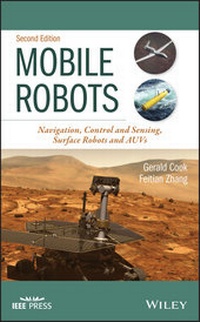
Mobile Robots
Description

This fully updated edition examines the use of mobile robots for sensing objects of interest, and focus primarily on control, navigation, and remote sensing. It also includes an entirely new section on modeling and control of autonomous underwater vehicles (AUVs), which exhibits unique complex three-dimensional dynamics.
Mobile Robots: Navigation, Control and Sensing, Surface Robots and AUVs, Second Edition starts with a chapter on kinematic models for mobile robots. It then offers a detailed chapter on robot control, examining several different configurations of mobile robots. Following sections look at robot attitude and navigation. The application of Kalman Filtering is covered. Readers are also provided with a section on remote sensing and sensors. Other chapters discuss: target tracking, including multiple targets with multiple sensors; obstacle mapping and its application to robot navigation; operating a robotic manipulator; and remote sensing via UAVs. The last two sections deal with the dynamics modeling of AUVs and control of AUVs. In addition, this text:
* Includes two new chapters dealing with control of underwater vehicles
* Covers control schemes including linearization and use of linear control design methods, Lyapunov stability theory, and more
* Addresses the problem of ground registration of detected objects of interest given their pixel coordinates in the sensor frame
* Analyzes geo-registration errors as a function of sensor precision and sensor pointing uncertainty
Mobile Robots: Navigation, Control and Sensing, Surface Robots and AUVs is intended for use as a textbook for a graduate course of the same title and can also serve as a reference book for practicing engineers working in related areas.
More details
Other editions
Additional editions
Persons
GERALD COOK, ScD, is the Earle C. Williams Professor Emeritus of Electrical Engineering and past chairman of Electrical and Computer Engineering at George Mason University. He was previously Chairman of Electrical and Biomedical Engineering at Vanderbilt University and before that, Professor of Electrical Engineering at the University of Virginia. He is a Life Fellow of the Institute of Electrical and Electronics Engineers (IEEE), a former president of the IEEE Industrial Electronics Society and a former Editor-in-Chief of the IEEE Transactions on Industrial Electronics.
FEITIAN ZHANG, PHD, is an Assistant Professor in the Electrical & Computer Engineering Department at George Mason University. He was awarded the GMU Multidisciplinary Research Awards in 2017 and the Office of Naval Research (ONR) Summer Faculty Fellowship in 2019. He is a member of the Institute of Electrical and Electronic Engineers (IEEE) and American Society of Mechanical Engineers (ASME).
Content
Preface xi
About the Authors xiii
Introduction 1
1 Kinematic Models for Mobile Robots 5
1.1 Introduction 5
1.2 Vehicles with Front-Wheel Steering 5
1.3 Vehicles with Differential-Drive Steering 8
Exercises 11
References 12
2 Mobile Robot Control 13
2.1 Introduction 13
2.2 Front-Wheel Steered Vehicle, Heading Control 13
2.3 Front-Wheel Steered Vehicle, Speed Control 22
2.4 Heading and Speed Control for the Differential-Drive Robot 23
2.5 Reference Trajectory and Incremental Control, Front-Wheel Steered Robot 26
2.6 Heading Control of Front-Wheel Steered Robot Using the Nonlinear Model 31
2.7 Computed Control for Heading and Velocity, Front-Wheel Steered Robot 34
2.8 Heading Control of Differential-Drive Robot Using the Nonlinear Model 36
2.9 Computed Control for Heading and Velocity, Differential-Drive Robot 37
2.10 Steering Control Along a Path Using a Local Coordinate Frame 38
2.11 Optimal Steering of Front-Wheel Steered Vehicle 49
2.12 Optimal Steering of Front-Wheel Steered Vehicle, Free Final Heading Angle 67
Exercises 68
References 69
3 Robot Attitude 71
3.1 Introduction 71
3.2 Definition of Yaw, Pitch, and Roll 71
3.3 Rotation Matrix for Yaw 72
3.4 Rotation Matrix for Pitch 74
3.5 Rotation Matrix for Roll 75
3.6 General Rotation Matrix 77
3.7 Homogeneous Transformation 78
3.8 Rotating a Vector 82
Exercises 83
References 84
4 Robot Navigation 85
4.1 Introduction 85
4.2 Coordinate Systems 85
4.3 Earth-Centered Earth-Fixed Coordinate System 85
4.4 Associated Coordinate Systems 88
4.5 Universal Transverse Mercator Coordinate System 91
4.6 Global Positioning System 93
4.7 Computing Receiver Location Using GPS, Numerical Methods 97
4.7.1 Computing Receiver Location Using GPS via Newton's Method 97
4.7.2 Computing Receiver Location Using GPS via Minimization of a Performance Index 105
4.8 Array of GPS Antennas 111
4.9 Gimbaled Inertial Navigation Systems 114
4.10 Strap-Down Inertial Navigation Systems 118
4.11 Dead Reckoning or Deduced Reckoning 123
4.12 Inclinometer/Compass 125
Exercises 127
References 131
5 Application of Kalman Filtering 133
5.1 Introduction 133
5.2 Estimating a Fixed Quantity Using Batch Processing 133
5.3 Estimating a Fixed Quantity Using Recursive Processing 134
5.4 Estimating the State of a Dynamic System Recursively 139
5.5 Estimating the State of a Nonlinear System via the Extended Kalman Filter 150
Exercises 165
References 169
6 Remote Sensing 171
6.1 Introduction 171
6.2 Camera-Type Sensors 171
6.3 Stereo Vision 181
6.4 Radar Sensing: Synthetic Aperture Radar 185
6.5 Pointing of Range Sensor at Detected Object 190
6.6 Detection Sensor in Scanning Mode 195
Exercises 199
References 200
7 Target Tracking Including Multiple Targets with Multiple Sensors 203
7.1 Introduction 203
7.2 Regions of Confidence for Sensors 203
7.3 Model of Target Location 211
7.4 Inventory of Detected Targets 215
Exercises 220
References 221
8 Obstacle Mapping and Its Application to Robot Navigation 223
8.1 Introduction 223
8.2 Sensors for Obstacle Detection and Geo-Registration 223
8.3 Dead Reckoning Navigation 225
8.4 Use of Previously Detected Obstacles for Navigation 229
8.5 Simultaneous Corrections of Coordinates of Detected Obstacles and of the Robot 233
Exercises 236
References 237
9 Operating a Robotic Manipulator 239
9.1 Introduction 239
9.2 Forward Kinematic Equations 239
9.3 Path Specification in Joint Space 242
9.4 Inverse Kinematic Equations 242
9.5 Path Specification in Cartesian Space 248
9.6 Velocity Relationships 249
9.7 Forces and Torques 255
Exercises 261
References 262
10 Remote Sensing via UAVs 263
10.1 Introduction 263
10.2 Mounting of Sensors 263
10.3 Resolution of Sensors 264
10.4 Precision of Vehicle Instrumentation 264
10.5 Overall Geo-Registration Precision 265
Exercise 267
References 267
11 Dynamics Modeling of AUVs 269
11.1 Introduction 269
11.2 Motivation 269
11.3 Full Dynamic Model 270
11.4 Hydrodynamic Model 273
11.5 Reduced-Order Longitudinal Dynamics 274
11.6 Computation of Steady Gliding Path in the Longitudinal Plane 276
11.7 Scaling Analysis 279
11.8 Spiraling Dynamics 281
11.9 Computation of Spiral Path 286
Exercises 288
References 289
12 Control of AUVs 291
12.1 Introduction 291
12.2 Longitudinal Gliding Stabilization 291
12.2.1 Longitudinal Dynamic Model Reduction 292
12.2.2 Passivity-Based Controller Design 295
12.2.3 Simulation Results 297
12.3 Yaw Angle Regulation 298
12.3.1 Problem Statement 298
12.3.2 Sliding Mode Controller Design 300
12.3.3 Simulation Results 303
12.4 Spiral Path Tracking 307
12.4.1 Steady Spiral and Its Differential Geometric Parameters 307
12.4.2 Two Degree-of-Freedom Control Design 310
12.4.3 Simulation Results 314
Exercises 321
References 322
Appendix A Demonstrations of Undergraduate Student Robotic Projects 323
Index 327
1
Kinematic Models for Mobile Robots
1.1 Introduction
This chapter is devoted to the development of kinematic models for two types of wheeled robots. The kinematic equations are developed along with the basic geometrical properties of achievable motion. The two configurations considered here do not exhaust the myriad of possible configurations for wheeled robots; however, they serve as an adequate test bed for the development and discussion of the principals involved.
1.2 Vehicles with Front-Wheel Steering
The first type of mobile robot to be considered is the one with front-wheel steering. Here the vehicle is usually powered via the rear wheels, and the steering is achieved by way of an actuator for turning the front wheels.
In Figure 1.1, we have a diagram for a four-wheel front-wheel-steered robot. The equations would also apply for the case of a single front wheel. The angle the front wheels make with respect to the longitudinal axis of the robot, yrobot, is defined as a, measured in the counter-clockwise direction. The angle that the longitudinal axis, yrobot, makes with respect to the yground axis is defined as ?, also measured in the counter-clockwise direction. The instantaneous center about which the robot is turning is the point of intersection of the two lines passing through the wheel axes.
From geometry we have
which may be solved to yield the instantaneous radius of curvature for the path of the midpoint of the rear axle of the robot.
Figure 1.1 Schematic diagram of the front-wheel steered robot.
(1.1)From geometry we also have
or
which can be written as
(1.2)If one held the steering angle a constant, the trajectory would result in a circle whose radius is dictated by the robot length and the actual steering angle used per equation (1.1).
Now the instantaneous curvature itself is defined as the ratio of change in angle divided by change in distance or change in angle per distance traveled. It is given by
which is the inverse of the instantaneous radius of curvature. Thus, the radius of curvature may be interpreted as
i.e., the change in distance traveled per radian change in heading angle.
The complete set of kinematic equations for the motion in robot coordinates are
(1.3a) (1.3b) (1.3c)Converted to earth coordinates these become
(1.4a) (1.4b) (1.4c)This form of the equations is quite simple; however, it should be noted that these equations are nonlinear. Also see Dudek and Jenkin.
Now if we wish to take into account the fact that steering angle and velocity cannot change instantaneously, we may define the derivatives or rates of these variables as control signals, i.e.,
(1.5a)and
(1.5b)The system of equations for this model is now fifth order. The equations provide the correct kinematic relationships among the variables for motion and rotation in the xy plane but do not include the complexity of suspension or motor dynamics. Also not included in this model are robot pitch and roll.
It may be desirable to form a discrete-time model from these equations. This would be useful for discrete-time simulation as well as other applications. Clearly these equations are nonlinear. Therefore, the methods used for converting a linear continuous-time system to a discrete-time representation are not applicable. One approach is to use the Euler integration method. This method is a first-order, Taylor-series approximation to integration and says that the derivative may be approximated by a finite difference
This can be re-arranged to yield
Setting t = kT and the sampling interval ?t = T and applying this to the above equations we have
(1.6a) (1.6b) (1.6c) (1.6d)and
(1.6e)Here the sampling interval T must be chosen to be sufficiently small depending on the dynamics of the original differential equations, i.e., the behavior of the discrete-time model must match up with that of the original system. For a linear system, this corresponds to selecting the sampling interval to be approximately one-fifth of the smallest time constant of the system or smaller depending on the degree of precision required. For nonlinear systems, it may be necessary to determine this limiting size empirically. This discrete-time model may be used for analysis, control design, estimator design, and simulation.
It should be noted that more sophisticated and more robust methods exist for converting continuous-time dynamic system models to discrete-time models. For more information on this topic the reader is referred to Digital Simulation of Dynamic Systems by Hartley, Beale and Chicatelli.
From time to time, it will be convenient to interpret speed expressed in various units. For this reason the following equalities are presented.
1.3 Vehicles with Differential-Drive Steering
Another common type of steering used for mobile robots is differential-drive steering illustrated in Figure 1.2. Here the wheels on one side of the robot are controlled independently of the wheels on the other side. By coordinating the two different speeds, one can cause the robot to spin in place, move in a straight line, move in a circular path, or follow any prescribed trajectory.
The equations of motion for the robot steered via differential wheel speeds are now derived. Let R represent the instantaneous radius of curvature of the robot trajectory. The width of the vehicle, i.e., spacing between the wheels, is designated as W. From geometrical considerations we have:
(1.7a)Figure 1.2 Schematic diagram of differential-drive robot.
and
(1.7b)Now subtracting the two above equations yields
so we obtain for the angular rate of the robot
(1.8)Solving for the instantaneous radius of curvature, we have:
or
or finally
(1.9)This results in the expression for velocity along the robot's longitudinal axis:
In summary, the equations of motion in robot coordinates are:
(1.10a) (1.10b)and
(1.10c)If we convert to earth coordinates these become:
(1.11a) (1.11b)and
(1.11c)As we did in the case for the robot with front-wheel steering, we may wish to account for the fact that velocities cannot change instantaneously. Thus, we would introduce as the control variables the velocity rates:
(1.12a)and
(1.12b)The system of equations for this kinematic model is now fifth order.
Again we can use the Euler integration method for obtaining a discrete-time model for this system of nonlinear equations,
(1.13a) (1.13b) (1.13c) (1.13d)and
(1.13e)More sophisticated and more accurate methods for obtaining discrete-time models exist; however, this Euler model may be quite useful if the sampling interval is set sufficiently small. These discrete-time models may be used for system analysis, controller design, estimator design, and system simulation. More complex models for mobile robots could also include pitch, roll, and vertical motion.
Exercises
- A front-wheel steered robot is to turn to the left with a radius of curvature equal to 20 m. The robot is 1 m wide and 2 m long. What should the steering angle be?
- A differential wheel steered robot is to turn to the left with a radius of curvature equal to 20 m and is to travel at 1 m/s. The width is 1 m and the length is 2 m. What should be the velocities of the right side and the left side?
- Using the discrete-time model presented, perform a digital simulation of the front-wheel steered robot using a steering angle of 45°, a length of 1.5 m, and a speed of 2.778 m/s. Experiment with the sample interval, T and find the maximum allowable value that yields consistent results.
- Develop a digital simulation for the steered wheel robot modeled in Chapter 1. Assume that the width from wheel to wheel is 1 m and that the length, axle to axle is 2 m. A sequence of speeds and steering angles will be inputs. Include limits in your model so that steering angle will not exceed ±45° regardless of the command. Simulate the robot for straight line motion and for motion when the steering angle is held constant at 45° and then constant at -45°. Simulate several seconds of motion. Use the Euler formula for integration and experiment with the...
